- Top 10 Things to do in Nara - 6 March 2026
- Do You Need to Book Shinkansen Tickets in Advance - 1 March 2026
- How to Get to Katsuo-ji, Osaka – And What To Do When You Arrive - 27 February 2026
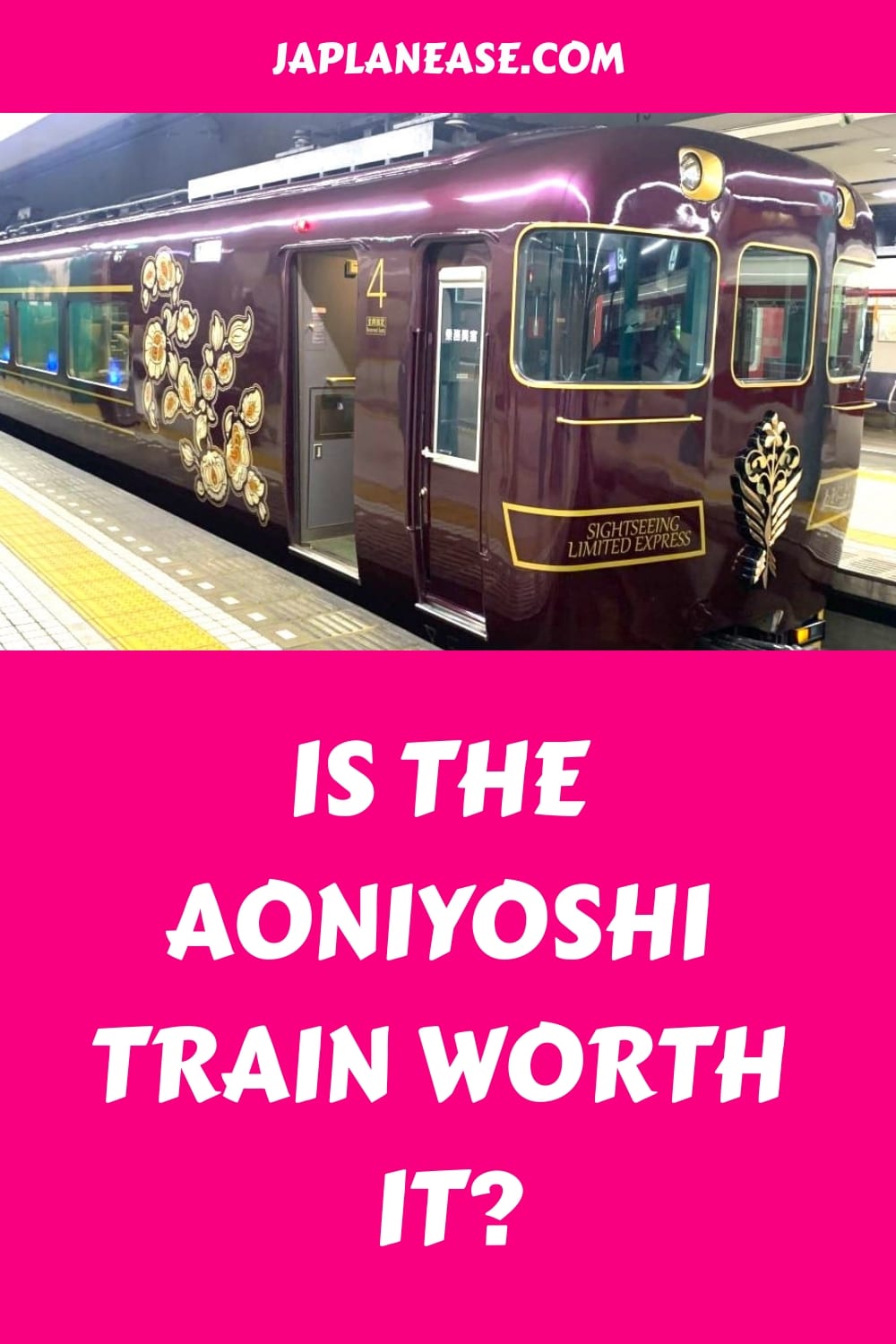
You’ve probably seen it on social media—a train with luxurious green seats facing beautiful windows, pretty purple cakes, and an equally pretty purple livery. This is the Aoniyoshi train that runs between Kyoto and Osaka, but the pretty train also comes with a pretty price tag. So is it worth paying the extra money?
Spoiler alert. I enjoyed the experience but wouldn’t do it again, and I wouldn’t say it’s a ‘must-do’. Read on to find out why…

Article by Helen Foster. Disclosure: Some links in this post are affiliate links. See our Affiliate Disclosure.
- Originally Published: August 17, 2024
- Last Updated: May 4th, 2025
- Price Information Verified: May 2025
- Schedule Confirmed: May 2025 (Sources: Kintetsu Railway Official Aoniyoshi Website)
My Journey on the Aoniyoshi
I was catching the train from Kyoto Station to Nara. I arrived fresh off the bullet train and Thunderbird Express from Kanazawa and was pleased to see that the Kintetsu-Line area of Kyoto station was very easy to find – I’d been lost in that station before!
Despite my navigational luck, at first I was still confused. I couldn’t work out what train ticket I needed. To ride the Aoniyoshi, you must buy two separate tickets, one to book your seat, which you can book in advance, and the base fare, which you must buy on the day. I couldn’t work out exactly what to buy on the machine to pay my base fare.
I went to ask for help and they just said something very obvious… ‘IC card?’ with a questioning tone!

Doh – I’d been traveling around Nagano and Toyama before this, where the trains don’t take Suica cards so I’d completely forgotten that getting onto any train, except the bullet train, simply requires a swipe of your IC Card. Two seconds later, I was through the barrier and onto the platform. So, useful point one – you can use your Suica, Pasma, or ICOCA card for the base fare!
RELATED READ: If you’re still confused about how Suica cards work, check out our Simple Suica Guide.
It was easy to spot the train, it looks gorgeous and very luxurious. I found my seats and ran up and down the corridors, checking out the other carriages and areas – even the basin in the bathroom is cute. When I got back to my seat, the carriage was full, and we were ready to go.
Thirty-four peaceful minutes later, I arrived at Kintetsu-Nara station, ready to begin three days with the deer.
That sounds perfect, right? And don’t get me wrong—the train geek in me was very happy, but I didn’t love it enough to do it again or to wholeheartedly suggest that you run to the station clutching your ticket.
So Why Didn’t I LOVE It
The train itself is pretty and luxurious, but I don’t think the view on the journey is pretty enough to warrant the beautiful big windows or the side-facing chairs. I’d seen some stunning views around the Lake Biwa area from the train I’d just got off, so a few fields didn’t quite cut it.
And yes, it sells exciting swirly puddings, but, as I was boarding it at 11 am and hadn’t even had breakfast yet, let alone a lunch to have pudding after, they didn’t hugely appeal! The queues for the bar car are also quite long.

However, the main reason I didn’t love the Aoniyoshi was the price.
A normal Kintetsu Line train between Kyoto and Nara costs 760 yen; the Aoniyoshi train requires you to pay that standard fare PLUS a limited express fare of 730 yen.
Now that’s normal on trains that stop at fewer stations or that have something special about them (and if you catch a normal Kintetsu Limited Express train on this route, your fare will go up to 1530 yen, making the Aoniyoshi the going rate).
But considering the pretty Kyo Train Garaku, which travels from Kyoto to Osaka and is just 410 yen, and, in my opinion, much more interesting, that was already quite a hefty amount for a short journey.
But It Gets Worse
I had to pay more than that.
I was traveling solo, and you can’t buy single tickets on the Aoniyoshi train. You must be traveling as at least a pair—be that two adults or an adult and child – or at least pay for that. So, I had to book two seats, one for me and one for my imaginary child.
This meant it cost me 1860 yen to travel to Nara, over 1100 yen more than the price of the normal train, and I’d have seen the same things out the window.

Obviously, I knew this before I booked, and because I was researching it for this post, I chose to pay, but if you’re a solo traveler who isn’t giving other people advice as to whether they should ride the pretty train, weigh up the cost vs. the experience.
It does take 13 minutes less than the regular train, but I’d be okay with spending the extra time for the savings.
Arriving in Nara
Also, note that the Aoniyoshi goes into Kintetsu Nara station. This is nearer the big attractions like the deer park and Todai-ji than the JR-run station in Nara – but, if you want to catch the bus up to these, they are often full by the time they get there, so, if you have limited mobility or are just trying to save your feet, you’re better off going on the JR local train to Nara station where the bus starts and grabbing a seat!
And that will only cost you 720 yen from Kyoto.

So, if you’ve seen this pretty train on social media and wondered about riding it. It’s lovely, but I don’t think it’s worth paying much more for the trip when Japanese trains are generally quite pleasant.
The 5 Reasons Why I Wouldn’t Ride the Ayoniyoshi Again
As I said, I enjoyed the experience, but wouldn’t do it again for several specific reasons:
Value For Money: At 2.5x the cost of regular trains, the premium features don’t justify the expense.
View Quality: Unlike scenic trains like the Sagano Romantic Train ( which is rated 4.5/5 by 3,200+ reviews on TripAdvisor), the Aoniyoshi doesn’t really go through anywhere scenic enough to justify those lovely big windows.
Time savings: It’s only 13 minutes faster than regular trains
Unique Features: It looks pretty, but it lacks the ‘I’m in Japan’ feel of the other cool Kyoto train, the Kyo Train Garaku
End Station: It’s not necessarily the most convenient stopping point.
All Your Questions Answered
However, if you’re looking at the pictures and thinking, ‘You don’t know what you’re talking about, woman; it looks fantastic,’ here’s what else you need to know.
Where Can You Catch the Aoniyoshi?
It runs between Osaka Namba Station and Kyoto Station (via Nara) on its first and last journeys of the day. The rest of the day, it travels the shorter route between Kyoto Station and Kintetsu Nara Station. You can get on or off at any of these stations.

How Many Times a Day Does It Run?
It makes four journeys between Kyoto and Nara daily. Within those, it makes one return between Osaka and Kyoto.
The full journey departs Osaka-Namba Station at 9.10 am, arrives in Nara at 9.45 am. It departs for Nara 6 minutes later. If you’re taking the whole journey, you’ll arrive in Kyoto at 10.34 am on a weekday (10.29 am on the weekend).
It then runs between Kyoto and Nara, departing at 10.55 a.m., 12.55 p.m., and 2.55 p.m., with a final journey at 4.55 pm. The journey takes 34 minutes.
Or, if you are coming back from Nara to Kyoto, you can catch it at 11.55 am, 1.55 pm, or 3.55 pm. Again, it takes 34 minutes between the two.
If you want to journey back from Kyoto to Osaka-Namba, the train leaves Kyoto at 4.55 pm during the week and arrives in Osaka at 6.16 pm (6.12 pm at weekends).
It runs six days a week – it’s off on Thursday
Source: Aoniyoshi Webpage, check the latest timetable here.

How Much Does It Cost?
As I said, the ticket has two parts: the base fare and the Limited Express Ticket/Special Car surcharge. Add these two parts together to get your actual fare (for example, it’s 2140 yen for an adult to go all the way from Osaka to Kyoto).
The Base Fare
On the day I update this (May 2025), the base fare is
Osaka to Kyoto (or back) – 1140 yen
Kyoto to Nara (or back) – 760 yen
Osaka to Nara (or back) – 680 yen
Children pay half this fare.
You pay for this at the station on the day. You can either buy a ticket at the machine or, if you have an IC card like Suica, Icoca, or Pasmo, simply use the balance on that by swiping through the gates.
The Supplemental Fare
This is the part that actually allows you to ride the Aoniyoshi.
The supplemental fare is as follows.
Osaka-Kyoto (or back) – 1000 yen
Kyoto to Nara (or back) – 730 yen
Osaka to Nara (or back) – 730 yen
Children pay half this fare.
All the train seats are reserved and sell out, so you’ll want to book this in advance (details below).
Source: Aoniyoshi webpage. Prices may change, so double-check current prices on the Aoniyoshi booking page.
Remember, Solo Travelers Must Pay More
As I said, you cannot buy one ticket for Aoniyoshi. In cars 1, 3, and 4, the seats are designed in pairs, and you have to pay for both. Thankfully, they let you buy a child’s fare for the second seat, which saves a little bit.

What If You’re a Group of Three?
Groups of three will sit in Car 2, in the Salon part of the train. This is a group of four seats together in their own small space, but even though this leaves an empty seat, you don’t have to pay for four seats.
They are the first seats on the train to sell out, though, so book early.

If the Salon Seats are full and you want to travel in one of the standard cars, the booking system won’t offer this as an alternative; you must book two seats for one party and then go back in and book one more for another adult and their (imaginary) child.
How Does This Compare in Cost to the Other Trains?
If you are watching your budget, you might want to know the costs of the other trains between Kyoto and Nara.
| Train | Cost | Journey Time |
| Aoniyoshi | 1490 yen | 34 minutes |
| Kintetsu Line (regular) | 760 yen | 45 minutes |
| Kintetsu Line (Ltd Exp) | 1530 yen | |
| JR Nara Line | 720 yen | 45 minutes |
When traveling between Kyoto and Osaka, there are six different train lines. The Shinkansen’s unreserved seat costs 1450 yen, while the Hankyu Line’s is as little as 410 yen.
Related Read: See more about picking the best line for you in our guide on getting from Osaka to Kyoto
Can You Carry Luggage on the Train?
There are luggage spaces in cars 1, 3 and 4.
Which Seats to Pick?
If you want the seats that directly face out of the window, these are seats C and D on the seat map. A and B face each other.

Is It Accessible?
Car 3 has several wheelchair-accessible seats and a barrier-free restroom.
As you can see below, there is a small step up to the train from the platform, but the staff will have a ramp that can be used. They also know when you are getting off and will help you at the departure station.

What’s the Deal With the Cakes?
A shop in Car 2 sells refreshments, including some pretty purple-topped cakes. The queue for this gets long, and someone in my Japan Planning Facebook group said the person opposite them spent most of their journey queuing for their cake rather than sitting in their seat! Go early if you want to try one.
Save Money with Klook & Japlanease
If you plan on buying tickets or tours from Klook for when you’re in Japan, you could save up to 10 per cent by using the code JAPLANEASEKLOOK at the checkout. Click here to see what’s on offer.
T&Cs apply. Some items, including Tokyo Disney and USJ tickets, are not available for discounts.
Where Do You Buy Tickets?
You can buy them directly via the Aoniyoshi website. There are only 84 seats on the train, and they can sell out, especially the Salon seats, which go very quickly; definitely book these early. They go on sale a month in advance at 10:30 a.m. Japanese time.
Remember, the price you pay is only the supplementary part of the fare, so you’ll still need to pay the base fare at the station before boarding.
If you do travel, have a great time. It is a gorgeous-looking train.