
- What to Do in Kawaguchiko – When You Can’t See Mount Fuji - 21 October 2026
- Kennin-ji: Kyoto’s Temple for Art Lovers - 19 October 2026
- How to Watch the Oiran Parade at Edo Wonderland, Nikko - 15 October 2026
Katsuo-ji is a temple outside of Osaka that’s famous for the thousands of daruma dolls people leave there as offerings. Here’s how to get there and everything you need to know once you arrive.

Article by Helen Foster. Disclosure: Some links in this post are affiliate links. See our Affiliate Disclosure.
What Are Daruma?
Daruma are a way of making wishes in Japan.
You buy the doll you feel drawn to. Then, write your wish or goal on the back of it. After blessing the doll with incense, you colour in one eye while making your wish.
Once it is granted, you fill in the other eye and bring it back to the temple and place it on display.

Sounds easy, right? Not quite so fast, you also have to focus on making that wish come true and take actions to achieve it – the daruma just helps things along.
But, considering every daruma with both eyes filled in at Katsuo-ji is a granted wish, and there are thousands of them, they must be doing something right.
They also make quite an incredible sight visit.
What Not to Miss at Katsou-ji
You can go a bit into sensory overload here, as there are just daruma as far as the eye can see. But, some points not to miss include…
Main Gate and the Purification Bridge
While you enter the temple area via the entry building and shop, the first structure you see at Katsuo-ji is the Main Gate, then behind this is the purification bridge that you must pass over before you enter the shrine. It’s said that crossing this clears you of bad luck before you pray.

Some days, mist from the pond envelops the bridge, giving it a mystical look – sadly, it wasn’t doing spooky stuff the day I was there, though.
The Giant Daruma Steps
Officially known as the Kachi Daruma Votive Shelf, this is the display of hundreds of daruma you might have seen online – and it’s incredible to see in person.
Daruma of all shapes and sizes fill spaces that line the set of steps that take you to the upper levels of the temple. These are all Daruma that have granted wishes for their owners and have been returned to the temple.

Note – these daruma are burned in a ceremony on December 28th. If you visit early in the year, this area might not be as full as you expect. These pictures were taken in October, so there was almost a full year’s worth of offerings in the spaces.
The Daruma Mikuji
Around no. 15 on the Katsuo-ji guide map is a small wooden building lined with tiny boxes, and in every box are two tiny Daruma.
According to my rough maths, there are about 250 in each section, plus a few extra dotted around, meaning there are 1000 tiny daruma in this one area alone.

These small Daruma are called Daruma Mikuji – and they are actually fortune-telling Daruma. Instead of granting your wishes like the larger daruma, these have a tiny fortune-telling slip inside.
You can buy these at the shrine. Once you do, think of a question you want to have answered. Then, look inside the doll and pull out the slip of paper. This is said to give you the answer to your question – although, if you don’t speak Japanese, you’ll need to translate it first.
Once you have read and absorbed your fortune, leave the daruma somewhere around the grounds.

Daruma Mikuji make up the majority of the daruma around Katsuoji – they appear on every flat surface and even make their way on the top of lanterns and up trees. One of the best displays is of those stacked along the top wall of the temple as far as the eye can see.
But as people are adding daruma to the shrine all the time, you never know where you might find them.
I also loved the heart-shaped display near the koi pond (see this below), where you can also feed these beautiful giant fish.
Fun Photo Ops
While Katsuo-ji is an important place of worship, they do seem to be encouraging people to have fun on their visit here.

You can have your photo taken in a Daruma-patterned stained-glass window. There is a Lego Daruma display inside the shop and other fun touches around to look out for.
You can also buy all sorts of Daruma-shaped souvenirs in the temple’s shop.

The Point of the Place
This is something you might not pick up. Most of the descriptions of Katsuo-ji temple talk about how it’s a place to increase luck and reach your goals, but they also hope you do something else while you are here.
In their audio guide, they say that they hope that by visiting, you take advantage of the peaceful surroundings, relax, reenergise yourself and refocus on what matters to you in life. Then, I guess the Daruma will help you achieve it.
The Katsuo-ji Stamp Quest
Katsou-ji is most famous for the Daruma displays, but there’s something else in the shrine that’s grabbed attention on social media – the stamp quest.
In this, you fill in a postcard with coloured stamps at six different stops around the complex.
The exact design of the postcard varies depending on the season, but this is the one that we collected when we went.

This gets its own section in the piece because, while it sounds easy, at least one of the stops is easy to miss. So, here are some clues on where you find the stamps so you don’t have to double back on yourself (ahem, like we did).
Stop 1
The first stop is staright ahead of the main entry building as you exit after buying your ticket. This is also where you pick up your postcard. There is always a short queue here, so you’re unlikely to miss it.

Insert the card in the stamp frame so the side with the writing is at the bottom, and push it as far over to the side as it can go. When you grab the stamp, make sure that the arrows on the stamp point toward you.
Stop 2
Close to the fountain before you get to the steps with the huge Daruma. If you come up the stairs from the main entrance, it will be right ahead of you.
However, we wound our way up the ramp and could have missed it – so, make sure you head straight ahead to the Daruma steps rather than heading up the right-hand path to try and beat the crowds.
Stop 3
This is the one we missed – despite my taking a picture of the actual spot. It’s at the top of the steps lined by the giant Daruma by the building called San Po Kojin Do.

The spot you need is here – you can even see the chain for the stamp in the far left corner if you look carefully! I think I was probably distracted by the ceiling and so totally missed the stamp!
Step 4
You might not expect the location of this one, as it’s actually up the steps of the main hall with the green roof and red pillars. The stamp is off to the right, where the couple are standing in the picture below.
Step 5

This is easy to find as the stamping lectern is set up outside the small wooden building to the right of the main hall. There was also an obvious queue when we got here.
Step 6
The last stop is way back down near the main entrance building to the shrine.
How to Get to Katsuo-ji
It took me a few trips to Osaka to get to Katsuo-ji, as it didn’t used to be the easiest place to reach. The connections have got better in recent years, though, and it’s now pretty easy.
Here’s how to do it.
Getting to Katsou-ji from Osaka
It’s just over an hour’s journey, by train and then bus, from Osaka’s Namba district.
First, take the Midosuji Line to Minoh Kayano Station. This will take about 35 minutes from the centre of Osaka. This line can be very busy during rush hour. We had to let a couple of trains go by before a relatively empty one came in. Allow a bit of extra time in case you have to wait for a train with space.

At Minoh Kayano, you catch the number 30 bus to Katsou-ji.
The stop is very clearly marked (it was stop 6a and 6b when we went) and is also easy to spot by the queue of tourists lining up for the bus. It takes about 20 minutes to get to the temple.
The journey will cost around 1330 yen if you’re coming from Namba Station.
Getting to Katsuo-ji From Kyoto
While Katsuo-ji is usually described as being near Osaka, it’s actually slightly quicker and cheaper to get here from Kyoto.
It takes about 52 minutes to get to Katsuo-ji from Kyoto Station – but allow a little extra time to make your connections – and to get in the bus queue.
Make your way to Shin-Osaka Station via the Tokaido Sanyo Line (this is a local train, not the Shinkansen). The journey takes about 23 minutes.
From here, change to the Midosuji Line and take this to Minoh Kayano Station. This will take about 20 minutes from Shin Osaka.

From here, the steps are the same as the above. At Minoh Kayano, you catch the number 30 bus to Katsou-ji. It takes about 20 minutes to get to the temple on a direct bus.
The journey should cost around 920 yen.
Need Extra Planning Help?
Our Japan trip planners can help. You might like our First-Timers Japan Planner, which will help you plan your trip to Tokyo, Kyoto and Osaka step-by-step, including tips on everything from picking hotels to sightseeing and dining. Or our super-duper Tokyo Disney Planner makes arranging your park trip MUCH easier. Find them in our Planners store – printable and digital versions are available.
How Often Do the Buses Run to Katsuo-Ji
The first buses leave Minoh Kanaya at 9 am. The last bus goes to Katsouji at 3 pm.
The buses to Katsuo ji run every 30 minutes on weekdays at 00 and 30 minutes past the hour.
At weekends, the buses run at 20-minute intervals at 00, 20 and 40 until 1 pm when they change to 30-minute intervals.
Obviously, double-check this nearer the time to ensure it’s still the case. The Katsuo-ji website has the timetable in English).
The buses do get full, so don’t cut your connections too fine – we got there five minutes before and were right at the back of the queue above.

I would aim to arrive at Minyo Kayano at least 10 minutes before the bus is due to depart (more during a busy period) and get into the queue immediately to ensure you get on. They will cram as many people onto the bus as possible, but they did have to leave a few people behind to wait for the next one when we went.
Getting Back from Katsuo-ji
You can catch the same bus back from the temple to the station – the temple handily publishes the schedule outside, so you can check it, but buses leave every 30 minutes during the week and weekend mornings.
Frequency increases to every 20 minutes after 1 pm at weekends.
They also have a contingency to add some buses if the original ones are full. Check the full up-to-date timetable on signs outside the temple or on their website.

Returning from Katsuo-ji, the first bus leaves at 11.20 in the week and 10.30 at the weekend. The last bus leaves at 17.05. If you miss it, you’ll need to take a taxi back to the station.
Talking of taxis, you’ll often find drivers waiting outside the temple. As we had a busy day, we decided to take one back to the temple. The journey is metered and costs us 3000 yen – about twice as much as we would have paid for two on the bus – but the convenience was well worth it.
If there are no taxis there, there is a courtesy phone inside the shrine entry building to call one.
Opening Hours and Costs
Katsuo-ji is open seven days a week from 8 am to 5 pm.
However, as I said above, the first bus doesn’t leave Minoh Kanaya until 9 am. If you want to get here for the opening, you’ll need to take a taxi from the station, but you’ll virtually have the place to yourself as most tourists arrive by bus.
It costs 500 yen for adults to enter Katsuo-ji; children aged 6-15 cost 400 yen, and children aged 3-5 cost 100 yen. Those two and under visit for free.
How Long Does It Take to See Katsuo-ji
We had a lot to get done in Osaka, plus my mobility was slightly limited during this trip, so we didn’t linger as long as we might have.
We arrived at 9.30 am and left the temple at 11 am. I would say that’s the least amount of time you can spend here and still see everything – plus complete the postcard.

However, this does mean that if you want to arrive on the first bus up from the station and leave on the first bus down again, you can rest assured you will see everything you need to.
If you want to take your time a bit, then I’d say allow two hours for your visit.
AndI think that’s everything you need to know to visit Katsuo-ji.
Who Writes This Blog?
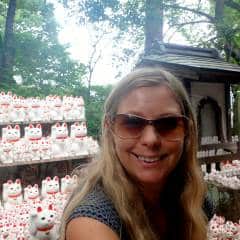
My name is Helen Foster, and I’m a journalist and author. My travel articles have appeared in publications including The Australian, Escape, RAC Horizons, Jetstar Magazine, Sainsbury’s Magazine, and more.
I’ve travelled to Japan nine times before – solo and with my partner and visited over 50 towns and cities. My last visit was in April 2026, so everything here is pretty up to date.

