- What to Do in Kawaguchiko – When You Can’t See Mount Fuji - 21 October 2026
- Kennin-ji: Kyoto’s Temple for Art Lovers - 19 October 2026
- How to Watch the Oiran Parade at Edo Wonderland, Nikko - 15 October 2026
There is a 4000 yen entrance fee, you must book in advance, and you’ll need to do some Japanese writing before you visit the main event. I’m talking about Kyoto’s Saihoji Temple, also known as the Moss Temple. Here’s what to expect if you’re wondering whether to add it to your plans.
Kyoto can be crowded. In some spots, you’re bumping shoulder to shoulder with other tourists, so the idea of quietly contemplating moss in the garden of the quiet Saihoji temple in Arashiyama was very appealing. But there was a slight catch…I wasn’t sure I would be allowed to leave the main hall!

You see, while tourists mostly come here to visit its beautiful moss garden, the monks who run this 1300-year-old Buddhist temple don’t want you to forget that it’s a place of worship – and part of doing this is to have every visitor write out a copy of a Buddhist sutra, the Enmei Jukku Kannon Gyo, in kanji (Japanese writing) – before they enter the garden.
The idea is that even if you can’t read the writing or understand the sutra, the simple act of writing the letters on paper with a calligraphy pen helps still your mind and gives you some time for concentration, silence and reflection.
Frankly, it was just giving me some stress…
What Does Writing the Sutra at Saihoji Involve
There are 49 characters to be written.
My writing in English is barely legible, and my kanji would probably get me arrested. I broke up with my last Japanese teacher when, at the end of our first lesson, she suggested I get a calligraphy pen to write my kanji; even when I write them with a pen, my strokes are usually not the width apart that they are supposed to be I have no hope with a brush!
I was, therefore, a bit worried that I might spend the rest of my life trying to complete the sutra without offending the entire Japanese population – or at least the monk who had to look at it!
It seems my concern was misplaced. The information sheet they give you before you start clearly states that ‘the Buddha dwells within each written character. Concentrate on the act of copying the sutra before you, and not on the neatness of your handwriting.’ That I could do.

If you are similarly artistically challenged, I can confirm that you get to trace the letters rather than write them from scratch, and, thankfully, no one is marking your work at the end. You can take the sheet home with you, or leave it at the temple as an offering. It takes about 15 minutes to complete the sheet – but, it’s not a race, the longer you spend the calmer you get.
Don’t take this lack of supervision as an excuse to skip the exercise, though; it does help remind you why you are there, and I loved the fact that in among the crowds and chaos that Kyoto attracts, you can bring about 50 tourists into a room, get them to sit down on the floor (there are also benches if you need them) and have them be absolutely silent for a little while.
What Does The Sutra Mean?
According to the Saiho ji website, The Enmei Jukku Kannon Gyo is a short sutra of 49 characters. It is short enough to be easily memorized after chanting it a few times. Its name can be translated into English as “The Ten Phrase Life-Prolonging Kannon Sutra.” Hakuin Zenji, a Zen master who was popular among the common folk in the Edo Period (1603-1867), asserted that it encapsulates the essence of all sutras.
Kanzeon Bodhisattva (or Kannon for short) is the Buddha of compassion. This sutra begins by invoking the name of Kanzeon and teaches the basic principle of Buddhism that all living beings possess the heart of the Buddha.
According to one Buddhist site, in English, it would translate to…
Kanzeon! At one with the Buddha, related to all Buddhas in cause and effect,
And to Buddha, Dharma, and Sangha, joyful pure eternal being.
Morning mind is Kanzeon, evening mind is Kanzeon.
This very moment arises from mind, this very moment is not separate from mind.
Other Things to Know
The sutra copying isn’t the only way the monks reinforce that this is a place of worship, not a tourist attraction. You must also take your shoes off to enter the sutra copying area, and no photos are allowed inside, nor can you take pictures of the outside of the building.
And I do think that focus on reverence carried forward into the garden, which has no real rules except not damaging the moss. While there were quite a few visitors there, people talked quietly, walked slowly and enjoyed the peace.
It’s also why they insist on reservations – and is probably one reason for the high entrance fee. Only those who are serious about visiting will bother.
We were serious!

The friend I was traveling with on this trip has a thing for moss.
The last time we went to Kyoto together, Saihoji was in its pre-internet phase. To visit meant sending a postcard to Japan and then waiting for one to return to confirm your appointment. That all seemed too hard – but now you can make reservations online. It was quickly decided that, finally, all of the moss would be ours to be seen.
On the appointed day, two months before the date we wanted to visit, we booked our appointment for 9.30 on a Sunday morning. Then we waited…
Was It Worth It?
Sixty-odd days later, Moss Girl was in her element! In less serene surroundings, she’d probably have squealed. There were around 847 photos taken of various bits of frilly green stuff, conversations about whether something was moss or lichen, and her knees will probably never recover from all the squatting to get close-ups.

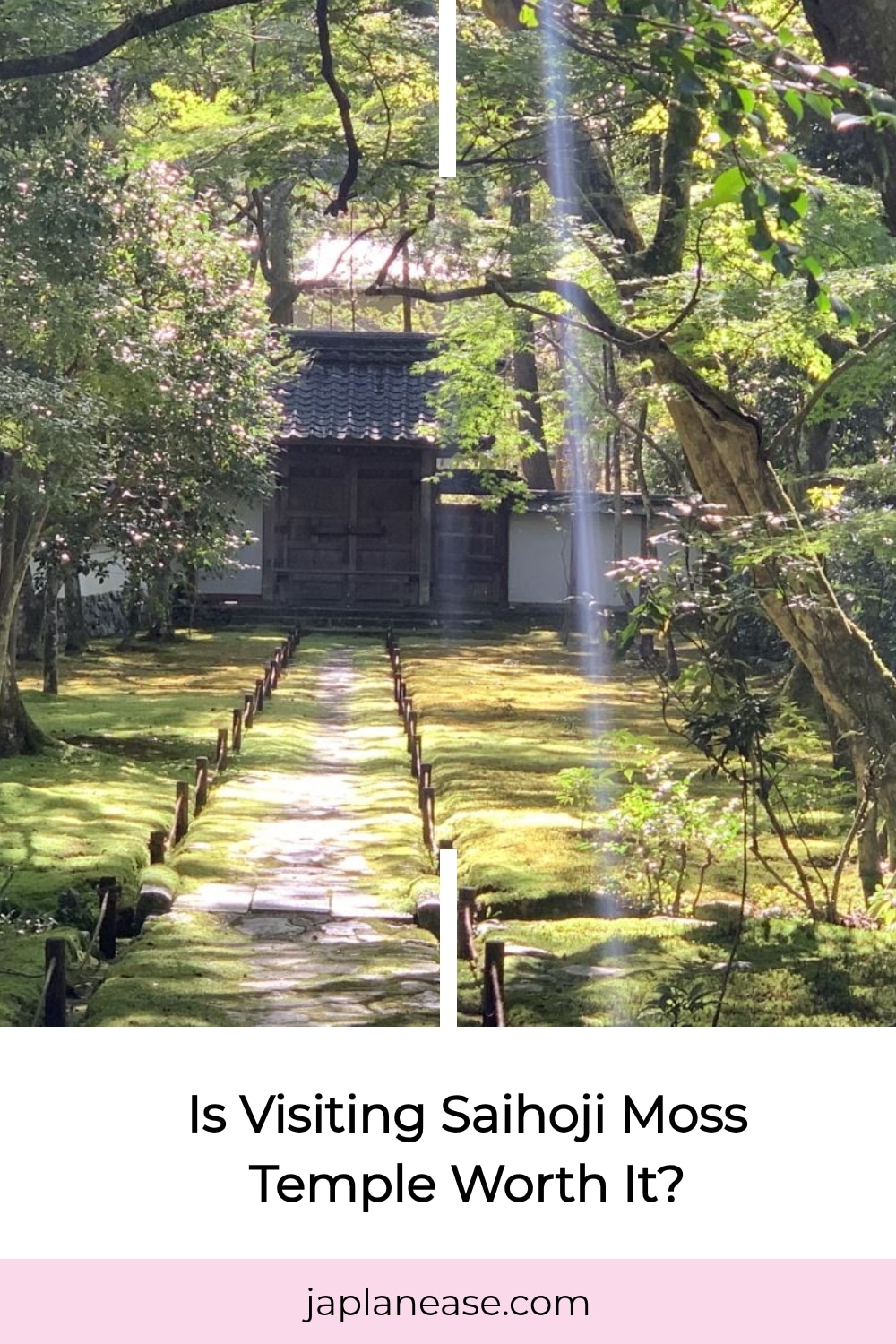
I am not as good a photographer as she is, but I still managed about 100 mediocre photos. There are over 120 different types of moss in the garden, and the different patterns, depths, and colours stretching all around you are a sight to behold and look way better in the flesh/tendrils/fronds (or whatever it is that moss has) than in my pictures, and the garden is generally very pretty.
It’s also fun to look for little anomalies like the plants sneaking their way through the moss in the picture above. If you take your time and spotall the little details, there is a lot to see in what, initially, just looks like a sea of green.
I was a bit surprised by how many people were there, though. I thought that needing reservations might limit numbers or the cost might put people off, but this didn’t seem to be the case.

It wasn’t as busy as the main sights in Kyoto by any means, but I had also been to far less busy shrines and temples at other points on this trip. I would guess there were around 50-70 other people in the garden when we were there. It is large, so you will always find your own space, but still, I was only expecting a handful of other visitors.
A few interesting things about the garden if you do visit. The pond is shaped like the Chinese character for heart. The boat in the middle of it is there to remember when the shogun of the day used to visit and view the gardens by boat situation in the middle of the lake.
The original gate to the shrine is the one you see as you exit the garden and head toward the new, larger gate used today. This is now sealed and you can’t even walk on the stone path that leads to it (see it in the last picture in this post).

The buildings dotted around the gardens are tea houses, although they don’t serve tea today. They were, however, used by the shogun back in the day, and, on the temple’s website, they say, ‘it’s said that the famous tea master, Sen no Rikyu, came here to quieten his heart after being ordered to commit ritual suicide by Toyotomi Hideyoshi.’ There’s a lot of history to this place.
On the temple’s website, they say that the aim of your visit is ’empowering you to be more creative, to be inspired, and to return to your life feeling completely re-tuned and ready for a fresh start.’
I didn’t go quite that far, but I enjoyed writing the sutra, despite my initial misgivings, and, if you take time to sit for a while in the garden, it is very pretty and watching the light play on the pond and the carpet of moss is very relaxing.
If you’re not convinced by the entrance fee, though, there is an alternative to get your moss fix.
Arashiyama’s Other Moss Shrine
If moss is your thing but you don’t want to pay the higher fee for Saihoji, or, only have limited time in Arashiyama and so want to stay close to the main area, you can also visit the Gioji temple, which is located off the pretty Saga Toriimoto Preserved Street and close to the Bamboo Forest.

This is an old nunnery, with a spot in Japanese history as it appears in the novel The Tale of Heike. It’s also the site of a burial ground for geisha, and ladies of the night. Find some other interesting elements of the temple not to miss in their guide.
The garden isn’t as large as Saihoji, but the moss is lush, green and plentiful – and the entrance fee is only 300 yen!
Generally, though, Kyoto’s moss game is strong; you’ll find small moss areas in other main temples, including Ginkakuji (the Silver Pavilion).
Need Extra Planning Help?
Our Japan trip planners can help. You might like our First-Timers Japan Planner, which will help you plan your trip to Tokyo, Kyoto and Osaka step-by-step, including tips on everything from picking hotels to sightseeing and dining. Or our super-duper Tokyo Disney Planner makes arranging your park trip MUCH easier. Find them in our Planners store – printable and digital versions are available.
What Else is Near Saihoji?
Saihoji is located in Arashiyama, but not the main touristy bit with the popular bamboo grove. It’s located on the south side of the river that divides the area.
This is fantastic if you’re trying to escape the crowds, as most people stay north of the river. While quiet, the area is teaming with small shrines.
We started our visit at Jizoin Temple – aka take no tera or the bamboo temple. This has a beautiful bamboo grove (and wasn’t too shabby in the moss department itself).

If you’re here in autumn, you can also go into Joju-ji, which has beautiful foliage. They charge an 800 yen entrance fee during this time. At other times, the grounds are accessible, but not the main building. As it’s slightly wild and run-down, this is going to be one that’s more for photographers than general sightseeing.
As well as stumbling upon small shrines, much of the area is residential, and it’s fun to decide which house you’d like most.

Don’t miss the photogenic Bamboo Coffee cafe if you need to stop for a snack or caffeine fix. Or, for old-school vibes, we had breakfast at Okazaki Cafe next to Kami-Katsura. It’s very local, no frills, don’t expect sourdough toast or flat whites with oat milk, but the cheese-laden pizza toast set me up nicely for the day.
The Arashiyama Monkey Park Iwatayama is also only a 15-minute bus ride (or 40-minute walk away) on the south side of the river.
Most people, though, will head up to the central part of Arashiyama, which is across the Togetsukyo bridge. If you’re feeling energetic, this is a 45-minute walk, or you can get the local bus, which will take about 20 minutes. Check on Google Maps for the quickest route when you’re leaving.
From here, you can explore all the other sights in Arashiyama. Check out the Arashiyama day in our Four Day Kyoto Itinerary for some ideas of how to spend your time.
How to Get to Saihoji
There are two stations within walking distance.
From Kyoto
Take the Hankyu- Arashiyama line from the city to Kami- Katsura station. Saihoji is an easy 17-minute walk from there.
To/From the Monkey Park
You can get on the same line at Arashiyama station (note, this is not the one on the main street; it is located south of the river) and travel south to Matsuo Taishamai station. It’s a 19-minute walk from there. Or, you can jump on the connecting bus.

To/From Arashiyama’s Main Street.
The best option would be to take the bus. Three routes will get you there – the 63, the 73 and the 83. Use Google Maps to determine which is best for you.
How to Book Tickets to Saihoji
In case you missed it above, reservations open two months before the date you want to enter and you can book until 11.59 pm the night before your visit. You book via the website. The link is here.
RELATED READ: Saihoji isn’t the only thing in Kyoto that might need advance bookings. To make sure you don’t miss out on any others, take a look at our guide on what to book in advance in Kyoto and Osaka
Why is Saihoji Also Called Kokodera?
Easy. They’re the Japanese words for Moss Temple.
Need Extra Planning Help?
Our Japan trip planners can help. You might like our First-Timers Japan Planner, which will help you plan your trip to Tokyo, Kyoto and Osaka step-by-step, including tips on everything from picking hotels to sightseeing and dining. Or our super-duper Tokyo Disney Planner makes arranging your park trip MUCH easier. Find them in our Planners store – printable and digital versions are available.