
- Where to Stay in Hiroshima - 10 February 2026
- What to Wear in Japan: 15 Common Questions Answered - 9 February 2026
- Should You Tip in Japan? - 6 February 2026
Located on an island south of Mihara in Hiroshima Prefecture, Setoda is home to one of the most ornate temples I’ve ever seen in Japan. Check out the pictures, and once you’ve picked your jaw off the floor, find out how to visit it here.
I love the weird. I have a map of over 1000 weird things to do in Japan; it’s so full you can barely see the town name in some places. Yet Kosan-ji and the quaint town in which it sits weren’t on it – until I was investigating things to do in the town of Onomichi one Saturday afternoon and suddenly saw some pictures of the most amazing-looking thing.

There seemed to be a giant 12-foot pointy marble sculpture on an island in the middle of nowhere.
Then I discovered that the pointy sculpture was located in the middle of a shrine that looked like a paintbox that had exploded in a gilt factory.

This was Kosanji – and my research into the shrine walk in Onomichi quickly got abandoned as I tried to work out how on earth I was going to get there!
Thankfully, it sounded pretty easy. It went on the list.
Where are Setoda and Kosani-ji?
Let’s get the geography out of the way. Setoda is a town on an island called Ikuchijima, located a short boat ride from the ports of either Onomichi or Mihara in Hiroshima Prefecture.

This makes it an easy day trip from either Okayama or Hiroshima.
It takes about 80 minutes by local train from Okayama to get to Onomichi Port, where you can catch the ferry. If you are coming from Hiroshima, you’re better off getting on your boat at Mihara, which is just under 40 minutes by bullet train or 80 minutes by the cheaper local train.
Other smaller destinations nearby that you might be visiting and that might combine well with a trip here include Onomichi, Kurashiki, Okunoshima (Bunny Island) and Naoshima.
Why Should You Visit?
Setoda is most famous for two things – lemons and Kosan-ji.
To reach Kosan-ji, you take a short stroll through Setoda town; I adored every minute of this walk. This is the type of town in Japan that I love. It’s still very, very local, but with some touristy touches.

If you arrive on the first ferry, the shops will be opening up, and you’ll find a mix of local essentials like the butchers and greengrocers, located alongside some more touristy shops, and a few interesting quirks like stuffed scarecrows, all situated in slightly ramshackle stores with cute faded signs.
I imagine everyone knowing everyone around here.
It’s what I hoped Kurashiki would be until I discovered that that was far more gentrified.

You’ll also find a lot of yellow!
Setoda is famous for the lemons that grow on the island, and it has most definitely leaned into its citrus industry.
The boat you catch over from Onomichi is yellow, as is the port’s postbox. There are lemon designs on anything they can stick them on and yellow art pieces dotted all over the island.
And, not surprisingly, you’ll also find a host of lemon-flavoured things you can eat and drink.
As I had arrived on the early morning ferry, it was a bit early for lemon beer (sadly), but during my visit, I tried lemon ramen from a restaurant called Sayo.
It’s nice and light and a bargain lunch at just 630 yen a bowl!

I also bought one of the town’s famous lemon cakes.
There are a few places selling these on Setoda, but I got mine from Setoda Baigetsudou, virtually opposite Kosan-ji.
It lasted about three minutes on the ferry back before I scarfed it down, and it was delicious. I’m not usually a cake fan, but I could eat that right now if I had one.

You can also pick up lemon ice cream, and the seafood restaurant Wakaba does a lemon hot pot – there’s probably more citrus-themed dishes if you wander into the different shops and restaurants.
And if, for any reason, everything on Setoda is closed when you arrive, you’ll also find a vending machine selling lemon salt and packets of lemon curry!

If lemons aren’t your thing, stop at Okatetsu (above) instead. This butcher’s shop is famous for its croquettes, and judging by the mass of letters, signed things and pictures by the takeout window, it has quite the following – including a few celebrities.
Kosan-ji – The Main Event
At the end of this cute high street is Kosan-ji, a temple made by the Osakan businessman Kozo Kosanji in 1936 in honour of his mother – and, let’s say – he really liked her!
It took 30 years to build and decorate, and some of its buildings are now designated National Tangible Cultural Properties in Japan.
Over the top doesn’t even start describing the detail.
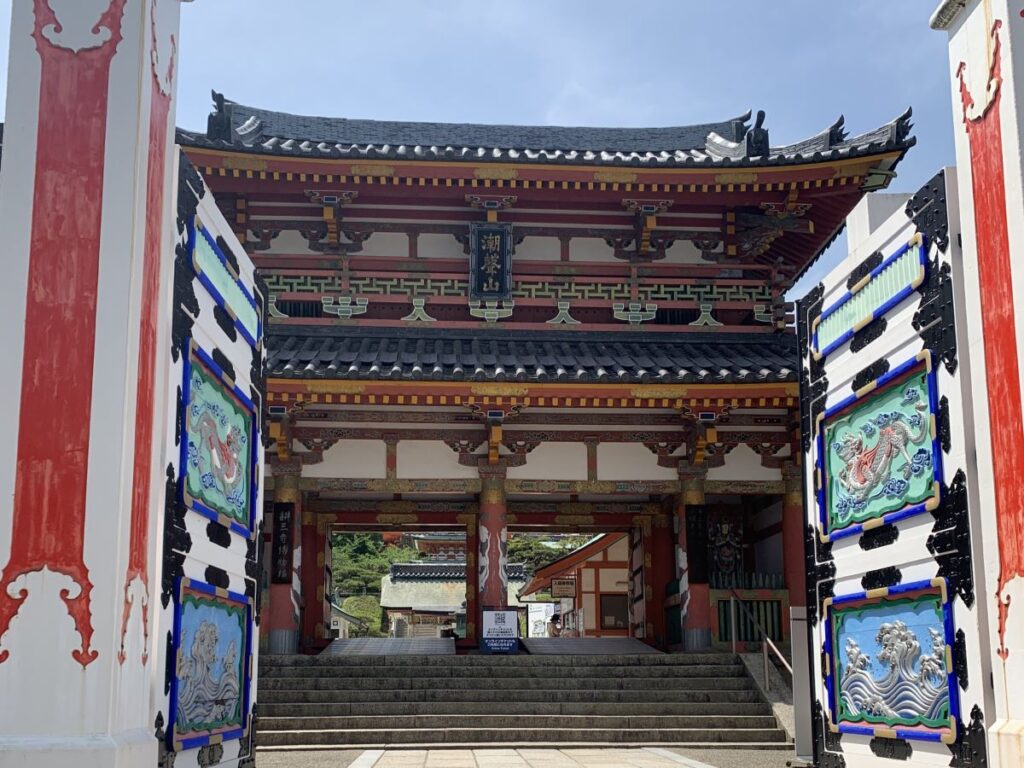
This place has to be seen. My pictures do not do it justice. My descriptions will absolutely not do it justice. I alternated between giggling at the OTTness of it all and standing staring open-mouthed at the next random thing I spotted.

The main buildings and entrance gate are adorned with ornate carvings, paintings and enough gold leaf to form a decent-sized nugget. The grounds and buildings team with statues, gates, pagodas, ponds and other touches. However, the buildings that make up the worshipping part of the temple are only part of the draw.
There’s also an underground tunnel with 1000 Buddhas carved into the walls, but the piece de resistance is located up on top of the hill – The Hill of Hope.
This marble-covered area is full of white sculptures, and it took 16 years for the sculpture Itto Kuetani to finish. It uses 3000 tonnes of Carrara marble – I don’t even want to think how much that cost.
Apparently, it represents a peaceful world full of hope for the future.

I really just can’t explain the amount of detail you’ll find at Kosanji.
Every time I turned my head, I saw some new addition – a carving of a peacock, a painting of a dragon tucked up on a ceiling, a giant Kannon that would dwarf most small town shrines, yet here was just kind of tucked away up the back.
Below are just a few of the 100+ pictures I took! But even seeing these individually doesn’t conjure up what you feel as you stand there and realise that all of these details are in one place, created by the vision of one man, for his mum!
I feel I’ve adulted correctly if i send mine flowers on her birthday!


I spent about 90 minutes wandering around, checking things out, before heading off for my bowl of lemon ramen – and then the ferry.
But I still didn’t have time to see two areas – the Chouseikaku Villa, located next to the temple, was built as a retreat for Kosanji’s mother. This costs an extra 200 yen to enter, and I didn’t actually realise it was then until it was too late.
There’s also the Kongo Gallery across the road, which contains some of the artworks Kosanji collected over his lifetime. Entrance to the gallery is included in the main admission ticket to Kosanji, which, at the time I went, was 1400 yen. There are also statues and sculptures in the gallery garden.
Konsanji is open seven days a week from 9 am to 5 pm. The Buddha Cave and the Villa have slightly different hours and close a little before the main temple area, so if you want to visit those, don’t leave things too late in the day.
Getting To and From Setoda – The Trick to Know
When I was planning this day, I couldn’t work out how to time it properly. Because I was coming from Okayama about 80 minutes away, I was going to catch the 9.15 ferry from Onomichi, which got me onto the island at 9.54. That was fine.
However, I then had the choice of the 11.20 ferry back, which seemed too little time, or the 13.25, which seemed a bit too long as I aimed to spend the afternoon exploring Onomichi.
However, I then realised I could get a ferry back to Mihara in between and jump on a train back to Onomichi. This would allow me more time in Kosan-ji and still get me back to Onomichi before I would have arrived on the later ferry.
This is what I choose to do.

So, if you do visit, play around a bit with the transport timings and routes to find the best combination for you.
The Navitime app can help you if you plan in advance or check the schedules posted at the ferry terminal when you arrive so you know your options.
Mihara and Onomichi are only 12 minutes away from each other by local train, and the journey only costs 240 yen, so it’s very easy to make your decision later in the day.

Another piece of useful advice is knowing where the boat goes from if you are taking it from Onomichi.
The ferry terminal is right by the station and very easy to find – but once I got there, I couldn’t work out which dock the ferry to Setoda went from as it wasn’t marked. I had to use my rudimentary Japanese to ask.
Assuming it’s still the same when you go, it’s not the dock that’s straight ahead of you as you arrive in the port; it’s the floating dock round to the right.
The boat is bright yellow when it comes in, which helps you spot it if you’re confused.

You can buy your ticket from the guys on the dock; make sure you have some cash to make things easier. I’d suggest just buying a single in case you decide to return via the other route, as the tickets are not interchangeable between the two routes.
If you sail in and out of Mihara, things are more straightforward as it has a central ferry terminal building where the wharves are clearly marked.
The Thing I’d Change If I Did It Again
With hindsight, I wouldn’t have combined Setoda and Onomichi into one day trip. I’d have just dedicated this day to Setoda – and visited Onomichi on a separate day.
Onomichi is a maze of hills and steps, and my visit there suffered a bit because I had gone to Setoda first. I ran out of time and energy to do everything I wanted.
If you’re super fit and don’t mind a long day, it won’t be an issue, but if you’re going to struggle after walking about 15km – especially if you’re climbing steps and hills; or if you need to get back to your hotel early, or are traveling during a time when the days are shorter – separate them.

Not rushing to Onimichi would also have allowed me to spend more time in Setoda.
I only popped my head into the other temple complex on the island (admittedly, it would be hard-pressed to compete with Kosan-ji for ostentation), but exploring that would have been nice. I’d also have liked to spend more time in the shops and backstreets – and to stop in for a cheeky lemon beer after lunch.
Traveling Around the Island
More time would also have allowed me to work out if it’s feasible to see the artworks along the island’s coast by public transport.
If you like cycling (which I do not), Ikuchijima is part of the Shimanami Kaido Bike route, so the island is very bike-friendly, and cycling would be the perfect way to get around.
You can rent bikes in Onomichi and transport them on the ferry (there is a fee), or wait until you get to Setoda. Check the website here for details – I would suggest booking if you can to make sure bikes are available and that the type you want is allocated to you.
So, there you have a brief taste of what to expect from Setoda and Kosan-ji. It’s definitely not yet on the main tourist track, so if you’re looking to get away from the crowds a little bit on your trip, add it to your plans.

