
- Hakone’s Venetian Glass Museum – The Biggest Surprise in Town - 19 March 2026
- How to Fill in Your Visit Japan Web Arrival Documents for Japan - 18 March 2026
- The Beginners Guide to Getting on the Shinkansen - 16 March 2026
Are you confused about using the Shinkansen? This guide explains what to expect when arriving at the station, on the platform and on the train. Check it out, and you’ll be nipping around Japan like a local in no time.
Let’s start with the basics. The Shinkansen, aka the Bullet Train, is the rail network used to travel long distances in Japan.
There are different lines, but the one most often used by first-time travellers to Japan is the Tokaido Shinkansen, which runs between Tokyo and Kyoto and Shin-Osaka.

Article by Helen Foster. Disclosure: Some links in this post are affiliate links. See our Affiliate Disclosure.
When going further west, the line is operated by a different rail company and is renamed the Sanyo Shinkansen. This goes from Shin-Osaka to Hakata in Fukuoka, serving cities such as Okayama, Hiroshima, and Kokura. If you’re travelling to say, Hiroshima from Tokyo, though, don’t worry, you don’t need to get off, you’ll just stay on the same train.
The advice in this piece is mostly related to these two lines – there are some small differences regarding other lines, and I’ll mention them if relevant.
The Other Shinkansen Lines
If you’re going somewhere other than Tokyo to Kyoto/Osaka, Hiroshima, Hakata or stops along that route, the line will have a different name.
- Hokuriku Shinkansen – Connects Tokyo with Tsuruga, passing through the Japanese Alps and stopping at cities such as Nagano, Toyama, and Kanazawa.
- Kyushu Shinkansen – Runs through the island of Kyushu, connecting Hakata with Kagoshima, with stops including Kumamoto.
- Tohoku Shinkansen – Travels north from Tokyo to Shin-Aomori, serving major cities such as Sendai, Morioka, and Fukushima.
- Hokkaido Shinkansen – Extends the Tohoku Shinkansen beyond Shin-Aomori, travelling under the sea through the Seikan Tunnel to Hakodate in Hokkaido.
- Joetsu Shinkansen – Runs from Tokyo to Niigata, serving destinations in the Niigata Prefecture region.
- Yamagata Shinkansen – A “mini-Shinkansen” branch line that splits from the Tohoku Shinkansen at Fukushima and runs to Shinjo via Yamagata.
- Akita Shinkansen – Another “mini-Shinkansen” branch line that leaves the Tohoku Shinkansen at Morioka and travels to Akita.
Understanding the Train Layout
The Tokaido and Sanyo Shinkansen are divided into three main types of carriage…
- Ordinary Class unreserved carriages, where you can sit anywhere.
- Ordinary Class reserved cars, for which you book an allocated seat.
- Green Cars, which are like First Class and need a seat reservation.
Some of the other lines also have a section called Gran Class, which is ultra plush.

Seating Configuration
Both of the Ordinary Class carriages have a 3 x 2 seat configuration. Seats A, B and C are the three. D and E are the two.
If you want to be on the Mount Fuji side, choose D and E. It doesn’t matter if you are going from Tokyo or to Tokyo, it’s always seat D and E.
Green Cars have a 2 x 2 configuration. Seats C and D are on the Mount Fuji side.
Storing Luggage
The back seats in the car have a gap behind them for luggage. You must reserve these in advance if you want to use them.
However, if you can lift your bags above your head, have a smaller bag that fits by your legs, or are getting on early enough to snag the luggage compartment between the cars, you do not need to book these, as you can place the bags by your legs, in the overhead compartment or on a luggage rack between the cars.
See more about the rules of luggage on the Shinkansen for more detailed advice.
Other Shinkansen do not have the same rules about luggage as the Tokaido and Sanyo lines. You can put the luggage overhead or on luggage racks in the compartments.
Buying Tickets
I have a longer post on how to buy Shinkansen tickets here, so I’m just going to bullet point these tips to save this from turning into a book. If you want more details on any of the points below, head over to that post.
- Trains on the Tokaido and Sanyo Shinkansen run very regularly, so you don’t need to book in advance. But, it can be helpful if you’re travelling in a large group, have larger luggage or are travelling over a Japanese holiday when reservations might be mandatory.
- The official site to buy tickets in advance is Smartex. Klook also works
- You can also buy tickets in Japan at ticket offices or ticket machines – these have English options.
- Shinkansen tickets have two parts. You pay a base fare, then you pay a seat fare – even when buying an unreserved seat. As a general rule, you should pay around 13,000 yen (give or take 1000 yen) to get between Tokyo and Kyoto/Osaka – if you pay significantly less than that for a normal ticket, you may not have bought both parts.
- If you book unreserved, not only can you sit anywhere, but you can also get on any train going to your destination that day. Reserved seats are set seats on a specific service.
Where to Catch Bullet Trains
It often surprises people to discover that the Shinkansen does not run from the behemoth that is Shinjuku Station. Instead, if you are going on the Tokaido Shinkansen, you can catch it from either Tokyo Station or Shinagawa Station – you don’t need to specify which when you book. Your ticket will work at either.

In Kyoto, you catch the train to or from Kyoto Station. There is only one station with this name.
In Osaka, you go into Shin-Osaka Station – this is a bit further north than most of the main tourist sights. It is not the same as the station simply called Osaka Station.
Using the prefix ‘Shin’ is common in cities to differentiate the Shinkansen station from a local station of the same name. Yokohama, Kobe and Kurashiki are other cities where the bullet train uses a station with the Shin suffix. These aren’t always in the middle of town, so make sure you know where you are going to end up.
Finding the Shinkansen Tracks
Major Japanese stations can be huge. The two stations where I’ve had the most trouble finding the Shinkansen lines are Tokyo Station and Kyoto, and I’ve learned it really helps to arrive at the closest entrance.
At Tokyo Station – aim to enter the station at any of the Yaseu entrances. Look for the white signs for the Tokaido/Sanyo Shinkansen. The Hokuriku Shinkansen also goes from here – its signs are green. There is a map here.
At Shinagawa Station – it’s a smaller station, but try to come in close to the Konan Exit if you can. There is a map here.

At Kyoto Station – aim to enter the station on the side closest to Kyoto Tower. This will bring you to the Central Gate. Once through the gate, it’s a little bit of an up-and-down walk to the tracks, but they are clearly signposted. There is a map here.
At Shin Osaka, the Shinkansen tracks are on the third floor. It’s not as confusing as the others. Both the Central Gate and South Gate will see you enter close to the Shinkansen Area. There is a map here.
If you are arriving by subway or local train, the Shinkansen tracks will be signposted. Just keep following those signs.
How Soon Should You Get to the Station
As you can see, the stations can be pretty large. If you are booked on a specific train, it’s a good idea to get there early to ensure you don’t miss it.
If you don’t know where you are going or are carrying a lot of luggage, I’d get there 30-45 minutes early to find the platform, locate the lifts, etc. If you’re travelling light or are at a smaller station, 20-30 minutes ahead is fine. You don’t need to go up to the platform, just locate it. You can shop or sit in the waiting area downstairs if you prefer.
Go up to the platform 10-15 minutes before your train so you can work out where to stand on the platform.
Finding Your Platform
When you arrive at the Shinkansen gate, you’ll see black signs listing all the upcoming trains. Simply look for your train on this – you use the destination, and, for reserved seats, the train number and/or departure time to do this.
Remember, there may be three or four trains going to the same place within a short period. Unreserved, you can catch any of these; with reserved seating, make sure you catch the one you are booked for.
Or, use an app like Navitime, which will tell you the platform number in advance so you can just head to it. Unlike in other countries, Shinkansen trains use the same platforms all the time.
You’ll also have a second chance to check everything on the platform.
Save Money with Klook & Japlanease
If you plan on buying tickets or tours from Klook for when you’re in Japan, you could save up to 10 per cent by using the code JAPLANEASEKLOOK at the checkout. Click here to see what’s on offer.
T&Cs apply. Some items, including Tokyo Disney and USJ tickets, are not available for discounts.
How to Read a Seat Reservation Ticket
If you have reserved seats, you will be given a ticket that shows the seat details. Each person travelling should have their own one of these. Here’s what they mean

- Where the train leaves from (Kagoshima-Chuo)
- Where you’re going (Shin-Osaka)
- The date of travel (April 4)
- The time the train leaves (15.01)
- The time it gets to your destination (19.24)
- The type of train and number (match this to the station sign) (Sakura 562)
- The car number you need to find (Car 4)
- Your seat in that car (Seat 15 B)
- Whether it’s smoking or not (Cigarette)
Getting Through the Barrier
How you do this will depend on the type of ticket you have. If you have a QR code-enabled ticket, you should just be able to scan this at a QR code reader on the gate – but do read the instructions carefully, as some retailers still require you to pick up paper tickets.
If you have a paper ticket, put the ticket, and the seat reservation ticket if you have one, in the slot – they will both pop out at the other end.
Now, it’s time to head to the platform and find the right spot to stand.
Need Extra Planning Help?
Our Japan trip planners can help. You might like our First-Timers Japan Planner, which will help you plan your trip to Tokyo, Kyoto and Osaka step-by-step, including tips on everything from picking hotels to sightseeing and dining. Or our super-duper Tokyo Disney Planner makes arranging your park trip MUCH easier. Find them in our Planners store – printable and digital versions are available.
How to Read a Japanese Train Sign
If you’ve ever run up and down a British train platform dragging a bag trying to find First Class (or avoid it) before the train moves, this is going to blow your mind.
Japanese trains not only pull into the same platform each time, but they also tell you exactly where to stand on the platform to find your seat!!
You just have to know where to find the information, and the answer is on the electronic signs like these…
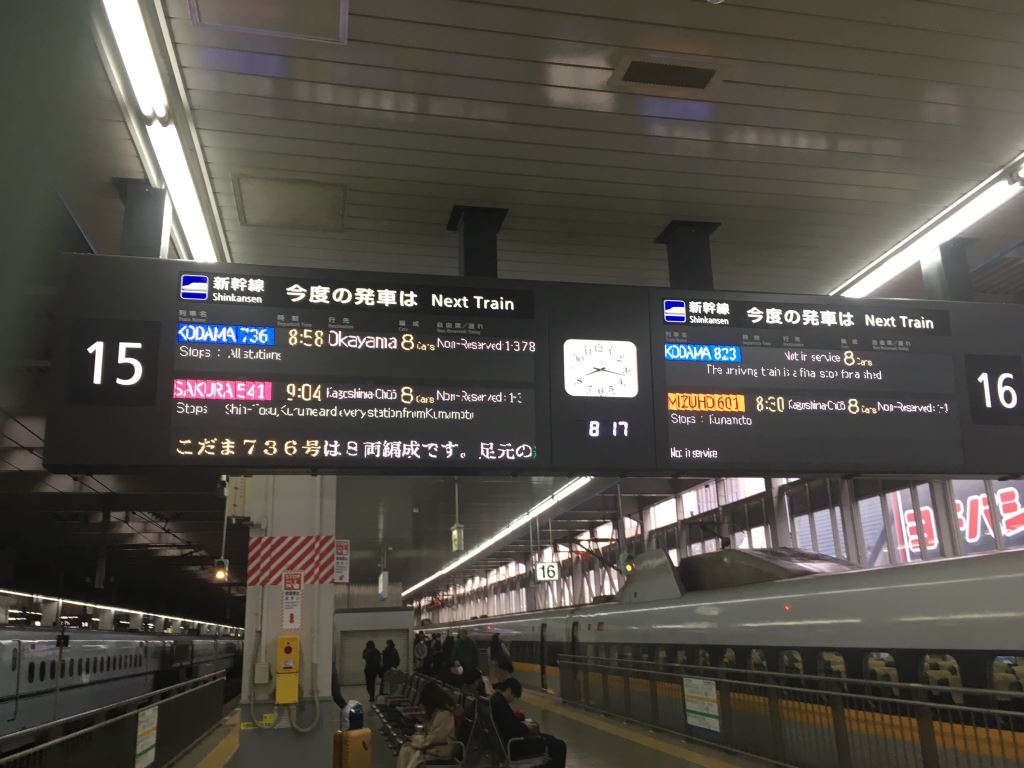
So, what does all that mean…
The first colored column is the train type and number. This is handy to check you’re on the right platform.
The second column is the time of departure – and the train WILL be on time.
The third column is the destination, and the stops en route run along the underneath this. Don’t panic if it’s all in Japanese; the English version will come next.
Now we get to the important bits to do with finding your seat.
The fourth column tells you how many cars the train has – this will be important when trying to work out where you need to stand.
The fifth column shows the carriages open for those with unreserved seats. So it’s 1, 3, 7, and 8 in the example above.
Where to Stand
You can use the advice above to find your spot.
Stickers on the edge of the platform, or electronic signs above the train, will show you where the cars will pull in.

Sometimes the number of cars the train has will alter the position. The sticker may say Car 8 on a 12- car Train and Car 10 on a 16-car train. Remember, the train sign tells you how many cars the train so check this and position yourself correctly.
The car is also marked by the train door itself as it pulls in, so you can double-check it.
Queuing in the Right Spot
I still forget this the first time I turn up to catch trains in Japan; the Japanese will form a queue to enter trains, including the Shinkansen, and, with trains potentially coming in every five minutes on a busy route like the Tokaido Shinkansen, it’s good to know how these work.
On the floor, you might see two sets of white lines. The ones closest to the platform are the queue for the next departing train. If there is a second queue, that’s for the one after. Join the queue when your train is next, or the one after.

Look for This Chart
Each Shinkansen carriage has two entrances; it doesn’t really matter which you use, as both will get you into the right car – but, if you see a map that looks like this on the train gates, it can be handy. It tells you which door is best for your seat location, which can prevent you from trying to traverse the whole carriage, against the flow, with luggage.
You won’t see them at every station, but they are very handy if you do find one
Note, if you are getting on at the first stop, you have a little more time to work all this out, but if you are getting on the train along the route, note that they don’t hang around. If in doubt, just get onto your train; you can always walk through the train and find your seat once it’s moving.
What Happens if You Miss Your Train
Don’t panic. If you bought an unreserved seat, simply get on the next one going to your destination. Remember, you need to sit in the unreserved car.
If you have a reserved seat, then you have lost your reserved seat, unfortunately. But you can just get on the next train going to your destination and sit in the unreserved section.
This is not the case if you have bought the discounted Hayatoku fares via Smartex. These are only valid for the train you booked. If you miss this, you’ll need to buy a new fare.
On The Train
Announcements will be in both Japanese and English, so don’t worry, you’ll know when your stop is coming.
There’s also usually an electronic sign at the end of the carriage that shows you all the stops.
If you’ve still got your luggage with you, small cases should go in the luggage rack above the seat or in front of you – not in the aisles.

If you have booked a space for larger cases, they will go in the oversized luggage area in your carriage.
You’ll notice how clean and quiet everything is – please try to act the same way. If you need to use your phone, then go to the area between the carriages to chat. On a long journey, it’s okay to eat at your seat.
When your stop is coming, it will be announced – get ready early. If it’s not the last stop, the trains don’t spend that long on the platform.
And I think that’s everything you need to know. If you do have any further questions, though, head over to my Facebook page and someone will help you out.

Who Writes This Blog?
My name is Helen Foster, and I’m a journalist and author. My travel articles have appeared in publications including The Australian, Escape, RAC Horizons, Jetstar Magazine, Sainsbury’s Magazine, and more.
I’ve traveled to Japan eight times before – solo and with my partner and visited over 25 towns and cities. My last visit was November 2024 so, everything here is pretty up to date.