
- How to Watch the Oiran Parade at Edo Wonderland, Nikko - 15 October 2026
- 8 Mistakes Not to Make in Autumn Leaf Season in Japan - 10 October 2026
- How to Spend One Day in Nara - 29 September 2026
If you’re going to Japan, you’ll need some spending money. While credit cards are becoming more widely accepted, you’ll likely need cash at some point during your trip. So what’s the best way to convert your home currency to Japanese yen? Our guide can help you decide which is the best method for you – and which will get you the best rate.

Article by Helen Foster. Disclosure: Some links in this post are affiliate links. See our Affiliate Disclosure.
Do You Still Need Cash in Japan?
Yes is the quick answer to this. While more and more places take cards, it’s always good to have a few thousand yen on you for smaller places that don’t take them, like some small or more local restaurants, temples and shrines, or even some transport options.

Even in cities like Tokyo, Kyoto, and Osaka, you will encounter places that accept cash only, especially at smaller or more local places. Because of this, it is always wise to carry some yen in cash with you.
Related Read: All the places I needed cash on my last Japan trip
The Options to Change Money
- Changing money before you leave
- Changing money at an airport
- Getting cash out of an ATM via your normal bank
- Getting cash out of an ATM using a currency card
Each of these has pros and cons, mostly related to fees, exchange rates and convenience and I’ll go into them below – but, if you want the TL: DR version, here are the actual rates for changing Australian dollars that I saw on the ground.
| Method | Yen per AU$1 | Fees | OFX Comparison rate | Difference per $1000 |
| Bank | 108.17 | Nil | 110.18 | 2010 |
| Departure Airport | 89 | 8.90 | 110.18 | 21,180 |
| Arrival Airport | 103.7 | Nil (I believe) | 113.46 | 9780 |
| Tokyo Exchange | 110.88 | Nil | 113.35 | 2470 |
| ATM in 7-11 | 111.9 | 110-220 yen | 113.06 | 1700 |
| Currency Card | 113.1 | vary | 113.46 | 360 |
This is how much one Australian dollar would buy me on each day I checked. Unfortunately, you can’t directly compare each method against the others, as it was impossible to research all the rates on one day. For fairness though, I have included a comparison rate – the one offered by the OFX online currency exchange for that day – so you can see the difference with that and determine if a method is good value, or not.
The above might be enough for you to make a decision, but in case you do want more advice on the pros and cons of each method, or tips on how to use them in Japan, here’s what you need to know. Oh – and there also some important tips about using cash in Japan at the end.
Changing Money Before You Leave
This used to be the best way to get currency before you travelled. You’d go to the bank or a local currency exchange, get cash – or travellers cheques, remember those – and then pick it up a few days before you leave.
The benefits are that you have cash ready for when you land, which is handy. The rates will vary depending on where you buy your cash, but they usually aren’t too bad.
The downside is that some currency exchanges may have a minimum order, some might charge a fee, and you have to plan ahead in time to both order the cash and pick it up.
Rates in the Real World
On the day I checked, Travelex in Sydney was offering a rate of 108.17 yen for AU$1 – in comparison, OFX was offering 110.18. They were not charging any fees if you picked up the amount at the local branch. The minimum order available was AU$400 – and, when I tried a trial transaction, this was then rounded up to the nearest whole yen amount, which took the amount up to AU$462 or 50,000 yen.
Need Extra Planning Help?
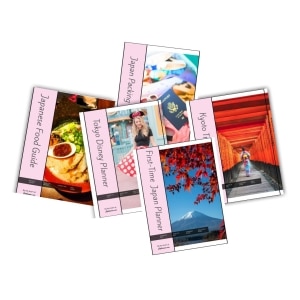
Our Japan trip planners can help. You might like our First-Timers Japan Planner, which will help you plan your trip to Tokyo, Kyoto and Osaka step-by-step, including tips on everything from picking hotels to sightseeing and dining. Or our super-duper Tokyo Disney Planner makes arranging your park trip MUCH easier. Find them in our Planners store – printable and digital versions are available.
Exchanging Money at Your Departure Airport
If you haven’t had time to arrange cash before you go, you might think about changing your money at the airport. The benefit of this is convenience – you don’t have to plan ahead, and you have cash on hand for when you arrive.
The big downside of changing money at your departure airport is that rates tend not to be the best and the fees can be high.

There is normally at least one currency exchange at the airport – but you’ll often find a couple of competing companies both landside and airside. It’s important to check rates and fees at the different companies as they can vary.
Rates in the Real World
On the day I researched this at Sydney Airport, the currency exchange I approached (not the one pictured above) was offering 89 yen for AU$1.00 – plus an $8.90 transaction charge. In comparison, OFX was offering 110.18 yen per dollar.
Exchanging Money at Your Arrival Airport
Haneda Airport has at least two currency exchanges in the Arrival area of Terminal 3, where most international flights arrive, so you can wait until you reach Japan to change cash. Narita also has exchange counters.
Again, this can be convenient as you don’t have to plan ahead to order or pick things up, and you have cash on hand for when you need it.

The downside is that you might not feel like trying to find the currency exchange when you arrive at the airport. Rates can also vary between exchanges, and wandering around the airport, comparing deals might not be much fun after a long flight.
My original plan for this piece was to compare rates within a 24-hour period, but this was thwarted because I flew ANA which lands in Terminal Two, and the currency exchange there is in departures not arrivals and I couldn’t see it – and it all just felt too hard after a 10 hour flight!
Rates in the Real World
On the day I researched this at Haneda Airport, one of the currency exchanges in arrivals (again, not the one pictured above, which is actually in Nagoya) was offering 97.38 yen for AU$1.00, and the other was offering 103.7. Neither had their transaction charges listed, but I believe they build the fees into the rate. In comparison, the rate on WISE that day was 113.5 yen to a dollar.
Exchanging Money in Town
This is probably the least convenient of all the methods here – you need to draw out sums of cash before you leave and locate a currency exchange near your first hotel before you can spend any money, but you will find exchanges in popular tourist areas like Asakusa or Shinjuku so there might be one right by your hotel.
As with the other types of exchanges, rates and fees can vary between companies, so shop around before committing to a transaction. However, I admit, the rates weren’t as bad as I was expecting. Especially as most of the companies were also offering no commission transactions.

You’ll also see exchange machines in hotels or the 7-11. These are convenient, but, they did seem to offer lower rates than the exchange offices.
Rates in the Real World
I checked the rates in Shinjuku, where there is a line of currency exchanges in a row and found they were offering everything from 111.76, 109.40 and 110.88 per AU$1.00 – usually with no commission. Conversely, on this same day, OFX was offering 113.2.
Withdrawing Cash With Your Normal Debit Card
Withdrawing cash from an ATM with your normal bank debit card is one of the easiest ways to get yen during your trip. You don’t need to transfer money around accounts before your trip, and ATMs are readily available in convenience stores – usually 24 hours a day.
The ATM you draw money from though will likely to levy a charge – at most Japanese convenience stores, this is 110 yen if you’re drawing out more than 10,000 yen or 220 yen for 20,000 or more. The rates and any fees charged by your home bank will vary so you need to check these.

Rates in the Real World
On the day I researched this, using an Australian Commonwealth Bank card was giving 111.9 yen for a dollar drawn at 7-11, conversely WISE was offering 113.6 yen to a dollar.
You are usually charged 110 yen to draw out over 10,000 yen, and 220 yen on withdrawals over 20,000 yen. You bank might also levy a charge – check with them about this.
Drawing Out Cash With a Currency Card
In recent years, currency cards like Wise and Revolut have become popular options for international travellers.
These work like a normal debit card in that you must have cash to draw on in your account, but they allow you to store money in different currencies that you can then withdraw from a normal ATM.
You do pay fees when you change money from your local currency to yen, but these are often lower than you pay for, say, using a credit card to pay the same bill.
Decide on Your Approach
There are two ways to use a Currency Card.
- Changing Money in Advance: With this, you change your home currency into yen before you travel. The benefit of this is that you can change money when the exchange rate is in your favour and/ or add a little to your account each month to budget for your trip.
- Withdrawing on the Day: You can also just keep money in your home currency, and it will give you the card’s rate on the day. Even though this will fluctuate, it was always higher than the other methods.
When drawing cash fees vary depending on the type of card you use and the country in which it was issued, so check these before signing up. It’s often free up to a certain limit, after this, there is a small fee per transaction. You don’t get charged for online or tap-style withdrawals in local currency.
As with using your normal debit card, the ATM provider will also charge you a fee.

Rates in the Real World
I started changing money to yen once I booked my trip. I got everything from 101 yen to 115 yen to the dollar.
If I’d kept my money in Australian dollars, I would have got the daily rate, which ranged from 109 to 113 during my trip, so I did lose out a little bit changing in advance – but that’s the gamble you take.
I used my one free cash draw a month, then once I did start getting charged, it cost me 133 yen on a 20,000 yen withdrawal – plus the 7-11 fee of 220 yen.
Important Money Tips for Japan
There are a few additional things that travelers should know about handling money in Japan.
Know the Rate to Check
Remember that when you are changing your home currency to yen, you need to look at the Buy Rate – it is usually the lower of the two.
ATMS That Accept Foreign Credit Cards
It’s important to note that, when using a foreign credit card to draw out cash in Japan, you don’t go to a normal bank – these generally do not accept foreign cards. Instead, you go to the convenience stores like 7-11, Family Mart, or Lawson. Some Japanese post offices also work with foreign cards.
IC Cards Can Reduce the Need for Cash
Prepaid transport cards such as Suica, Pasmo and Icoca can be used not only on trains and buses but also at many vending machines, convenience stores and small shops that might not take credit cards.
Loading one of these cards with yen can reduce the amount of cash you need to carry day-to-day. On the day I transferred money onto my Suica, I got a rate of 109.5 yen per AU$1 (OFX was offering 113.46).

Always Have a Back-Up
Whatever method you are using, make sure you have another way to get cash and/or pay for bills. On this trip, my Australian debit card did not work in any konbini, and I still don’t know why. Conversely, my WISE card did not work at two hotels when they put it in the chip and pin machine, so I had to switch to my credit card.
Do Not Rely on Digital Cards
These can work okay in stores but you may not be able to get cash out of a machine with a digital card. Bring the physical card with you.
Always Choose ‘Local Currency’
When withdrawing money overseas, you may be asked whether you want the transaction processed in local currency. Always say yes. It gives a more favourable exchange rate.
Beware the 2000 Yen Note
Japanese yen notes come in 1000, 5000 and 10,000 denominations, but interesting, foreigners may also end up with one of the rarest Japanese bank notes – the 2000 yen bill – as they are used by currency exchanges overseas. They are legal tender, but people in Japan may be surprised to see them. Until recently, this wasn’t a problem, but the note is being phased out, and some people in my Japan Facebook group have experienced stores not being keen to take them.
Don’t Stress About Big Notes
Conversely, do not worry if you get a lot of 10,000 yen bills when you exchange or draw out currency – you can always break these. Convenience stores like 7-11 or Family Mart are good places to break the notes – obviously, you need to buy something first.
Cash Handling Is Very Safe But…
Japan has one of the lowest crime rates in the world, and it is normal for people to carry cash. However, crime can happen anywhere, so still be cautious as to where you store cash and do not flash big wads of notes around – especially in areas full of other tourists.

Who Writes This Blog?
My name is Helen Foster, and I’m a journalist and author. My travel articles have appeared in publications including The Australian, Escape, RAC Horizons, Jetstar Magazine, Sainsbury’s Magazine, and more.
I’ve travelled to Japan nine times before – solo and with my partner and visited over 50 towns and cities. My last visit was in April 2026, so everything here is pretty up to date.

