
- Hakone’s Venetian Glass Museum – The Biggest Surprise in Town - 19 March 2026
- How to Fill in Your Visit Japan Web Arrival Documents for Japan - 18 March 2026
- The Beginners Guide to Getting on the Shinkansen - 16 March 2026
The answer is you’ve arrived in time to see the Doll Festival in Japan, aka Hinamatsuri, Doll Day, or Japanese Girls Day on March 3rd, and if you know where to look, it’s THE most amazing sight.

Disclosure: My trip to the Hinamatsuri festival was part of a trip to Western Japan hosted by the Japan National Tourism Association.
How Did the Tradition of the Japanese Doll Festival Begin?
It harks back to the Heian period, about 1000 years ago when dolls with human features first became popular in the country.
It was actually an evolution of a cleansing ritual brought to Japan from China where people would throw paper dolls into the river hoping they would take ill health and impurities with them.
In time, people stopped throwing the dolls away and instead, used them as a symbol of their hopes and prayers – in the case of the Japanese Girl’s Day dolls, high status and good marriage.
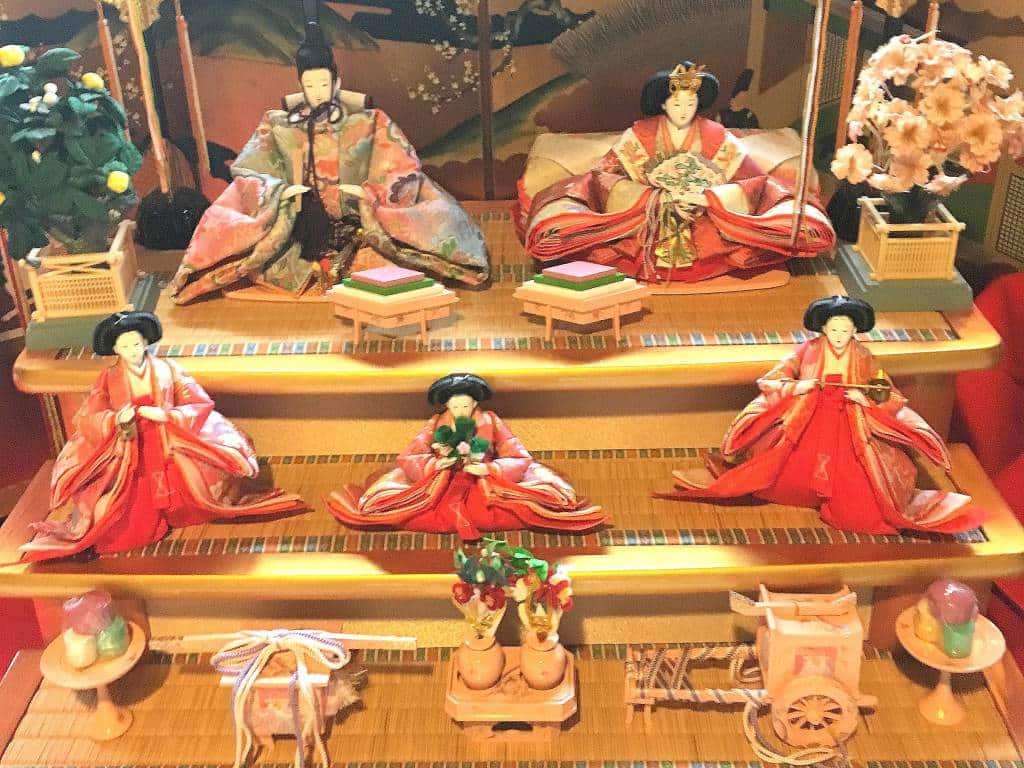
That’s why, while the appearance, size, shape, and cost of dolls on display for the larger displays you see during the Hinamatsuri Doll Festival might vary, you will always see at least one display containing dolls representing the Emperor and Empress on their wedding day surrounded by their congregation.
These dolls are displayed on a set of steps, usually covered in red cloth. In the most ornate displays, this can run to many storeys.
In every stepped display, though the Emperor and Empress are always at the top, and then different steps work their way down through their congregation of waiting ladies, musicians, etc.
Why is Hinamatsuri Celebrated?
The point of Girl’s Day in Japan is to celebrate the girls in a family and wish for their good health and good fortune. Every family who has a girl will own a set of Hina dolls, as they are known.
They are often made by hand (this page shows how many parts there are in a Japanese Hina Doll – it’s quite incredible) and it’s not unusual for a family to spend thousands of yen on their Girl’s Day dolls, and that set is then passed down through the generations.

While Hina Dolls used to be made in one style, the very formal, ornate look above, you can now buy different types of dolls.
I even saw anime-style ones in a doll shop in Osaka (the name is only in Japanese so I can’t type it, but if you want to visit it, it’s on Nipponbashigashi, pretty much opposite Hotel Naniwa).
Even big companies like Disney now offer sets of Hinamatsuri-style dolls in the Tokyo Disney Resort as Hinamatsuri approaches. They, obviously, have Mickey and Minnie at the top.

Families and companies will often also add individual touches to the lower levels of the traditional doll displays…check out the cats in this display at the Kaho Theatre in Iizuka, near Fukuoka, which is known for its Hinamatsuri With Cats.
When is the Doll Festival?
Girl’s Day in Japan is March 3rd, but you’ll start to see the dolls displayed from early February.
Don’t wait too long after March 3rd to try and see things though. The dolls are usually taken down quickly after the festival.
Just like Christmas decorations, it’s seen as bad luck to leave the dolls on display after Doll Day has passed.
You’ll be lucky to see any up by March the 5th. One exception to this is the display at the Keio Plaza Hotel in Tokyo which stays in place until March 31st – that’s it below.

The Best Doll Festival Displays in Japan
While Hinamatsuri dolls are mostly put up in the family home, many hotels, shrines, and businesses will have a display in the lobby or somewhere else public, so keep your eyes peeled.
There are also some places that put on exceptional displays.
Sometimes the dolls all come from one family, but often the whole town comes together to create a community Hinamatsuri festival display.
Here are some good ones to check out.

The Best Hinamatsuri Displays in Tokyo
Keio Plaza Hotel in Shinjuku
This is one of the most popular hotels in Tokyo, you might even be staying there and have seen the dolls – and that’s why you’ve ended up on this post!
It has one of the biggest public Hinamatsuri doll festival displays in Tokyo with over 6500 dolls on show.
They also offer special Hinamatsuri meals in their restaurant.
See more about the hotel here.

Mejuro Gajeon Hotel, Meguro
Describing themselves as a Museum Hotel of Japanese Beauty, it’s not really surprising that this hotel in Meguro, south-west Tokyo, has one of the best Hinamatsuri displays in Tokyo.
They display their dolls on a huge staircase.
The hotel is also renowned for the beautiful paintings in their restaurant and meeting rooms.
See more about the hotel here.
Hinamatsuri Displays Near Tokyo
Katsuura, Chiba
The Katsuura Big Doll Festival displays over 30,000 dolls in five different locations but the most amazing is the display at the Tomisaki shrine which displays the dolls on an old stone staircase. The sight of almost 2000 dolls on the staircase’s 60 steps is quite impressive.
Also, don’t miss the display in the Citizen’s Hall which sees row after row of dolls on display. About 7000 of the dolls are from local people, the rest are loaned from families around the country.
Katsuura is easy to reach from Tokyo. It takes about 90 minutes on the Wakashio Limited Express Line.

Konosu, Saitama
The town of Konosu, about an hour’s train ride, northeast of Tokyo has a long history of doll making so it’s not surprising they also offer one of the country’s best doll displays
The highlight is the 31-storey pyramid of 1800 dolls, the highest doll pyramid in Japan, that stands in the Elmi Konosu Shopping Mall outside the JR station. All the dolls are on loan from locals and other families and around the country and, the pyramid is even earthquake-proof.
Another special touch of the Konosu pyramid is that it has added chicks – a symbol of the town.
Dolls are also displayed at five other venues in Konosu.
Hinamatsuri in Kyoto
The Kyoto National Museum often puts its dolls on display but on March 3rd, Doll Day in Japan itself, the Shimogama Jinga shrine in Northern Kyoto carries out a whole Hinumatsuri ceremony with people dressed in elaborate kimono.
Part of this is a ceremony called Nagashibina which sees people floating tiny paper dolls downstream replicating the origins of Hinamatsuri.
See more about the ceremony here
It could be a great thing to do if you’re traveling to Kyoto with kids, especially daughters, at this time.

The Best Hinamatsuri Near Hiroshima
The port town of Tomonoura in Hiroshima Prefecture put on a display called Tomo Machinami Hiroshima where 100 houses in the town put their family’s dolls on display.
To reach Tomonoura, you need to travel to Fukuyama station and then take a bus to Tomonoura.
This takes 75 minutes from Hiroshima or a little under 2 hours from Osaka. If you get stuck when you reach the town, they do have a Tourist Infomation Office.
Hinamatsuri Near Fukuoka
Fukuoka in Kyushu in the far west of Japan isn’t on every first-time traveler’s Japan itinerary, but if you are traveling there around Hinamatsuri you might want to take a detour to the town of Iizuka, a 40-50 minute train ride from Fukuoka.
Iizuka, Fukuoka
Over 10,000 dolls are displayed around 17 sites in the town.
This is where I experienced Hanamatsuri and most of the pictures in this post were taken in Iizuka. You’ll find a list of where you can see all the dolls on the Welcome Kyushu Hina page for details of what’s on where.
However, the big draw, and one place you absolutely not miss if you’re here, is the Ito Denemon House.
Here thousands of dolls fill room after room of the old house: there are regal dolls, some hundreds of years old, lining the corridors.

Walk into one room and a scene of thousands of dolls spreads out in front of you – look closely and you’ll spot tiny kimono-clad dolls carrying umbrellas and warrior dolls riding tiny horses.
There are little towns full of dolls with trees and rivers and houses. In fact, there are dolls as far as the eye can see.
And what makes the display even more impressive is they are all owned by one woman, Ms Senoshita Mamiko.
Her son now works at the house and told us that his mother traveled all over Japan to collect the dolls.
For the doll’s festival, she shows them all over town. Funnily, he himself has a daughter but does not display any dolls in his house. ‘She can go anywhere in town to see her family dolls, he laughs. ‘People are always asking to buy the collection but we will never sell.’
Chofu Garden, Shimonoseki
Also close to Fukuoka, this beautiful garden is worth a visit in its own right, but when I visited during the Doll Festival, it turned out they also filled one of the garden’s beautiful old wooden buildings with all sorts of dolls.
As well as the traditional human figures they had some really cute animal dolls in their display.

Getting to Chofu Garden takes just over an hour by train and bus from Hakata station in Fukuoka.
So, there you have it, the meaning of Doll Day in Japan and some of the best places to celebrate the Doll’s Festival in Japan.
What to Read Next
If you’re wondering about the time of other festivals in Tokyo and Kyoto, then you might want to look at our guides on the best time to travel as these include a section of festivals in each season.
Find the guide on the best time to visit Tokyo here.
Or, if you’re traveling to Kyoto, then you’ll find our list of the best times to travel to Kyoto here.

Who Writes This Blog?
My name is Helen Foster, and I’m a journalist and author. My travel articles have appeared in publications including The Australian, Escape, RAC Horizons, Jetstar Magazine, Sainsbury’s Magazine, and more.
I’ve traveled to Japan eight times before – solo and with my partner and visited over 25 towns and cities. My last visit was November 2024 so, everything here is pretty up to date.

