
- How to Use Buses in Nara - 11 March 2026
- 8 Tips for Travelling in Japan as a Larger Family or Group - 10 March 2026
- Top 10 Things to do in Nara - 6 March 2026
Okay, so the shrines and temples in Kanazawa aren’t quite as jaw-dropping as some of the ones in Kyoto, but don’t discount visiting a few while you’re here. Many of them have interesting touches, including cartoon characters, hidden rooms, revolutionary statues, and more. Here are our favourites—and what to look out for when you visit.

Article by Helen Foster. Disclosure: Some links in this post are affiliate links. See our Affiliate Disclosure.
1. Gyokuryu-ji
Free entry, no official opening hours listed
When I first arrived in Kanazawa and spent an afternoon wandering in Higashi-Chaya, I regretted not booking a tour to learn more about what I was seeing – I think it’s the type of place with a lot of hidden gems. Back in my hotel, I started looking into tours for the next morning, and a picture stopped me in my tracks. I saw the sight below…
My first thought was, ‘Why is there a temple with a Gundam head?’ My second thought was, ‘Where is it?’ It took another cup of tea and a good hour of sleuthing to find it.

Its official name is Gyokuryu-ji, and what makes it special is the models and statues of random cartoon characters you find in the grounds. There’s a stone statue outside of Anpanman, Mickey and Minnie Mouse stand inside, and even a tiny Godzilla positioned next to a tree.
I don’t know exactly why, and I couldn’t find anything at the shrine to explain it, but there is a nursery school next to the temple, and the sign below is for that, so my guess is that the two are related.

But the best bit about finding Gyokuryu-ji was that it was right by the Ninja Temple. I probably wouldn’t have gone there if I hadn’t seen this picture, and it turned out to be my favorite thing here. So, let’s talk about that now.
2. Myoryu-ji
Open 9.00 am – 4.00 pm seven days a week (4.30pm on Monday). You must take the tour, which costs 1200 yen. Call 076-241-0888 to book in advance, or turn up on the day and book via the intercom.
Also known as Ninja-dera or the Ninja Temple, this is no ordinary shrine. In fact, it’s no ordinary building; and because of that it’s a must-see in Kanazawa.

Originally, Myoryu-ji was a small place of worship on the grounds of Kanagawa Castle. It was built by one of the important generals of the day, Maeda Toshiie, as his family temple. In 1643, his son, Maeda Toshitsune, a daimyo (lord of the area), ordered the temple to be moved to a new location and reconstructed, with some additions – hidden rooms and escape routes in case it was attacked, and even an entire concealed floor.
The tour takes you around several of these – and, even though it’s in Japanese, and international guests are given a booklet to look at instead, it’s completely fascinating. Read more about the tour in our review of the Ninja Temple.
Today, the temple is still a place of worship. It’s owned by the Nichiren sect of Buddhism, and your tour starts in the ornate altar area.
You’ll notice that the prayer plaques here are in the shape of a cute dog, which seems a bit confusing – what’s that got to do with ninjas? However, there is an explanation.

At one point, the shrine’s head priest, who loves dogs, visited an animal shelter elsewhere in the prefecture. Many dogs and cats had to be put to sleep here because they couldn’t find homes, and he was very sad about this, so he wanted to do something to mark that.
In addition, a dog that had been lost from its home a fair distance away turned up here, was rescued, and returned home.
From this point, the priest decided to make Myoryu-ji a place where you pray for all the members of your family – human and fur-covered. It must have worked – in recent years, the shelter has reached the point where no animals have had to be put to sleep.
3. Kourin-ji
Open 9.00 am to 5.00 pm, seven days a week. It costs 500 yen to enter Kourin-ji.
When Maeda Toshitsune moved Myoryu-ji, he also built several other temples around it. If you’re into shrines and temples, you’ll want to spend half a day in this area, as many of them have interesting touches … like Kourin-ji.
Walk inside this small temple and you’ll find a room displaying 60 Noh masks. Noh is a type of Japanese theatre that combines dance, drama and acting, but the unique thing about it is that the characters wear masks to convey their characters’ actions and feelings.

The masks were designed by the artist Mokukan Hirai, and the display allows you to see them up close. The explanations are in Japanese, but Google Translate will help you out.
The other artworks in here are by Uzan Kimura, one of Japan’s most famous kimono artists.
Once you’ve seen the masks, head outside into the garden, and you’ll discover why Kourin-ji is described as the temple to make your wishes come true.

In the garden, you’ll find a display of lots of statues – 12 of which are the signs of the lunar zodiac.
It’s said that if you take three laps around the garden, and then stop and pray for your wish at your lunar sign, and again at the statue of Fodu Myoo, your wish will come true. You can also buy a coloured sash, write your wish upon it and then drape it on the statue.
There’s also a Daruma statue here with a wide mouth. Buy one of the balls from the shrine and try to throw it into his mouth. If you succeed, you’ll have good luck.
Need Extra Planning Help?
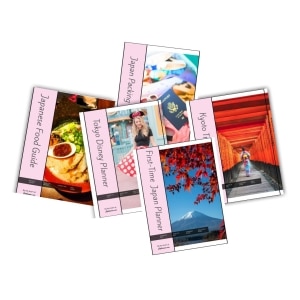
Our Japan trip planners can help. You might like our First-Timers Japan Planner, which will help you plan your trip to Tokyo, Kyoto and Osaka step-by-step, including tips on everything from picking hotels to sightseeing and dining. Or our super-duper Tokyo Disney Planner makes arranging your park trip MUCH easier. Find them in our Planners store – printable and digital versions are available.
4. Sanko-ji
Open 8.00 a.m – 4.00 pm, seven days a week. Free entry.
This small shrine next to Kourin-ji is worth a quick look because of the interesting carved gate. The priest at the temple is a stone sculpture and created the gate in 1991. You’ll also find some of his sculptures dotted around the gardens.

There are a number of other shrines in this area, known collectively as the Temachi Shrines, so, if you have more time in the area, you can wander around them all spotting small details like the the pretty carved gate in Gannen-ji, a cafe selling gold leaf topped matcha in Hosho-ji, a sutra wheel at Shincho-ji that, if you spin it, is said to confer the same blessings as reading the sutra – and much more if you have time to wander.
Don’t forget to translate all the signs – that’s when you find the real hidden gems in most shrines and temples.
Related Read: You can combine visiting this area with visiting the Nisha Chaya area of Kanazawa. Read our guide to what to see in Nishi Chaya here.
5. Utasu Shrine
Moving away from the Temachi area, this is one of the main shrines in the Higashi Chaya geisha district. It looks like quite a simple shrine when you first arrive, but look closer. There are two ninja figures hidden around the shrine building. Students put them there in 2016 to draw attention to Higashi Chaya’s samurai history.

The shrine here was the shrine of the Maeda family, one of the most important ruling families in Kanazawa’s history. They ruled the whole area between 1583 and 1869, and they made all their samurai live in the city, mostly in the Nagamachi area.
Also note the well at the back of the shrine. It’s boarded up now, but it used to be filled with sake-infused water, which it’s claimed could cure children of illness.
If you’re here on February 3rd, the Japanese ceremony of Setsubun is held here. Soy beans are thrown to dispel bad luck and evil spirits, but at Utasa Shrine, the act is not performed by the priest but by local geisha (or geiko as they are known in Kanazawa). The geiko also perform dances at the shrine.
If our articles or Facebook advice have helped make planning your trip easier, you can Buy Me Coffee (or, more likely, some ramen, a Sapporo or an egg sandwich) by making a small donation at our Buy Me a Coffee page.
6. Jukyo-ji
You’ll find this small shrine on the outskirts of Higashi Chaya, and it’s worth seeing mostly to visit a small display of statues located outside.
The story goes that in 1858 the price of rice had risen so high people couldn’t afford to eat. A group of 2000 angry citizens stormed the castle – they got their way, rice prices were reduced, but the seven ring leaders were executed.

These statues were carved by locals to remember them but also to pray for their souls – they each hold a rice plant in their hand.
If you’re here when the temple itself isn’t open, you’ll need to peer inside the windows of the slatted building outside to see the statues. It took me a while to work that out! If the temple is open, they will also open the slats.
7. Oyama Shrine
Open 9.00 am – 5.00 pm. The shrine grounds are open 24/7. If you can’t get here during the day, the gate is lit up at night. Entrance is free.
The front entrance to this shrine is what earns it a place on this list – it’s very unusual for a shrine in Japan. In fact, it looks more like something you might see somewhere in Europe.

It was designed by a Dutch architect and built in 1875. Initially, the glazed area right at the top housed a lantern that used to light the whole city of Kanazawa – and could even be seen as far as the Sea of Japan. The lightning rod on the top is said to be the oldest lightning rod in Japan.
Once you enter the shrine, you’ll find a pretty garden, the bridges and walkways here are inspired by the shape of musical instruments.
You’ll also find some cute statues, like this lily pad with frogs, a gold replica of Toshiie Maeda’s war helmet, and a carving of his wife on a rock.

Also, take note of the wooden gate at the back of the shrine with the intricately carved dragons under the roof. This gate used to be part of Kanazawa Castle but was brought here in 1963. It has survived a number of fires, as, it’s said, that the dragons called upon the gods to bring water to protect it.
Oyama Shrine is located close to Kanazawa Castle Park and the garden here. If you’re not visiting this, it’s probably best to jump on a bus to get here rather than walk too far out of your way. There are a few hotels in this area, so you might also find yourself staying nearby.
8. Yasue Hachimangu
Open from 9 am to 4 pm, but you can still view the grounds, and see inside the glass front of the altar after hours. Entry is free.
This shrine, a short walk from Kanazawa Station, is worth a quick visit to see the collection of small Okiagari dolls left by worshippers.
Okiagari dolls are rather like Weebles. If you knock them over, they bounce back up again – they are used to wish for good luck, good health and luck in business. You can write wishes on them and leave them at the shrine.

People also come here to pray for a safe childbirth.
If you’re here on January 15th, the shrine has a fire festival, during which people burn their old lucky charms.
There are many other shrines in, and around Kanazawa, but these were the ones I found most interesting on my recent trip. However, you never know what you might else you might find behind the gates.

