
- How to Watch the Oiran Parade at Edo Wonderland, Nikko - 15 October 2026
- 8 Mistakes Not to Make in Autumn Leaf Season in Japan - 10 October 2026
- How to Spend One Day in Nara - 29 September 2026
If you’re looking for something fun to do in Nagano, how about collecting stamps from the Seven Lucky Gods? The city has a walking course where you can pick up a special sheet and then go around seven shrines/temples in the city collecting their individual red seals. It’s a great way to see some smaller places you might not visit otherwise. Here’s what you need to know…

What is the Seven Lucky Gods Walk?
The challenge sees you visiting Shichifukujin – or the seven lucky gods – at different shrines around Nagano. As their name might suggest, these guys are said to bring luck – with each working in a different area of your life (rather like the lucky statues you can visit in Kyoto).
You can buy your stamp board (shikishi) for 800 yen at the Tourist Information Centre in Nagano Station when you arrive in the city.
They’ll also give you a map of the shrine locations, which is handy as, when I plotted this out myself on the map simply by looking at the shrine names, one of the shrines came up in the wrong place. So, make sure you get the official map rather than trying to do it yourself – or at least, follow the directions below.
In addition to paying for the board, you also pay 100 yen for the stamp at each shrine and 200 yen for the final stamp that goes in the middle – so it’s 1700 yen in all. In some shrines, someone will stamp your sheet for you, while in other shrines, the stamp is just there for you to use, and you put your stamp fee in the donation box – so make sure you have some coins handy.
Because some shrines require a person present to stamp, you must complete the challenge when the shrines are open, roughly between 9 a.m. and 4 p.m.
The tourist information office says it will take you about an hour and a half to complete all the shrines in one go; I took a little longer because I was distracted by things on the way, like tiny street museums, cute old buildings, modern art sculptures emitting fog, and Nagano’s famous grilled dumplings (see more about these in my list of Nagano’s Top 10 Sights).
You don’t have to visit the shrines in order or all in one day if that doesn’t fit with your plans, but I wouldn’t go to Sezon-in, the seventh shrine, until you’ve visited the others, or you’ll have to go back there and get the final stamp in the middle that finishes the sheet, or pick it up at the busier office in Zenko-ji.
So, let’s get started.
Shrine 1: Saikouji Temple
The god here is Jurojin, who is the god of longevity and wisdom. He carries a long staff and a scroll containing the world’s wisdom – both of which you’ll find on your stamp. There’s also a statue of him in the grounds.
You’ll visit the shrine office to get your stamp.
The shrine is also interesting – it’s home to the ashes of a father and son, Karukaya (the father) and Ishido (his son), who were both monks at the temple – but not in the happy family scenario you might imagine.
Instead, Karukaya, a nobleman, left his wife while she was pregnant with Ishido to devote his life to Buddhism. Later in life, his wife and son started searching for him, but, despite actually finding Karukaya, at one point on their quest, Ishido didn’t realise he was his father (and his mother, who might have recognised him, hadn’t been allowed into the sanctuary where he was living as she was female).

After his mother died, Ishido also decided to devote himself to the Buddhist faith and went back to Karukaya’s sanctuary, not knowing they were related. But, as the two studied together, other people made the connection. Rather than confess, Karukaya fled to Nagano, and hid at Saikou-ji – until, eventually, in the year 1212, Ishido tracked him down again – but it was too late, Karukaya had died before he arrived. Ishido then stayed at the shrine until his own death.
Now both are interred here – along with Ishido’s mother, Karukaya’s wife.
The statues of father and child outside the shrine are of Karukaya and Ishido as they might have been if Karukaya hadn’t left. The duo also carved two of the Jizo statues in the shrine.
You’ll also notice a sign with a lightbulb on it next to a carved stone – this is a memorial to the employees of the first oil company in the area. There are a few interesting memorials like this dotted around Nagano.
Shrine 2: Okuninushi Jinja
Here, you celebrate Daikoku-ten, the god of commerce, agriculture and prosperity.
It’s a small shrine on a main road surrounded by a car park, but pretty flowers and a weathered wooden torii gate give it more charm than you might think, considering its location.

As you might guess from the size of the shrine, this is one of the shrines you stamp yourself. You get a piece of paper with your stamp board to practise on, so make sure you have the stamp up the right way and work out how to position it – even doing this all the ones I did myself are slightly wonky!
The stamp is in the small wooden box on the left side of the shrine. Make sure you put your 100 yen ‘fee’ into the donation box up the steps. A few people had left theirs in the stamp box the day I did the walk.
Shrine 3: Akiba Jinja
Meet Fukurokuju, another god working on longevity, luck and wisdom. His bald head and long beard are said to show his ability to live a long life.
Now, back at the beginning of this piece, I said that each god could affect your life in different areas yet, here we have two (Fukurokuju and Jurojin) seemingly crossing into each other’s territories. Well it seem these two gods may depict the same person (if you really delve deep, they have similar origin stories), but their names and images got confused over time – but, let’s face it, who doesn’t want extra longevity and wisdom.

This was the shrine that was way further away on my own map than its real location. It’s actually tucked off one of Nagano’s main shopping streets next to Junen-ji Temple, which is the best marker to use on Google Maps if you don’t pick up the map at the Tourist Information Office.
It has quite a large courtyard, and at first, I couldn’t work out where the stamp was – but it sits on that little stool up the steps. Stamping this one takes a bit of balance!
There’s a metal donation box for your 100 yen coin underneath the statue of Fukurokuji in the courtyard.
Shrine 4: Oujo-in Temple
It’s time to add a woman among all these men, specifically Benzaitan, the goddess of ‘all things that flow’ – be that financial fortune, music, art and words (maybe I should have spent a bit more time at this one). You’ll find a small area dedicated to her at the back of the Oujo-in shrine.
This is another shrine where you can stamp your own stamp. Put your donation in the wooden box with the hole in it.

While this shrine might seem understated, its main area is very important as it was one of the places where the first statue of Buddha to enter Japan, now kept undercover in Zenko-ji, was stored before the larger temple was built.
The walk map makes it look like the entrance to this shrine is on the main road, but it’s not. It’s tucked down the covered mall that leads to the Gondo area. Look for the red flags to find the gates and walkway.
If you want a Google Maps reference, use the Japan Post Gondo branch.
Need Extra Planning Help?
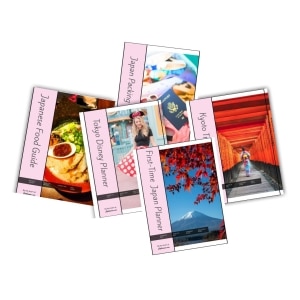
Our Japan trip planners can help. You might like our First-Timers Japan Planner, which will help you plan your trip to Tokyo, Kyoto and Osaka step-by-step, including tips on everything from picking hotels to sightseeing and dining. Or our super-duper Tokyo Disney Planner makes arranging your park trip MUCH easier. Find them in our Planners store – printable and digital versions are available.
Shrine 5: Fujiua Gohonjin Restaurant
Meet Hotei. I think he’s my favourite of the seven lucky gods, as he always looks like he’s having fun. Not surprising, really, as he’s the god of happiness, contentment, and good fortune.
Now, this is a bit of an unusual venue. As the name might give away, it’s not a shrine or temple. It’s an old hotel with a long history in Nagano.

The building that was initially here served the gentry travelling between their homes and Tokyo; it had a multi-storey design used on buildings from Europe, which was unusual in Japan at the time. It was redesigned in 1925 with numerous Art Deco touches. It’s no longer a hotel and instead houses an upscale restaurant.
The statue of Hotei is on the porch of the building, off to the right-hand side.
Again, you’ll stamp this one yourself.
Shrine 6: Nishinomiya Jinja
It’s time to head off the main road again and wander down some pretty backstreets. Here, you’ll find the home of Ebisu, the god of business success.
Ring the bell in the shrine office, and someone will stamp your sheet. You’ll see the image is of the traditional image of Ebisu carrying a fishing rod and a seabream. And next to the office is a statue in the same image.
Get out some cash; there’s a fun thing you can do here.

You might think that the statue of Ebisu is sitting above the image of a big fish because, traditionally, he was a fisherman – and that’s probably true, but the ‘fish tank’ has another purpose. It’s a money-washing shrine.
The theory is that you put your cash in one of the wooden baskets nearby and swish it around a bit while asking Ebisu to help you out, and then fish it out. Once it’s dried, spend it on your business or carry it with you as a talisman, and the cash will come back to you – in multiples.
I tried money washing in Hakone as one of the things to do outside of the infamous loop, but I’m still waiting for my payback.
Shrine 7: Seson-in Temple
The god here is Bishamonten, the god of war and victory.
This is one of the shrines surrounding the Zenko-ji complex, the main shrine most people visit when they come to Nagano.
This is probably the most ornate shrine on the walk as the top of the exterior is overlaid with gold leaf, and it has beautiful drawings and gold carvings – although, you’ll find tiny touches to admire at all of the shrines.

It’s also the only one where you must take your shoes off to go inside and collect the stamp, which you do at the main counter. If you have already collected all the other stamps, you can also have them add the final stamp in the middle of your sheet rather than going to the busier office at Zenko-ji.
And you’re done. You can now go and enjoy the rest of the things do to in Nagano. If you like doing things during your trip you might want to take a look at our guide to hands-on experiences in Nagano.
And, if you’re just planning your trip when you read this and trying to work out your itinerary, have a look at our guide to how long to stay in Nagano. There’s a lot to do here and in the nearby towns that means you might want a bit longer here than you thought.
Also, if you do like the idea of the spiritual side of Nagano, you can stay in some of the small temples around Zenkoji. Find out more in our guide on where to stay in Nagano.

