
- How to Use Buses in Nara - 11 March 2026
- 8 Tips for Travelling in Japan as a Larger Family or Group - 10 March 2026
- Top 10 Things to do in Nara - 6 March 2026
IC cards make using the metro, bus and local trains easy in Japan. You might see them referred to as Suica cards, although that’s just one of the brand names. If you live in a country with a similar transport system, you’ll probably understand roughly how they work, but they can still be confusing. So, let us explain…
The Basics
IC Cards are cards that you use on trains and buses to pay your fare. Suica is one brand name for these – but, like Hoover and vacuum cleaner, it’s often used to refer to IC cards in general.
In reality, each area has its own IC Card with a different name. Suica is run by JR East and is issued in Tokyo, but if your trip starts in Osaka or Kyoto, you’ll see ICOCA cards instead. Go to other areas, and you’ll see their own local IC card. The other big card in Tokyo is called Pasmo.

The good news is that the cards are interchangeable, so you can use a Suica in Kyoto or an ICOCA in Tokyo even though they aren’t issued there.
Because most people start their trip in Tokyo, Suica is the one most people are familiar with, and it’s also the one with a few different versions you need to know about, so that’s why we’re focusing on here.
There Are Four Types of Suica
Welcome Suica
This red and white card aims at tourists. It lasts for 28 days. It doesn’t cost anything upfront. Unspent credit disappears at the end of 28 days. These are available at the Tokyo airports and some stations in Tokyo.
If you do buy this, keep the piece of paper they give you with it. This is your proof as to how long the card should last (in case you have problems), also if you have bought both adult and children’s Welcome Suica, the only way to tell the difference (until you go through the turnstile and it makes a noise) is by matching up the numbers on the back of the card to the information on this bit of paper.
The Welcome Suica T&Cs say you must have this bit of paper when using the card.
Physical Suica Card
This is silver and green with a penguin on the front. It costs 500 yen when you first buy it, this is classed as a deposit, but, if you get one of these, don’t cash that in! There has been a shortage of the chips these need recently, and but the supply is back. If you do get a Physical Suica, it lasts for ages. It will only expire if you don’t use it for ten years. Once you do use it, the ten years start again.
Unspent money can be refunded on this card.

Digital Suica
This is the version you can add to your iPhone or Apple Watch; it doesn’t work on Android.
It’s very convenient, and the balance will carry over to your next trip. They do not expire – although you might need station staff to reactivate them after a long period of inactivity.
We have a separate guide on setting this up and filling it here. The most important thing to know is that you don’t use the Suica app to do this, just Apple Wallet.
It’s very difficult to refund unspent funds on this card without a Japanese bank account so don’t over fill it.
The Welcome Suica App
Launched in March 2025, the Welcome Suica app aims at tourists. Right now, I can’t see the point of it as it’s also currently only on IoS and has a validity of 180 days, so it’s not quite as flexible as using the current system in your wallet.
However, in 2026, the idea is that this will also allow you to buy JR East Shinkansen tickets via the app and tap on the train ticket free, which will be useful.
Which is Better?
My personal opinion – if you can use a digital Suica then it’s the most convenient. You can set it up and load it with cash at home, and it’s ready to go as soon as you get off the plane – no need to try to find the right counter or stand in a queue.
You can see if the balance is low and top it up there and then (handy if you’re using buses a lot) and, chances are you’ll be carrying your phone in your hand to follow directions as you leave the station so there’s less fumbling about in your bag than there might be at home.
The main downside is that you can’t use it if you have an Android phone. Everyone also has to have their own phone to use it – trying to pay for multiple people on one phone will hold up everyone behind you – and in Tokyo, that could be a LOT of people. Children’s fares are also not valid on it, so you’ll need to get cards for children anyway if you want to take advantage of these.
If you’re just in Japan for a short while and it’s a one-off trip, there’s nothing wrong with the Welcome Suica so long as you don’t overload it with money, as you won’t get anything you don’t spend back. If you think you might come back again, or are there for over 28 days, then try for a Physical Suica, as it will last longer, but check the locations below to see where this might be available.
Do You Really Need It?
It’s not essential; you can buy paper tickets, but it makes things quicker and easier because unlike, say, the London tube system or the Sydney transport system, Japan’s public transport is run by lots of different companies. This means your journey might start on a line run by one company, but if you change lines you might swap to a different company – and you’ll need a new ticket.
This makes buying tickets confusing as you’ll need one for each line and adds extra time when you swap lines as you must find the ticket machines and work out how much to pay. With Suica you just tap in and out of the gates, and it works it all out for you.

Can’t I Just Use My Own Card?
In many countries of the world now, you don’t need a transport card to use buses and trains; you can just tap on and off with a credit or debit card or your phone. This is coming to Japan; it’s being trialled in some Kyushu, Osaka, and Tokyo stations, but it’s not yet commonplace, and you won’t get everywhere trying to use it.
Where to Get a Welcome Suica
You can’t buy them at every station. Right now, they are available at…
Narita Airport: At the JR East Travel Service Centres in the stations at Terminals 1, 2 and 3. You’ll also find a Vending Machine selling them at the stations.
Haneda Airport: JR East Travel Centre at the station at Terminal 3. There is also a Vending Machine selling them here. Note – if you’re flying ANA internationally, you might land at Terminal 2.
In Tokyo: JR East Travel Centres at Tokyo Station, Shinagawa Station, Shibuya Station, Shinjuku Station, Ueno Station, Ikebukero Station, Yokohama Station and Sendai Station. Google the station map to find the office location – especially at the bigger stations with many lines and exits. From personal experience, the office is very easy to find in Ueno as it’s on the main floor upstairs and clearly signposted.
Use the Asakusa entrance, and you’ll come in right near it. This map shows the exact location.
Where to Get a Physical Suica
This is still a bit of a situation in flux. The problems with the chips that stopped the sale of Suica in 2024 have now been resolved, and all warnings on the English version of the Suica site seem to have been removed, so you should, therefore, be able to pick them up at the station locations above – and, hopefully at other stations as well. You haven’t been able to buy them at the airport recently, but that might have changed.

If you really want a physical Suica, I advise paying your fare from the airport with cash. Go to one of the station locations above and ask – but don’t stress if you have to get a Welcome Suica instead.
What About Children?
If your child is under six, they don’t need a Suica card to travel. They go free.
Children over six and under 12 can use either a child’s Welcome Suica or a child’s Physical Suica.
If you are visiting Japan, the easiest option is to get your children to get a child’s Welcome Suica from one of the locations above.
If you would prefer a child’s Physical Suica, you’ll need to go to the JR ticket offices marked Midori no Madoguchi with their passport, and the staff will help you with the paperwork.
If you already have children’s cards, but your child turns 12, you will have to swap the card to an Adult Suica. Exactly how this happens, I can’t find any official information on – some say it does it automatically as the card is linked to your birthdate, others say you need to swap it at the ticket office. My advice would be to go and ask as using a child’s card when overage is one thing that will get you a fine in Japan.
Adding Money to the Cards
You can top up all three types of Suica at any station. Just find a machine with the IC symbol on it. However, there is a fun quirk – you can only top them up with cash, not a credit card. So, make sure you have some notes.
You can also top up cards and phones at machines marked with the IC symbol in convenience stores like 7-11 or Family Mart. Again, you need cash.
Topping up a digital Suica can also be done on the move or in your hotel so long as the Japanese rail system is open at the time.
How Much Should You Add to a Suica?
You can put up to 20,000 yen on a Suica. Whether you should is another matter.
As with anything to do with budgets how much to add is very much ‘how long is a piece of string.’ I rarely use my Suica for things other than trains and the occasional coin locker, so I usually start with 5000 yen, which, if you’re just using it for local transport, is enough for around 20 short journeys on the bus or metro.
Once I reach a balance of about 1500 yen, I’ll top up with another 5000. As the end of my trip gets nearer, I’ll reduce the top-up amount and try to run it down.
If you want to use your Suica to pay for things outside of trains, you might want to add some more – but remember, on a Welcome Suica you can’t get any unspent money returned.
Need Extra Planning Help?
Our Japan trip planners can help. You might like our First-Timers Japan Planner, which will help you plan your trip to Tokyo, Kyoto and Osaka step-by-step, including tips on everything from picking hotels to sightseeing and dining. Or our super-duper Tokyo Disney Planner makes arranging your park trip MUCH easier. Find them in our Planners store – printable and digital versions are available.
What Happens if You Lose It
While Japanese residents can link their Suica to their name, for most tourists, a Welcome Suica and a Physical Suica are not linked to your name or passport, so they’re like cash. If you lose them, they’re gone. This is another reason not to add too much money at a time.
One of my FB group members said they kept theirs on a lanyard to make it harder to lose.
Can You Have a Digital Card and a Physical One?
Not using the same funds, no.
Can I Use a Friend’s Suica?
If your friend has been to Japan before, they might have a Physical Suica, so is it okay if they lend it to you? This depends on whether the card is linked to their name or not.
If they have registered the Suica card against their name, then it is not transferable to anyone else. If they have an unregistered Suica though, then you can lend it to them.
But note that you can’t both use the card on the same individual train/bus trip.
Is It Just For Transport?
You can also use your Suica card to pay for things in some shops and via vending machines. If you don’t want to carry cash in Japan, it’s a good, happy compromise as some shops might not take credit cards but will take a loaded Suica (or other IC Card).
Here’s where to find a list of restaurant chains, shops, hotels and more where you can definitely pay with a Suica card. But you can also look for the green Suica logo – it’s a bit small in the picture below, but you’ll see a green-pill-shaped logo underneath the card panel with the pink light.
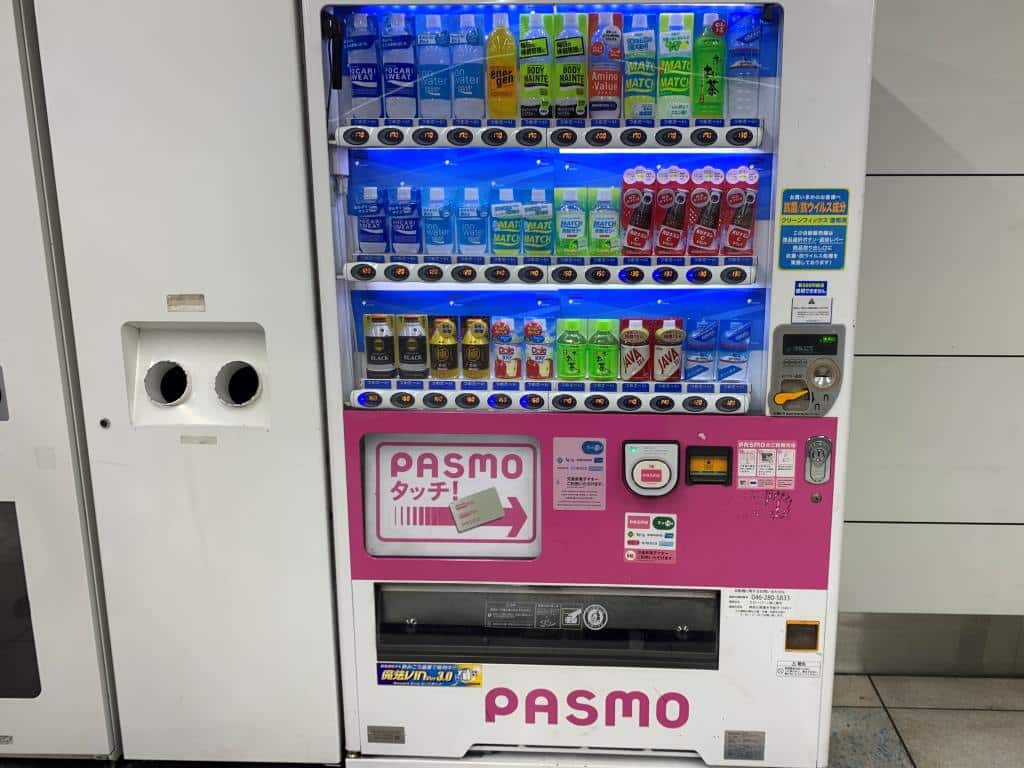
However, as we learned when Mr Japlanease tried to travel cashfree on his last trip, not everywhere takes cards of any kind. Even he was at the ATM by day two so, always have a couple of thousand yen to hand.
Can You Use Suica on the Bullet Train?
Not exactly. You can’t just tap in and out of the bullet train gates and pay your fare from your Suica Card funds like you do with the subway or local trains.
Instead, you have to buy a ticket online via Ekinet or Smart Ex (check our guide to buying Shinkansen tickets here), but you can then link that ticket to your IC card and use the card to tap on and off rather than carrying a paper ticket or using the QR code.
To do this, you must register your IC card with the service from which you buy your Shinkansen ticket and link the two together. This is easy with both a Physical Suica and a Welcome Suica, as they have the card number printed on them. You’ll find it on the black strip on the back of the card. It starts with JE. If you have a Welcome Suica, it’s also on the paper record they give you when you buy it.
Finding Your Card Number on a Digital Suica
If you are using a Digital Suica, this is a bit more complicated as you can’t see your full card number to register it – only the last four numbers. So here’s what to do…
Add the Suica card to your wallet – the instructions are here if you haven’t read them already.
Download the Suica App – even though you don’t use this to install the card on your phone, you need it now.
This is all in Japanese, but once you open it it will recognise the Suica in your phone and bring up a picture like this.

Click the little i in a circle next to your balance, and the full card number will appear on the next screen. It begins with a JE – and it should end with the last four numbers that you see in your Apple Wallet.
Register that on whatever service you’re using to buy your ticket.
For the pedantic among you, I know there is another system called Tap and Go Shinkansen, but it also requires the Suica app, which is all in Japanese, so let’s keep things simple and stick with Ekinet or Smartex!
If all of the above baffles you, don’t panic. You don’t have to link your Suica to use the train. I don’t, as it just seems like an extra complicated step, and I never entirely trust myself not to lose battery, internet, or my phone and end up stranded.
So, even though I’ve fully converted to using a Digital Suica, I still pick up all my paper tickets at the machine at the beginning of my trip and carry the one I need each day – and if all of the above freaks you out, so can you.
Is Suica Valid Everywhere?
In Tokyo, Kyoto, Osaka, Nara, Nagoya, Hiroshima, and most other places international tourists visit on their first trip, yes.
However, I was surprised to discover that Suica is not valid in Nagano, Toyama, and Matsumoto. If you’re traveling around Central Japan, make sure you have some cash or a credit card for longer journeys.
Again, none of this is a big deal if you always have a little bit of cash on you to buy tickets if Suica doesn’t work. There are usually signs saying ‘IC Card Not Accepted’ or you’ll see the IC logo or Suica logo with a big cross through it on services where you can’t use it.
Common Suica Problems
The IC Card system is very efficient, but there are a couple of issues you might come across…
My Card Suddenly Won’t Work at the Gate
Sometimes, you’ll try to enter a station, and your Suica won’t work – even though you know it has money on it.
The most common reason for this is that you didn’t tap out properly at the last station.
The most likely place for this to happen is when you swap from the subway to the Shinkansen. You walk out of the subway tunnel and see a gate marked Shinkansen. You put your bullet train ticket in, and the gates open so you go through – but, at that point, you haven’t actually left the station with your Suica card. This will block it from being used. It might also happen if you tap in and out at the same set of gates.
To unblock it, you’ll need to see a staff member – but it has to be done at a station run by the train company that blocked your card, which, if you haven’t realised it has happened, might not be the same as the one you’re trying to enter.

An unfinished journey is easy to see on the Digital Suica. If you see you started a journey, but then there hasn’t been a charge from the last station you left you’re still ‘in transit’. Go to another station run by the same company, and they should be able to help.
It’s a bit trickier with a Physical Suica or Welcome Suica, as you’re guessing this is why it’s broken – but a staff member will be able to tell you for sure.
The correct way to transit from the subway straight through the Shinkansen gate is to tap off with your Suica and then put your Shinkansen ticket in the gate.
I Tapped On, Then Had to Buy Another Ticket Too – Why?
Some trains in Japan operate on a two-ticket system. You buy your base fare, which you pay when you tap through the gates, but you might also have to pay a supplement.
This can apply to trains called Limited Express, Express and some premium cars on standard services. It’s also the case for sightseeing trains like the Aoiniyoshi, which have all reserved seats.
If you are asked to pay a supplement by the conductor or ticket staff as you try to leave the station, you were likely on one of these trains. Don’t worry; you won’t get fined like you might in other countries.

My Digital Card Has Stopped Accepting Payments
This is a trickier one as, as far as I’m aware, no one quite knows exactly why this happens or whether it’s the fault of Suica or the credit card company.
The first thing to ensure is that you’re not trying to fill it before or after the trains start running, as you can only top up a Suica when the train system is operating.
If not, the option to top up is to go to the station or 7-11 and use cash to top up the phone on the machine as per the picture above. It does counteract the convenience of the thing, but it’s the only solution I’m aware of.
Save Money with Klook & Japlanease
If you plan on buying tickets or tours from Klook for when you’re in Japan, you could save up to 10 per cent by using the code JAPLANEASEKLOOK at the checkout. Click here to see what’s on offer.
T&Cs apply. Some items, including Tokyo Disney and USJ tickets, are not available for discounts.
Where Can You Use Up Your Balance
As I said, it’s best to drip-feed your Suica so you’re not left with a big balance at the end of your trip, but if you do arrive at the airport with some money left, the bad news is you can’t use it duty-free, but you can use it to buy drinks and some last-minute snacks at the convenience stores.

