- Do You Need to Book Shinkansen Tickets in Advance - 1 March 2026
- How to Get to Katsuo-ji, Osaka – And What To Do When You Arrive - 27 February 2026
- How to Get From Hakone to Kawaguchiko - 26 February 2026
Most people who visit Miyajima Island near Hiroshima visit for the day, but is it worth staying overnight on the island? Here’s our opinion and how to decide if it’s the best option for you.
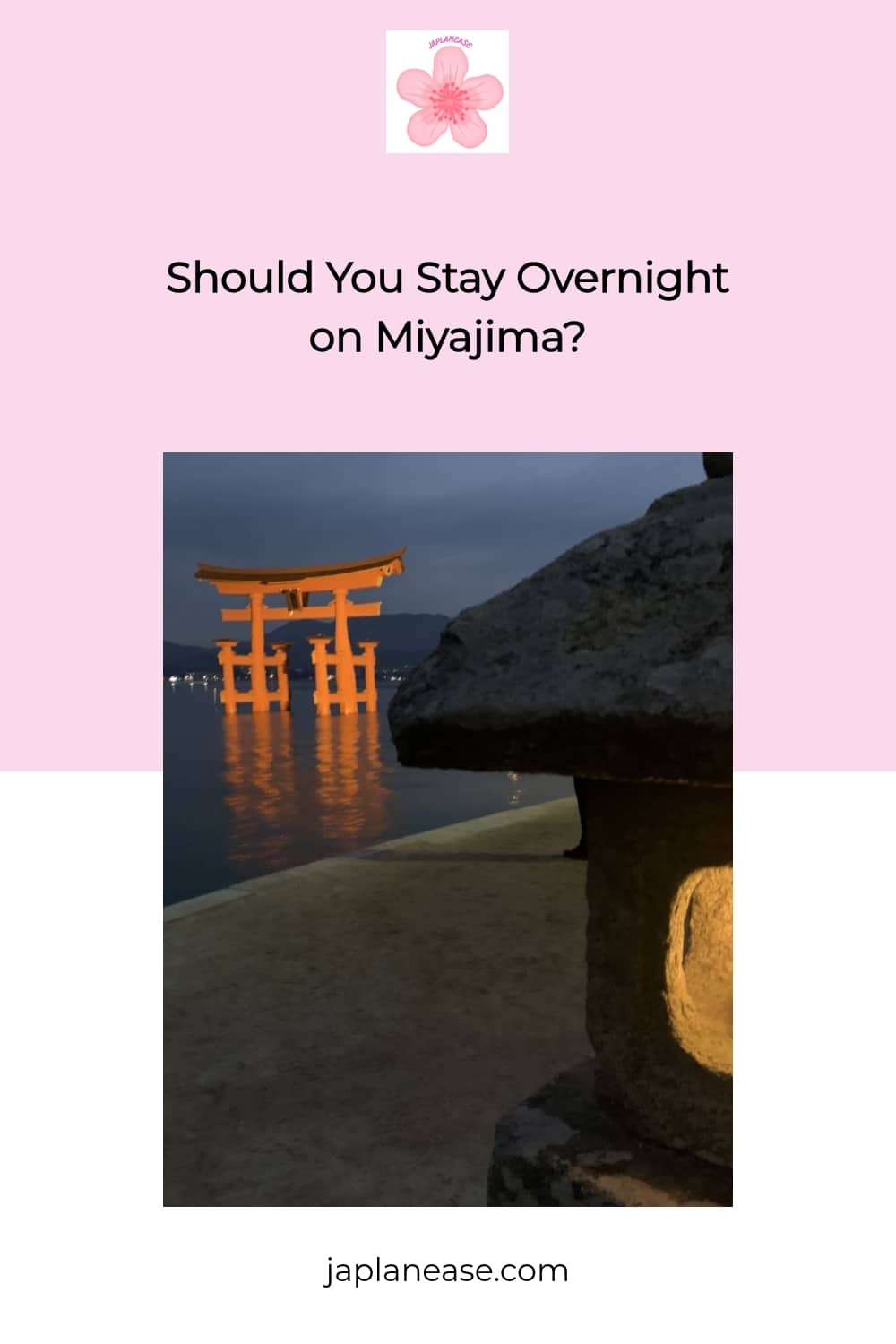
At 6 AM on Miyajima Island, my only companion was a deer stretching awake in the morning sun. Twelve hours earlier, I’d watched the famous floating torii gate glow red against black water with just two other people beside me. Most visitors to this small island near Hiroshima come for the day, but staying overnight revealed a completely different Miyajima.

Article by Helen Foster. Disclosure: Some links in this post are affiliate links. See our Affiliate Disclosure.
People say Japan is over-crowded. And during the day, when Miyajima teams with tour groups, school outings and day trippers, you might agree with them, but at night, you virtually have the place to itself – and that alone would be enough for me to decide that staying in Miyajima overnight was worth it – but it wasn’t the only reason I was happy with my choice.
Staying overnight also gave me time to explore the island properly. While the floating gate and shrine are the big draws here, the island is full of interesting sights (our top 10 are here) – the impressive (and fun) Daishoin shrine alone took me two hours to explore (see why in our guide on what not to miss at Daishoin). I was also blown away by the open-air shrine Hokoku-ji – and enjoyed having the time to sit on the giant wooden deck here and relax, watching the view.
Not having to rush back to Hiroshima also meant I could visit Itsukushima shrine after 5 pm, a time when there was no queue on the pier for the famous photo with the lantern and the torii gate in the background – and I even got time to fit in the quirky sights like the life-extending Jizo and the giant rice scoop.

The next morning, I got up early, had my meeting with the photogenic deer, wandered the backstreets of the island watching it wake up, and then got to the ropeway that climbs to the summit of Mount Misen well before the queues to get on started to climb up the stairs.
My hotel, Sakuraya, was simple, but it had a small public bath, and by staying overnight, I had time to enjoy it. And I had the place to myself. If you had one of the balcony rooms in the hotel, soaking in the lovely warm bath and then sitting on this watching the sunset over the water with a glass of Miyajima beer would be the perfect end to the day.
I ended up having a late lunch on the island, so I decided not to dine out that evening, and the local Family Mart provided all I needed. But if you did want to eat out, there is a handful of restaurants open – and the team at Sakuraya gave me a full list.

The other reason I chose not to dine out was that I was travelling solo, and the island is quite dark at night. I wasn’t worried about people, but I was a bit concerned about the deer! I didn’t want to encounter a grumpy one on my own in the dark.
I didn’t know how noisy deer could be until I spent the night on Miyajima. I’d heard them making cute chirping noises in Nara and during the day as I walked around the island, but at night, they make very different noises – shrieking noises. It’s like having ghouls! Well, at least I hope it was the deer anyway! If not, that island is seriously haunted!
My overnight stay on Miyajima convinced me it was worthwhile to work this into your itinerary, but your decision depends on what you’re seeking from your visit. Here’s how to decide if staying overnight makes sense for your trip.
Do You Want to See as Much as Possible?
There’s a lot to do on Miyajima, and while you can do it in a long day, staying overnight lets you explore at a relaxed pace and navigate to visit the popular spots first thing when most people are making their way to the island or last thing when many of the day trippers have left.

Wandering around the island once people have left is also quite special – even though I only spent about an hour wandering around once it got dark, getting up early and walking the backstreets with no one else around was so peaceful and a stark contrast to how the same streets would look in just a couple of hours. I loved finding the deer sitting on people’s porches or hiding around corners – and I wasn’t as wary of them in daylight.
Do You Want to Relax?
Many of the hotels on Miyajima have an onsen or sento bath, and with the island winding down as night falls, you have the perfect opportunity to sit and soak away the day. The peaceful surroundings lend themselves to just sitting and relaxing rather than rushing out to do things for the evening – especially if you’re staying in one of the hotels that offer a kaiseki meal in your room or their hotel restaurant.
Are You Just Coming to See the Floating Shrine?
Then, so long as you time your visit to work with the high tide during the day, you probably don’t have to spend the night on the island – but make sure you check the tide timings for your visit to make sure you don’t miss it.
Do You Want a Raging Nightlife?
There isn’t much open on Miyajima at night – a handful of restaurants, and a lot of them close by 8.30 pm. If you want a big choice of bars and restaurants, visit Miyajima by day and stay in Hiroshima instead.
Related Read: Check out the Hiroshima bar area I loved in our guide to the top 10 things to do in Hiroshima.
Are You Into Photography?
Not only does staying overnight decrease the chance of getting crowds in your photo, it also allows you to see the island with different backdrops – sunsets here can be spectacular if you’re lucky. Even on a typical day, the difference between night and day at the floating torii is stunning.
Are You on A Budget?
There aren’t as many hotels on Miyajima as there are in Hiroshima, and so, you might find your choices are more limited if you choose to stay overnight – especially if you’re travelling during a busy season.
If price is important to you, book early – the cheaper hotels like Sakuraya or Kikunoya all sell out fast.
How Much Does It Cost to Stay on Miyajimaa
There is accommodation for all budgets. Typing in a random date in October for two people sees the cheapest room costing AU$121 at the homestay, Full House Miyajima, and the most expensive costing AU$1600 at the exceptionally rated luxury ryokan Bettei Fujiya.
Check the map below to find more live rates for your dates.
When Are You Visiting?
As I mentioned, I was somewhat hesitant to venture far from my hotel in Miyajima at night, being alone as it is so quiet.
I was there in October, so it got dark by 6 pm. I was happy wandering around at first, but as more and more shops closed up, and more and more people disappeared, I became less sure about heading out for dinner. I was there on a Sunday, so even more restaurants than normal were closed. I would have had to head right into the backstreets to find somewhere – and after hearing the deer shrieks, I decided to stay put!

It was probably an unfounded concern, and had I not had such a big lunch, I’d probably have got over my worries – but, if you are travelling solo, you might want to consider this if traveling at a time when it gets dark relatively early.
Even then, it doesn’t mean you shouldn’t stay overnight; just maybe book a hotel with a restaurant, dine early before everyone disappears – or, as I did, enjoy a late lunch of delicious Miyajima oysters served fried and with curry rice so that you only need an egg sandwich and a beer when dinner rolls around!
Four Fabulous Hotels To Consider on Miyajima
So, if you do decide to stay on Miyajima, where should you sleep? Here are four excellent accommodation options, each offering something different depending on your budget, the level of luxury you require, and how many people you’re traveling with.

Sakuraya
This was my choice. It’s simple, but it punches above its weight for its price – their economy Japanese-style rooms are often the most affordable accommodation on the island. It has a Wonderful 9.0 rating on booking.com from over 3800 reviews!
The rooms have their own toilet and a small sink, but the bathroom is shared – and by this they mean you use the public bath or the showers in this area. When I went there about 7 pm, I was the only person in it. My futon bed was incredibly comfortable. The downside of the room is its traditional low seating, which I find too uncomfortable for extended periods, so I ended up spending a lot of time on the futon. For one night, though, it was fantastic – and it’s perfect for solo travelers or couples.
My room didn’t have a balcony, and while the window had a view of the sea, I had to stand up to look at it. If you’d like a sea view, spring for one of the rooms with balconies at the front of the building as these have gorgeous views. Sakuraya does sell out, so book as soon as you can.

Smoking Policy: Non-Smoking Hotel
Accessibility: There are steps to climb to get into the building, so it might not be the best option.
Kinsuikan
With a Wonderful – 9.1 rating on Booking.com from over 250 reviews, this mid-priced traditional hotel offers rooms that can accommodate up to four guests on futon beds, so it’s a good choice for families. It also has comfortable accommodations for two.
Many of the rooms have sea views, and others offer equally pretty views over the mountains. If you book one of these, you won’t be denied your chance to gaze at the water, the rooftop has chairs to allow you to sit and take in the sea view. It also offers a public bath and the chance to book a private onsen. You can choose a plan that includes dinner and/or breakfast.

Smoking policy: It’s a non-smoking hotel
Accessibility: The upper floors are accessible by elevator
Itsukushima Iroha
Has a Wonderful – 9.4 rating on booking.com from over 300 reviews. This five-star property, with a mid to high price point, is located just a five-minute walk from Itsukushima Shrine. It’s newly renovated, reopening in March 2024 after three months of work, which saw new, larger bathrooms added to many rooms. The rooms mix Japanese and Western design for ultimate comfort.
Rooms are large – starting at 40 square metres – and many have sea views. You can also see the floating torii from the rooftop public bath. The property offers the option to have a kaiseki dinner and has both Japanese and Western breakfasts.
One thing to note is that only children aged over 13 can stay here. It’s probably a better choice for couples or solos.

Smoking Policy: It’s a non-smoking hotel
Accessibility: There is an elevator, and some of the rooms have wheelchair accessible bathrooms.
Miyajima Grand Arimoto
One of the larger hotels on Miyajima, and the highest price of these four, this boasts a Wonderful 9.2 rating from over 1400 reviews. Rooms have Japanese touches but offer the option for Western beds if sleeping on a futon doesn’t appeal, and have a good seating area. Some of the rooms have private open-air baths on the balcony – and some of these have a view of the floating shrine.
While it’s perfect for couples, they do have rooms that can sleep four.
Note that people with tattoos cannot use the public bath in this hotel – you might want to know about the onsen chain that has just changed their rules to accept tattoos though.
There is a restaurant on the property, but you are also located right in the middle of Miyajima, a short walk from Itsukushima shrine, so there are also eateries on your doorstep.

Smoking Policy: Non-smoking
Accessibility: The upper floors can be accessed by elevator.
None of Those Quite Right?
Check live listings for your travel dates here.

Who Writes This Blog?
My name is Helen Foster, and I’m a journalist and author. My travel articles have appeared in publications including The Australian, Escape, RAC Horizons, Jetstar Magazine, Sainsbury’s Magazine, and more.
I’ve traveled to Japan eight times before – solo and with my partner and visited over 25 towns and cities. My last visit was November 2024 so, everything here is pretty up to date.