- How to Use Buses in Nara - 11 March 2026
- 8 Tips for Travelling in Japan as a Larger Family or Group - 10 March 2026
- Top 10 Things to do in Nara - 6 March 2026
The Tokyo Train map is enough to make even those used to the London Underground’s head spin – and, if you’re not from somewhere with good public transport, it’s probably blowing your mind. But, don’t panic, here’s everything you need to know about using the trains in Tokyo explained quickly, easily and simply so you won’t get lost – or stressed!
The Types of Trains in Tokyo
Tokyo uses four different types of trains to get you around the city.
You can use the underground trains of the Tokyo Metro, which has nine lines as part of its network.
You can catch the Toei Lines, which are often also underground lines, but owned by another company. There are four of these.

Article by Helen Foster. Disclosure: Some links in this post are affiliate links. See our Affiliate Disclosure.
They also have normal train lines, which can be run by Japan Railways or other companies. These include the Narita Express and Kesei Skyliner, which bring you in from Narita Airport, the Yamanote Line, which runs all the way around Tokyo, and the Keiyo Line, which goes out to Tokyo Disney Resort. You’d also use these train lines to go to places outside Tokyo, like Nikko, Hakone, or Mount Fuji.
Lastly, there are some monorail lines, notably from the airport and around the Odaiba area.
If you spend a few days in Tokyo, you’ll likely use a mix of these.
Note: You don’t use the bullet train inside Tokyo, that’s only for long-distance journeys.
Step 1. Work Out Your Route
We have the technology! Rather than attempting to decipher the Tokyo train map to determine whether you need a metro, a train, or the monorail, just enter your starting point and end point into Google Maps, and it will tell you everything you need to know to make your journey simple.
And by that I mean… It will tell you
- What station to get on at
- What entrance to enter that station (important as these can be a long way away from the platforms at some stations)
- What line you need
- What platform to head toward
- What time the train is coming
- What carriage to stand in to be closest to the exit point
- Where to get off
- What exit to leave the station to be closest to it.
That’s everything you need to navigate the Tokyo trains like a pro. I’ve been to Tokyo six times, and I can read the train map without issue, but even for me, Google Maps is still a game-changer because of the extra info it provides.
Related Read: How to get online in Japan so you can use maps easily.
Understanding the Tokyo Metro Map
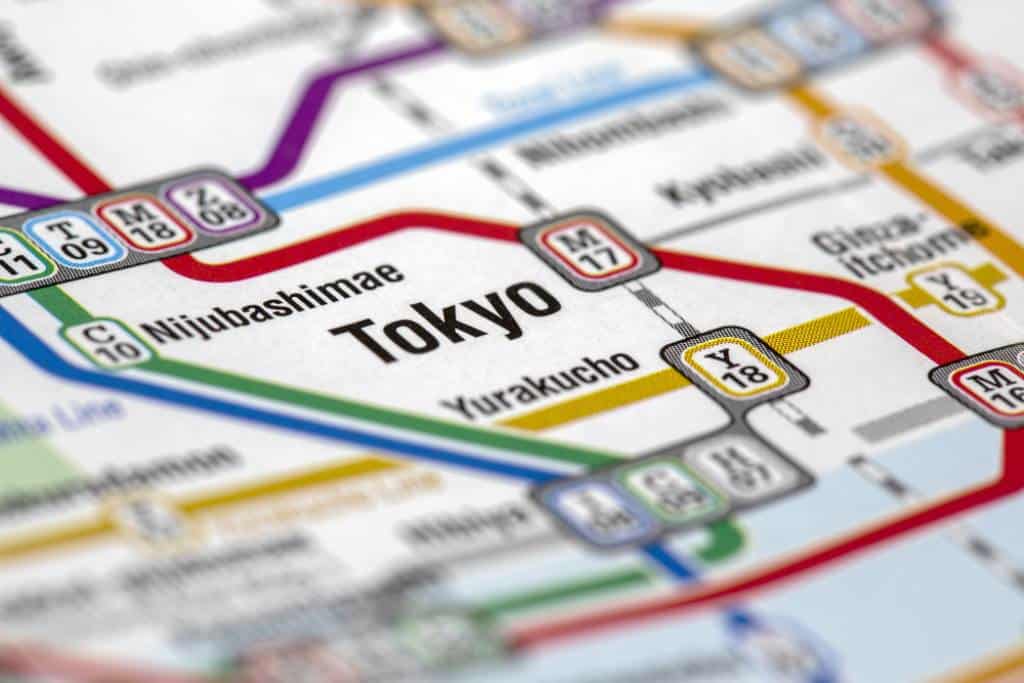
Even though Google Maps will do most work for you, it’s good to at least understand the Tokyo Metro map.
Each line on this is a different colour, and for the metro, Toei, and Yamanote lines, every station also has a different number and a letter corresponding to the line name. Ginza Station, for example, is on three different subway lines, so you’ll see it marked as M16 on the red Maranouchi Line, H08 on the silver Hibiya Line, and G09 on the orange Ginza Line.
Knowing the line colours and numbers of your stations is how you navigate around the stations.
The new Tokyo Metro For Tourists app includes a copy of the Subway Map. It’s also a good backup in case Google Maps fails. It’s available from the App Store and on Google Play.
Step 2: Buy Your Ticket
Every station has ticket machines with buttons to switch the language to English. You can buy tickets at these with cash if you want to. But, there’s another easier option.
An IC Card – or, you’ll often see it referred to as a Suica in Tokyo, as that’s one of the leading brands. You load your IC Card with money and then tap it at the entry gates, and tap out at the other end – and it just automatically deducts the fares for you. It’s far easier than buying tickets.
Related Read: This guide to using Suica cards explains everything in more detail, including where to buy them.

How Much Do Journeys Cost?
It varies by distance, but to give you a clue, here are some fares between Shinjuku Station and some common tourist spots.
Shinjuku to Shibuya Station – 170 yen
Shinjuku to Akihabara Station – 180 yen
Shinjuku to Asakusa Station (for Senso-ji) – 260 yen
Shinjunku to Kamiyacho Station (for teamLab Borderless) – 210 yen
Shinjuku to Maihama (for Tokyo Disney Resort) – 410 yen
Exact fares can vary depending on the route used.
Need Extra Planning Help?
Our Japan trip planners can help. You might like our First-Timers Japan Planner, which will help you plan your trip to Tokyo, Kyoto and Osaka step-by-step, including tips on everything from picking hotels to sightseeing and dining. Or our super-duper Tokyo Disney Planner makes arranging your park trip MUCH easier. Find them in our Planners store – printable and digital versions are available.
Are There Passes That Will Save Me Money?
There is a pass called the Tokyo Subway Pass, which you can buy for 24, 48, or 72 hours. It costs between 800 yen and 1500 yen for adults (half price for children).
It can be worth buying if your day’s journeys are only on the Tokyo Metro or the Toei Lines (which are both included on it) and you’re going to be taking 3-5 single journeys a day. The longer you use the pass, the more cost-effective it becomes. It does not include other train lines or the monorail.
Related Read: Find more details on the Tokyo Subway Pass and how it works.
Step 3: Find Your Platform
Google Maps will tell you the platform number, but sometimes, you still need to do a little bit of navigation. Most Tokyo train stations are very well labelled. To get around, you need to remember a couple of things.
First, note the name or letter of the line you need to take, and the colour it is marked on the map. Then, follow the signs leading you to that colour/name.
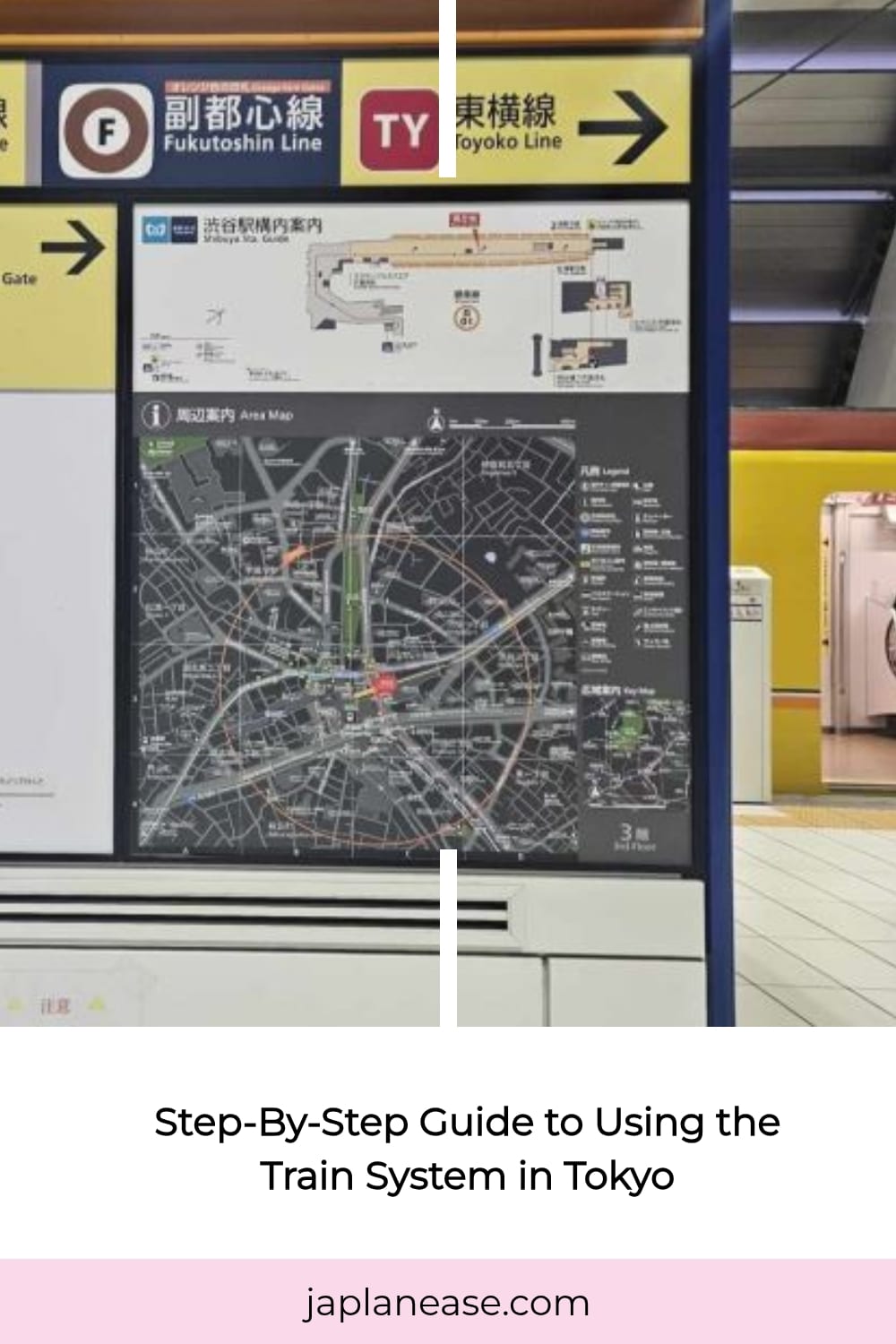
For example, the orange circle with the G in the centre in the picture below would lead you to the Ginza line platforms. If you wanted the JR lines, you’d follow the green square with JR in the middle, and if you needed the Inokashira Line, you’d follow the white and blue circle.

This doesn’t always work in huge stations like Tokyo or Shinjuku, where they might not show all the lines in every area. In these cases, you might need staff to point you in the right direction, but for most stations with just one or two lines, you’ll find navigating things really easy if you remember the colour and the letter of the line you need.
Most staff will speak some basic English, but if you do get stuck, ask ‘Ginza Line (or whichever line you’re trying to find) doko desu ka? – and they’ll hopefully point you in the right direction.
Related Read: Eight essential phrases that will save you in Japan.
Step 4: Get on the Right Train
The essential thing to know here is your train’s final destination, shown in the Google Maps directions. That’s it, ringed in yellow.
When you get to your platform, it’s likely to have two sides—one might go north, the other south (or east and west). To make sure you get on the right one, find the side labelled with that final destination.

Or, if you’re lucky, you’ll find a sign like the one below on the far platform wall. It shows you what direction the train is going in and what the next station is. You can then make sure it’s going the right way by checking the map or the list of stops on Google Maps.

An Important Note When Using Actual Train Lines
If your journey includes one of the actual train lines, rather than the Metro or Toei Lines, these can sometimes be a little more complex, as two services might use the same platform, or the line might include Express services that miss some stops.
To reduce the risk of this, check the on-platform sign. Make sure the next train arriving at that platform is leaving exactly the same time as the one Google Maps is telling you to get on. If there’s an electronic sign, it will also list the train’s stops in English, so you can also use that as a safety net.
Platform Navigation Step By Step
- Know What Line You Need – Check its colour and letter on the map.
- Follow the Colour – Look for signs up above or sometimes, lines on the floor
- Check the Direction – Look for the train’s final destination on the platform signs to make sure you’re on the right side.
- Verify the Train – Match the departure time with Google Maps and/or the platform signs.
- Board Quickly – Doors close in 30 seconds
- Take the Right Exit to Leave.
Step 5: Get Off at the Right Stop
One of people’s biggest worries is getting on a train in Tokyo and not knowing when to get off. That’s not going to happen. There’s a lot more English used in Tokyo than you might think, especially on transport.
You’ll usually get at least one spoken announcement in English, and the sign above the door will also tell you what the next stop is in English.

This sign can even show the next eight stops on some trains, so you can see exactly where you are and what’s coming next. The numbers underneath the station name indicate how many minutes it will take to get there. If you look up and it’s all in kanji like the one above, don’t worry – the English one will flash up soon.
If your train doesn’t have one of these, though, look out the window or poke your head out of the door, and you will see a sign on the platform. The name will always be in English as well as Japanese.
If you’re worried that you might get the name wrong, the easiest thing to do is to use the station number. As I mentioned, every station on the metro, and many other lines, has a number on the line – so Shibuya is G01 on the Ginza Line, and F16 on the Fukutoshin line above, for example.
Remember that number and you will get off at the right stop.
What Does Remain on Board Mean
There’s a fun little quirk about Tokyo train lines – they can change name and colour halfway along. The best example of this is going to or from Haneda Airport. Give it a try now. On Google Maps, enter the journey from Haneda Terminal 3 to Asakusa – a very popular area for tourists to stay.
You’ll see you start your journey on the turquoise blue Keikyu Airport Line, but at Sengakuji, you seemingly swap to the salmony-coloured Asakusa Line – but next to it is an instruction that says ‘remain on board.’ This is because the only thing that changes on that journey is the name of the line.
If you ever see a line change colour like that, with the instructions ‘stay on train’ or ‘remain on board,’ do exactly as it tells you. It’s just the line changing, not you.
Step 6: Changing Lines
Okay, you’ve got on train one and have to change to another line halfway—what now? It’s super easy—you just use the line colours again. Just follow the signs leading to your colour line.

If you used Google Maps to its full advantage and went into the closest carriage to your exit, you’ll be somewhere near this. If not, don’t stress; look around the platform and eventually you’ll spot the relevant sign over an exit, or you’ll see a sign like the one above with exit and interchange details.
If the train is busy, take a step back and wait by the wall for the crowds to clear so you can collect your thoughts, spot the sign, and head the right way.
Save Money with Klook & Japlanease
If you plan on buying tickets or tours from Klook for when you’re in Japan, you could save up to 10 per cent by using the code JAPLANEASEKLOOK at the checkout. Click here to see what’s on offer.
T&Cs apply. Some items, including Tokyo Disney and USJ tickets, are not available for discounts.
Step 7: Exit the Station
When you get to the station for your destination, check with Google Maps which exit you need to leave the station at. Sometimes, this won’t really matter, but other times, if you get this wrong, you’ll get super lost, so it’s a good idea to aim for it.
The bright yellow signs are the exit signs. Look around until you spot the one you need.

Depending on how big the station you’re in is, they might say things like North Exit or South Exit, or they might be numbered, or use letters, or both!
For example, if you’re going to teamLab Borderless, you want to come out of Exit 2 at Kamiyacho Station. To get to the famous Omoide Yokocho drinking area in Shinjuku, you’ll want to leave Shinjuku Station at Exit D1.
Again, everything will be clearly signposted. If you are in a big station that uses letters and numbers, like Shinjuku, first head toward Exit D. When you reach the D exit area, each numbered exit will lead off from this and be marked.
And that’s it – you’ve done it. Now repeat it for your next journey. Before you rush off to use the trains like a pro though, there’s a few final things to remember…
Train Etiquette to Be Aware Of
As you may already know, Japan is a pretty rule-based society, and following the rules is one of the reasons why it’s so nice to travel there. So, here are a few things to try and remember when using the local trains in Tokyo so you can fit in with the locals.
Don’t eat or drink on them.
Don’t speak loudly on your phone or play music on it. And if you’re chatting with each other, keep your voices down.
Put backpacks on your front so you don’t bash people. Even better, store them on the overhead rack.
If you’re traveling with bigger luggage, try not to block the doors.
Avoid rush hours if you can. These are roughly 7.00 am – 9.00 am and 5.30 pm – 7.30 pm. Definitely try not to travel with larger cases during rush hour.

Check for Women Only carriages: If you are travelling during rush hour, you might look down on the platform and see a sign that says ‘Women Only.’ This means that the carriage that’s going to pull up there is women only – if you’re male, or travelling with men in your party, check the hours written on this. If you’re within those, move a bit further down the platform.
Related Read: Why are there women-only carriages? Check out our guide to some dangers to be aware of in Japan to find out.
And that’s it, our guide to getting around Tokyo on the trains. Trust me, once you arrive, it’s a LOT easier than you think it’s going to be.

Who Writes This Blog?
My name is Helen Foster, and I’m a journalist and author. My travel articles have appeared in publications including The Australian, Escape, RAC Horizons, Jetstar Magazine, Sainsbury’s Magazine, and more.
I’ve traveled to Japan eight times before – solo and with my partner and visited over 25 towns and cities. My last visit was November 2024 so, everything here is pretty up to date.