
- How to Watch the Oiran Parade at Edo Wonderland, Nikko - 15 October 2026
- 8 Mistakes Not to Make in Autumn Leaf Season in Japan - 10 October 2026
- How to Spend One Day in Nara - 29 September 2026
Master essential phrases like ‘please’, ‘thank you’ and ‘excuse me’ and add in a couple of simple questions, and you’ll both delight the Japanese you meet and help your trip go a bit more smoothly. Here’s what to master.
I have been learning Japanese for years. I still cannot hold a proper conversation. It’s an incredibly complex language, and just when you think you’ve got the hang of it, your teacher will say something like ‘but in Japan we don’t actually use those words’ – and you have to learn something completely different!
For that reason, IMHO, anyone who says you should ‘learn to speak Japanese before your trip’ has either never tried to learn Japanese – or is a language savant.

Article by Helen Foster. Disclosure: Some links in this post are affiliate links. See our Affiliate Disclosure.
But that doesn’t mean you can’t master the basics. Most Japanese people don’t expect tourists to speak any Japanese at all, so, if you try, no matter how badly you will a) make them very happy b) unlock the secret English speaking skills that the Japanese person may have but be too shy to try out until you made a fool of yourself speaking Japanese first!
So, what phrases should you try to master? Here are the basics…
1. Hello – こんにちは
Phonetic: kon-nee-chee-wah
Meaning: Hello / Good afternoon
“こんにちは” (konnichiwa) is a friendly and polite greeting used during the day. While it technically means “good afternoon,” it’s commonly used as a general “hello.” Use it when entering shops, meeting someone, or just being polite in public spaces.

Kick Things Up a Notch
If you want to move up to expert level, Japanese has different words for ‘hello’ that are used at other times of the day. Try remembering…
Ohayou gozaimasu – おはようございます
Phonetic: oh-hi-yo-go-zi-mas Meaning: Good morning
Konbanwa – こんばんは
Phonetic: kon-ban-wa Meaning: Good Evening
2. Thank you – ありがとう// ありがとうございます
Phonetic: ah-ree-gah-toh / ah-ree-gah-toh go-zai-mass
Meaning: Thank you / Thank you very much
“ありがとう” (arigatou) is a casual “thank you,” while “ありがとうございます” (arigatou gozaimasu) is more polite. Remembering either version will be appreciated.

Kick Things Up a Notch
While you can use ‘arigatou’ when leaving a restaurant, there’s another phrase that explicitly means ‘thank you for the meal’ – it’s gochisousama deshita (ごちそうさまでした). Throw this out to sound like an expert.
Phonetic: go-chee-so-sama- desh-ta
Oh, and if during the meal you want to say how nice it is, use the word oishi – o-ee-shi – which means delicious.
3. Excuse me / I’m sorry – すみません
Phonetic: soo-mee-mah-sen
Meaning: Excuse me / I’m sorry
Have you seen the TV show, James May: Our Man in Japan? In it, he meets the person who writes the cute tunes that play on the Tokyo metro at each station – and they write him his own tune – the words to which are ‘James May, Sumimasen’ – as he says it’s the word he uses most in Japan.
And it will probably be yours too.

You can use it to get someone’s attention, say excuse me in a crowd, to apologise if you bump into someone, and you’ll repeat it endlessly trying to get off a Kyoto bus!
Related Read: Not using ‘sumimasen’ is one of the biggest mistakes you can make in a restaurant in Japan. Sometimes the staff won’t come over until you call, so you may wait for a while if you don’t use it. Get a list of other mistakes to avoid while dining here.
4. Please – くだ さい
Phonetic: ku-da-si
Meaning: Please
Politeness goes a long way in Japan, so remembering to say please is very important. Just add the word kudasai at the end of your sentence, and you’ll do okay.
Take Things Up a Notch
There is another word for ‘please’ in Japanese, ‘onegaishimasu’ – phonetically on-e-gai-shee-mas. This is more formal and polite, but a little bit harder to say, although it rolls off the tongue nicely when you’ve got the hang of it. On-e-gai-shee-mas.
Which you should use when has nuances I still haven’t completely grasped, but a good rule of thumb is.

Use kudasai when asking for someone to give you a thing, especially somewhere not too formal, like ordering a beer in a bar (biiru o kudasai).
Use ‘onegaishimasu’ if you’re making a request for a service, such as asking a taxi driver to take you somewhere, or if you’re asking for something in a more formal setting, like a nice restaurant. It’s also good if you’re talking to someone older or more important, like the police, or the man at customs!
As a guest in Japan, I tend to err on the side of onegaishimasu just to be polite – that’s probably wrong, but I’d rather be overly polite than too casual.
Related Read: If you’re going to be asking for things, you might want to know what some of the words are for those items, and a lot of them might be easier than you think. Here’s our guide to 100 Japanese words you might already know.
5. Do You Speak English? – 英語を話せますか?
Phonetic: ehh-go oh hah-nah-seh-mass kah?
Meaning: Do you speak English?
“英語を話せますか?” (Eigo o hanasemasu ka?) is a polite way to ask if someone speaks English. While some people might say “a little,” it often means they’re being modest. Just asking this phrase in Japanese is often enough to unlock those secret English skills.
Oh, and every week my Japanese teacher spends five minutes trying to teach me the longer, more accurate way to say this. Every week, I fail miserably to remember it all. Just go with the above!
Need Extra Planning Help?
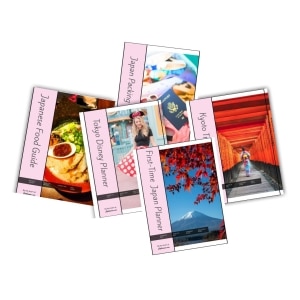
Our Japan trip planners can help. You might like our First-Timers Japan Planner, which will help you plan your trip to Tokyo, Kyoto and Osaka step-by-step, including tips on everything from picking hotels to sightseeing and dining. Or our super-duper Tokyo Disney Planner makes arranging your park trip MUCH easier. Find them in our Planners store – printable and digital versions are available.
6. Where is The Toilet? – トイレはどこですか?
Phonetic: toh-ee-reh wah doh-koh dess kah?
Meaning: Where is the toilet?
Yes, “toilet” in Japanese is literally toire — borrowed from English! “トイレはどこですか?” (Toire wa doko desu ka?) is an essential question, especially when you’re out exploring for the day. Most public places in Japan have clean, free toilets, and knowing this phrase will save you a lot of guesswork.

Kick Things up a Notch
Doko desu ka? (phonetically: doh-koh-dess-ka – means where is ….. Using it allows you to create all sorts of sentences.
Learn the words for things like station (e-ki), bus stop (busu su-top-po), police station (ko-ban), convenience store (kon-bi-ni) – or, add a destination like Shibuya Crossing or Fushimi Inari Taisha in front of the phrase. Ie: Sumimasen, Shibuya Crossing doko desu ka?
Hopefully, you’re very nearby and the person you ask can just point you in the right direction. Often, though, they will actually walk you there. That’s happened to me more than once.
7. How Much Is It? – いくらですか?
Phonetic: ee-koo-rah dess kah?
Meaning: How much is it?
If you’re shopping or browsing markets, “いくらですか?” (ikura desu ka?) is a useful way to ask the price. While most places in Japan have clearly marked pricing, it’s still handy to know, especially if you’re buying in a market or getting train tickets at the window.
Often, the person behind the counter will type the numbers into a calculator or the till to show you the answer.

Kick Things Up a Notch
At the end of a meal, using ikura desuka? will get the message across, but if you’d prefer to ask for the bill – and it’s not already on your table, use okaikei onegaishimasu. Phonetically – o-kai-kei-o-ne-gai-shi-mas.
If our articles or Facebook advice have helped make planning your trip easier, you can Buy Me Coffee (or, more likely, some ramen, a Sapporo or an egg sandwich) by making a small donation at our Buy Me a Coffee page.
8. What is This? – これは何ですか
Phonetic: Ko-re-wa-nan-des-kah?
If you’re in a shop and aren’t sure what something is, or, in a restaurant, and someone else’s food looks so good you want to order it too, you could gesture to it and ask kore wa nan desu ka? and hopefully your server will point it out on the menu so you can try it.

Kick Things Up A Notch
Technically, you only use kore for an item right in front of you. If you’re pointing at something nearer the person you are asking, you use sore (phonetically – so-re), or, if it’s a bit out in the distance from both of you, use are (phonetically – a-re) instead.
Using any of the sentences above will go down really well with the Japanese people you meet on our trip. No, some of them aren’t perfect, so apologies to native speakers reading this, but they’ll still be gratefully received.
Some of my best moments in Japan have been where I’ve tried to speak my (very bad) Japanese, at which point, the person either turns out to speak fluent English, or you both muddle through with pigeon versions of each other’s language, some actions and a lot of smiling.
Our best experience of both came when we visited one of Japan’s standing bars in the Ueno district. Fumbling through our bar order in poor Japanese got us the attention of the man next to us, who spoke perfect English. Attempting to order the specialty of the house on his recommendation (a beef stew), got Mr Japlanease a round of applause from the whole bar. So, definitely give things a go.
Great Language Books for Tourists
If you want to master more than the phrases above, two books that might help you are
15-Minute Japanese: Learn in Just 12 Weeks. Covers all the basics in just 15 minutes of learning a day. Find it on Amazon.
Japanese for Travelers: Phrasebook and Dictionary. This covers hundreds of useful phrases for all tourist situations like checking into hotels, buying train tickets etc. It also includes some helpful travel advice. Find it on Amazon.
がんばって! (Ganbatte!) – good luck!
Who Writes This Blog?
My name is Helen Foster, and I’m a journalist and author. My travel articles have appeared in publications including The Australian, Escape, RAC Horizons, Jetstar Magazine, Sainsbury’s Magazine, and more.
I’ve travelled to Japan nine times before – solo and with my partner and visited over 50 towns and cities. My last visit was in April 2026, so everything here is pretty up to date.

