- How to Spend One Day in Nara - 29 September 2026
- 12 Things That Seem Easy – Until You Try Them in Japan - 23 September 2026
- Is it Worth Paying Extra at Tofuku-Ji? - 16 September 2026
If you’re thinking about staying in a traditionally styled Japanese room on your trip, it’s important to make sure it’s the right type of room for you. Here are 11 things to consider before you book.
I’ve stayed in a lot of traditional Japanese-style rooms in Japan – and some of them I have liked more than others. So, I’ve now created a tick list of things to consider when booking into this style of room in the future – and here’s what I think you need to consider before you book one.

Article by Helen Foster. Disclosure: Some links in this post are affiliate links. See our Affiliate Disclosure.
What Makes a Japanese Hotel Room Different?
While every hotel will have its unique take on a traditional room, there are a few things that Japanese-style rooms are likely to have in common.
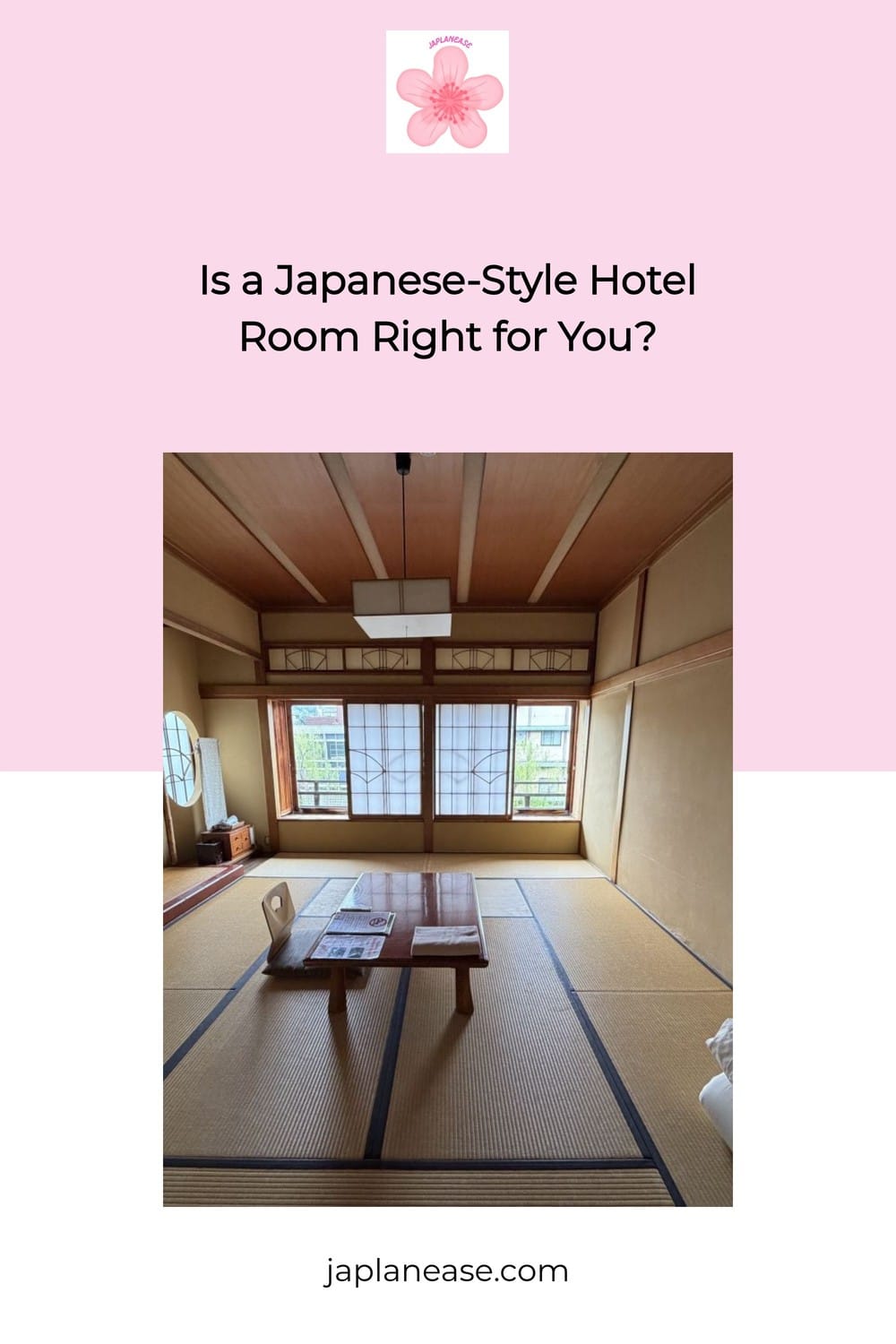
Instead of carpet or wooden floors, many rooms feature tatami mat flooring made from woven rush grass, which has a soft texture and distinctive fresh scent. Guests are expected to remove their shoes before stepping onto the tatami, and slippers are often provided for walking around other parts of the hotel.

Huge riverfront room at the super popular K’s House in Ito. Check rates on Booking.com here.
Rather than raised beds, traditional rooms usually contain futons that are laid out on the floor at night and stored away during the day to create more living space.
Furniture is often minimal, with low tables and floor cushions instead of chairs and sofas.
Sliding paper screens called shoji may separate different areas of the room, or cover the windows, and allow soft natural light inside.
Bathrooms can also feel different, with deep soaking tubs designed for relaxation rather than quick showers. Or, in older style properties, there may be no bathroom in your room at all but a communal onsen or a public bath on another floor.
This makes for an atmospheric stay, but it can also mean a few things that you need to get used to compared to staying in a normal hotel. So, before you rush off and book in for a traditional experience, consider the following.
1. How Mobile Are You?
This is the most obvious thing you need to consider regarding sleeping in a traditional Japanese-style hotel room. Futons are placed on the floor and only about 2-3 inches thick; this means to get in and out of them, you need to be able to lower yourself toward the floor.
When I was travelling to Japan before I had a hip replacement, I still stayed on a few futons – including the one below. I’d use the wall to help me down, and then flip onto my knees to get myself up!

Simple room at Kawaguchiko Station Hotel – Mount Fuji is right behind that window. Check rates here.
2. Do You Need a Soft Bed?
Futons can be extremely comfortable; I have had a better night’s sleep in some futons than in traditional Western beds, but because they are placed directly on the floor, they can feel hard if the mattress is a bit thin or worn – and however you cut it, they tend to be on the firmer side.
If you need a super soft bed, they might not be the most comfortable for you. If you arrive and find a thin base, ask your hotel if they can double the base of your futon to create a bit more padding.
3. How Many of You Are There?
This is actually a huge benefit of Japanese-style rooms for larger families.
Futons take up very little space, and they can be folded away when you’re not using them – what this means is, you can fit more people into a room with futons than with traditional beds.
The room pictured above that I had at K’s House can sleep up to five.
For larger families, picking a room with futons can be a way of finding one room big enough to fit you all.
Related Read: Tips for Travelling in Japan as a Larger Family

4. Do You Read in Bed?
This is the thing that drives me most mad about sleeping on a futon. There is no headboard, so you can’t prop yourself up to read – usually, this means I need to drag mine around the room to position it so my head can prop against something.
However, what I have also found is that in some Japanese-style rooms, their minimalist look means they don’t have a bedside lamp – so, once you’re in bed, all snuggled up and comfy and just about ready to fall asleep, you then have to hoik yourself up to turn off the main room light.
You can use your phone torch, but that can be a bit difficult to angle – and, as you’ll see later, the socket might not be in the best position to reach the bed.
Bibliophiles beware!

Perfect seating layout at the simple, but comfy, seafront Shimoda Kaihin hotel in Shimoda. Find rates here
5. Do You Spend a Lot of Time in the Room?
If your hotel room is traditionally Japanese, not only might you not have a bed to lounge on, you also may not have a comfy chair or sofa. Traditionally, Japanese chairs are low to the ground. These are more comfy than they look, but they take a bit of getting used to, and they aren’t great for a relaxing night in the room.
Some hotels marry Japanese sleeping arrangements and Western seating arrangements by having a main room covered with a traditional tatami mat that’s used as your sleeping area – and then have some armchairs, a sofa, or a small table and chairs elsewhere in the room. This is now the room layout I look for if I know I’m going to be relaxing in the room in the evening.
Also watch out if you like to take an afternoon nap. In a more traditional ryokan, someone will come in and lay out your futon before bed, and put it away while you’re out during the day – which means no handy bed when you come back at 3 pm for a snooze! Thankfully, futons are pretty easy to assemble – just make sure you’ve worked out where they put it when they take it away!
6. Are You Sensitive to Noise or Light?
As I mentioned in my description of a Japanese hotel room above, a very traditional room will not have doors and curtains; it will have screens on the windows, between the vestibule and the bedroom – and sometimes even as the main door to the room.
Screens are beautiful, but they are not fully lightproof or particularly soundproof. So, if you are a light sleeper, make sure you bring earplugs and/or an eye mask so you aren’t disturbed.

Loved this mixed set-up at the Mount View Hotel in Hakone – the bed was also super comfy. Rates here.
7. Do You Get Up Very Early or Very Late?
This isn’t so much about the room per se, but the type of building it is in. Older Japanese buildings tend to have gorgeous wooden floors in their communal areas – and gorgeous, old, wooden floors creak. This is fine during daylight hours, but not so great if you wake up in the middle of the night and need to go out to the communal bathroom or have to leave the hotel to catch an early train, and everyone else in the building is fast asleep.
I enjoyed staying at K’s House in Ito, but I literally tiptoed around for three days, as I am usually up at 5 am to work on this website’s Facebook group, and I need tea to do this – and the kitchen was at the other end of the floor to my room. I also wanted to shower and use the private onsen (which were open 24 hours) before heading out at 8 am. To do these things, I had to get out of a clanky screen door with a loud lock and tiptoe down a creaky corridor. I did it, and no one yelled at me, so I hope I did it quietly, but it didn’t make it the most relaxing stay.
It was at that point that this post was born.
Need Extra Planning Help?
Our Japan trip planners can help. You might like our First-Timers Japan Planner, which will help you plan your trip to Tokyo, Kyoto and Osaka step-by-step, including tips on everything from picking hotels to sightseeing and dining. Or our super-duper Tokyo Disney Planner makes arranging your park trip MUCH easier. Find them in our Planners store – printable and digital versions are available.
8. Do You Need Your Own Bathroom?
Talking of communal bathrooms and onsen, often hotels with more traditional rooms will have an onsen, or shared public bath, on the premises.
Depending on the size of the hotel, or your room type, this might mean your hotel doesn’t have its own shower or bath in your room as it’s expected that you will want to use the onsen – and shower there.
Some rooms will have their own toilet and sink, while others will also ask you to use a shared toilet.
I usually pick rooms with their own toilet at least. The exception was the Kawaguchiko Station Hotel, but for the price and the view of Mount Fuji right outside my window, I could handle that for one night.
Make sure you know which arrangement will suit you best and pick the room accordingly.
Related Read: Don’t Make Mistakes Naked! Read our Guide to Onsen Etiquette.

Traditional seating at the Yumoto Kankyo Hotel Saikyo in the onsen town of Nagato. Check rates here.
9. Are You Okay With Stairs?
Again, this is more about the property itself than the room per se, but older Japanese hotels may not have lifts – or, might have lifts to some floors but not others.
If you have heavier luggage, make sure you know what the situation is – particularly, as some traditional hotels won’t just ask you to take your shoes off in your room; they will ask you to leave them in a shoe room by the front door. Trying to navigate cases, up and down wooden stairs in just socks isn’t necessarily for everyone!

It looks sparse, but I had the best night’s sleep on this futon at Sakuraya in Miyajima. Check rates here.
10. Do You Want to Watch Television?
Check they have one. Some don’t. Partly to preserve the traditional image of the room, partly to prevent noise carrying around the hotel if they do have screen doors.
11. Do You Carry a Lot of Gadgets?
I was discussing this post with Alyse, who runs the blog The Invisible Tourist, when we were out the other evening. She stays in a lot of small, more traditional hotels, and this was something she brought up, and I’ve also found it to be true.
If your pretty Japanese room also comes in an older Japanese building, it definitely won’t have USB ports, and possibly will only have one or two plug sockets.
If you’re carrying a phone, a powerbank and portable wifi – or, like me, also a tablet and a laptop, juggling charging everything with one socket can be tricky. That one socket might also not be near the bed.
It’s not the end of the world, but it is something to be aware of; you might want to bring a multiport USB plug adaptor so that you’re covered.
This post may make it sound like I don’t like Japanese-style-rooms. Far from it. I’ve had amazing sleeps on futons, I love having an onsen in the hotel, the prices I’ve paid for more basic traditional rooms with Mount Fuji views have been well worth putting up with some of the minor inconveniences I’ve mentioned here, but, the more rooms I stay in, the more I’m learning what makes my stay more or less comfortable – and, if I’m there for a few nights, that matters. And it might matter to you too.

Who Writes This Blog?
My name is Helen Foster, and I’m a journalist and author. My travel articles have appeared in publications including The Australian, Escape, RAC Horizons, Jetstar Magazine, Sainsbury’s Magazine, and more.
I’ve travelled to Japan nine times before – solo and with my partner and visited over 50 towns and cities. My last visit was in April 2026, so everything here is pretty up to date.