
- How to Spend One Day in Nara - 29 September 2026
- 12 Things That Seem Easy – Until You Try Them in Japan - 23 September 2026
- Is it Worth Paying Extra at Tofuku-Ji? - 16 September 2026
About 25 minutes outside of Tokyo be a world of monsters. Specifically, the monsters of the much-loved Japanese manga GeGeGe no Kitaro. And if that name makes you happy, here’s what you need to know to visit them.
Okay, some of you reading this may already know what GeGeGe no Kitaro is, but if not, then here’s the brief synopsis.
It’s a manga story that tells the story of Kitaro, a one-eyed part-human, part-yokai boy.
Despite his youthful appearance, Kitaro is over 350 years old, the last member of the Ghost Tribe, and the series follows his encounters with yokai – monsters from Japanese mythology – and other ghosts and monsters from around the world.

Article by Helen Foster. Disclosure: Some links in this post are affiliate links. See our Affiliate Disclosure.
His sidekicks include the remains of his deceased father (who appears as an eyeball) and Nezumi Otoko, his 360-year-old rat-like friend with a pointy head (who doesn’t bathe) and my personal favourite, Nurikabe, who is described as a sentient wall – and looks a bit like a walking sponge!
The cartoon’s illustrator, Shigeru Mizuki, lived in the Chofu area for much of his adult life, and the town has embraced this wholeheartedly with statues, manhole covers, play parks and more to be found.
Here’s a simple walking tour to take in the sights.
Start at Chofu Station
This is on the Keio Line, which is easily reached from Shinjuku Station in about 25 minutes.
At the station, head out of the Hiroba Exit and head directly west toward Kitaro Park.

The road doesn’t have its name marked on Google Maps, but it’s the one travelling due west of the station exit with the Aeon Cinema complex on the southern side and Pinto Thai restaurant on the northern side.
You’ll know you’re in the right place when you start seeing black-and-white drawings from the series on panels located on the railings that line the side of the road.
Find The Green Statues
Keep walking down here, and you will come to a statue of Mizuki, drawing at his desk.

If you didn’t realise it until this point, Mizuki only had one arm. He lost it during the war when the hospital where he was recovering from malaria was bombed.
His love of yokai came from his childhood in Sakaiminato, Tottori (where you’ll also find a road dedicated to his work), where he was told stories about local monster legends by his old nanny/housemaid.
From this point you’ll find small green statues of all the main characters from the GeGeGe series lining the left-hand side of the road.

There are more than the ones pictured here!
If you’re here during cherry blossom season, this road is also lined with flowering trees.
Reach Kitaro Park
The road leads you down toward Kitaro Park, a play park which is full of kid-sized statues of the characters. These are made to be played with, climbed on and cuddled.
The day I was there, at least two school trips were in the park (which is why I don’t have photos of all the statues, as I didn’t want to photograph close to the kids).

I really wanted a picture of the eyeball which is in the treehouse with the slide, but that seemed to be a favourite play spot, and no-one was letting me near it!
Once you’ve taken all the pictures you need, you can head back toward the station for the next stop – more statues!
Watch for Manhole Covers
But on the way, keep your eye on the ground.
As you may know, Japan is famous for its coloured manhole covers and not surprisingly, some of the ones in Chofu are themed around GeGeGe no Kitaro.

Their locations are on this map, but I didn’t see a couple of them where they were supposed to be. I’m not sure if that was my error, the map being slightly out, or, if they’ve had to move a couple.
The one above is close to the pedestrian crossing by the Apple Gym on Kyu Koshu Kaido Dori, though. This is just before you reach our next stop – Tenjin Dori.
Head up Tenjin Dori
Tenjin Dori, the road that leads up to Fuda Tenjin Sha shrine in the town, is also lined with statues of the GeGeGe characters- this time, colourful ones sitting on top of utility boxes.

The street itself is very quaint and lined with lots of restaurants if you’re feeling hungry.
About halfway up the street on the right is Kitaro Chaya, a gift shop jam-packed with GeGeGe merchandise – and even themed snacks.
Get a Fortune at Fuda Tenjin Shrine
From here, walk up to the shrine. The character Kitaro lived in the forest behind this shrine in the series, and it features in the manga series.
You can buy GeGeGe Kitaro-themed fortunes at the shop – and, I have seen the goushuin of the shrine with the characters on them – although, they didn’t seem to have these the day I was there.

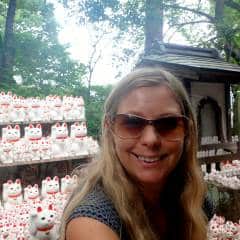
I didn’t buy a Kitaro fortune – because I got distracted by some other tiny plastic food-shaped fortunes. Each food shape had a different meaning – I got a strawberry, which apparently is very lucky.
The shrine has some other interesting points. The zelkova tree at the front is over 500 years old, and the oxen statues represent one of Japan’s legends.

The shrine reveres the scholar and poet Sugawara no Michizane. He was born in the year of the Ox and loved oxen, and it’s said that during his funeral, the oxen drawing his coffin lay down and refused to move.
Sugawara no Michizane also loved cherry blossoms, which is why the trees are planted at the shrine.
On the 25th of each month, dance performances happen on the shrine’s performance stage.
Pay Your Respects at Kakushoji Shrine
This is the one place I didn’t get to on my visit. This is where Mizuko is buried, and his grave features a statue of Kitaro and carvings of his most famous characters.
It took me about two hours to explore the sights on this list, so it’s a nice half-day outing from Tokyo to a sight with very few other obvious tourists. You can also wander the shopping streets and restaurants around town as well.
Or, carry on walking 20-minutes north and you’ll reach at Jindai-ji, a temple area with a very different feel (and a lot of soba restaurants) – and if you want to know more about that, then you need to check out our Jindai-ji Guide.
Who Writes This Blog?
My name is Helen Foster, and I’m a journalist and author. My travel articles have appeared in publications including The Australian, Escape, RAC Horizons, Jetstar Magazine, Sainsbury’s Magazine, and more.
I’ve travelled to Japan nine times before – solo and with my partner and visited over 50 towns and cities. My last visit was in April 2026, so everything here is pretty up to date.

