- How to Watch the Oiran Parade at Edo Wonderland, Nikko - 15 October 2026
- 8 Mistakes Not to Make in Autumn Leaf Season in Japan - 10 October 2026
- How to Spend One Day in Nara - 29 September 2026
Visiting the city of Hiroshima and the island of Miyajima is a really popular day trip from Osaka or Kyoto, but what should you do during your visit? Our guide to spending one day in Hiroshima and Miyajima can help you decide.
If you are going to visit the main sights of Hiroshima and the island of Miyajima on the same day, you’ll need to get up early and split your day into two halves. I’ll discuss how to decide which comes first and transport in a minute, but first, let’s explore what you might want to do in each half of the day.
If you have a whole day to visit Miyajima, have a look at our one-day Miyajima plan instead, as it contains some extra things to do.

Article by Helen Foster. Disclosure: Some links in this post are affiliate links. See our Affiliate Disclosure.
1. The Sights Around the Peace Museum
As I’m sure you’re aware, the fate of Hiroshima irrevocably changed on August 6th 1945, when the bomber Enola Gay dropped an atomic bomb on the city. One half of this day trip covers some of the sites associated with this. It will take 2-3 hours to see the most popular of these – there are more outside of this area if you have more time.
Related Read: Our guide to the atomic bomb sights in Hiroshima
The Genbaku Atomic Bomb Dome
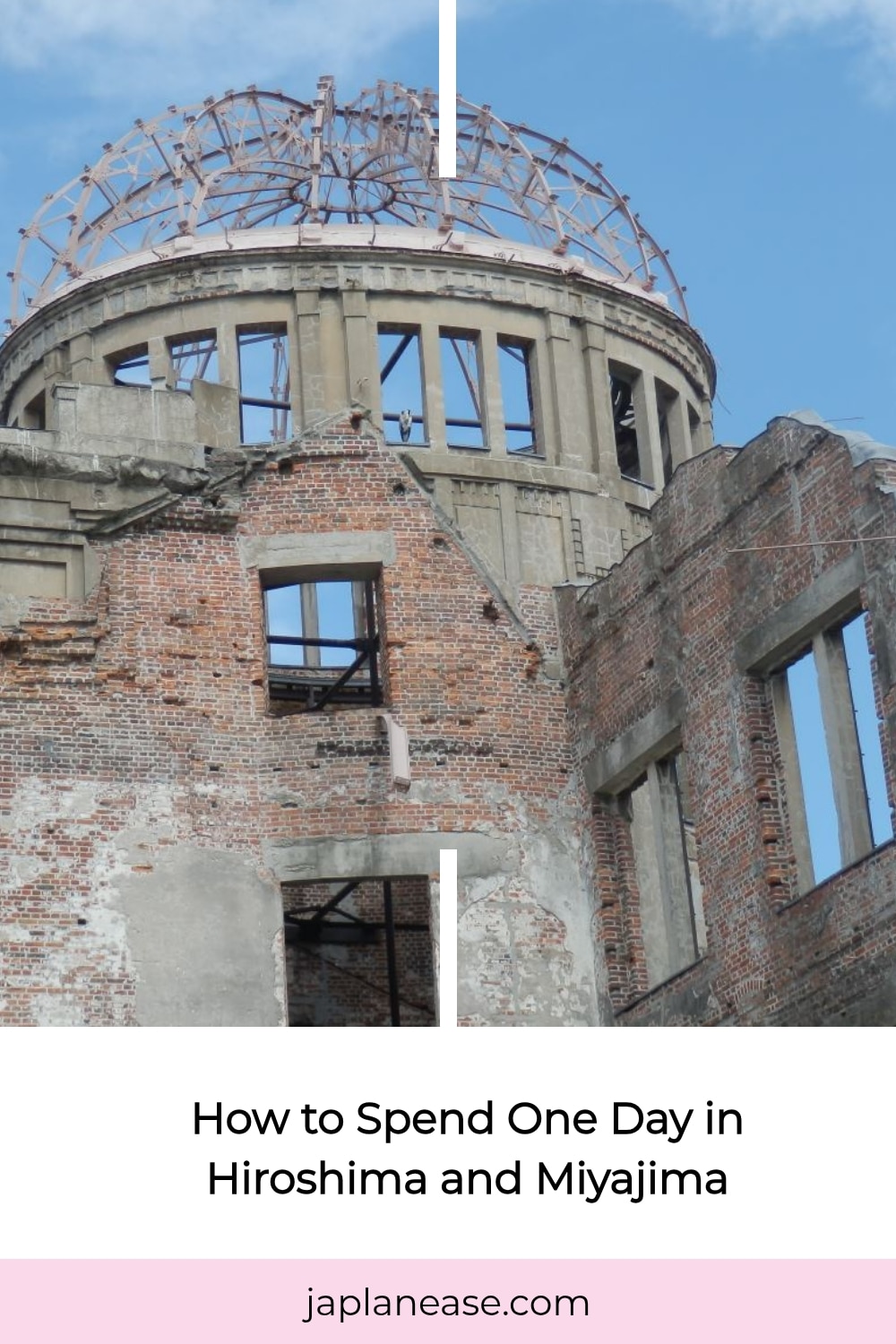
The hypocentre of the blast was above the Shima Surgical Clinic, about 240 metres east of the river, and it obliterated many of the surrounding buildings. One exception was the Hiroshima Prefectural Industrial Promotion Hall, a domed building designed by Czech architect Jan Letzel, the shell of which is left as a symbol of the day that scarred the city.
You can’t go inside the dome, but you can still see the twisted metal and impact of the blast on the remains.

The Peace Memorial Museum
Full of pictures, personal belongings, and stories, this museum humanises the impact of the bombing. It’s very sombre. I first visited in 2012, then again in 2024, and the way the museum is designed now is far more melancholic than I remembered from my first visit. When I was there, the whole place was silent- no one spoke at all. That’s not a criticism, it’s so that you have an idea of what to expect.
It will take at least an hour to walk around the museum, longer if you want to read everything.
The Museum can get busy, and to try to control queue times, you can now buy tickets in advance. This doesn’t mean you have to book weeks ahead; I bought mine via a QR code standing outside the entrance. This actually links to Klook, so if you’d like to book ahead, you can purchase tickets here. The tickets are 200 yen for adults, 100 yen for children.
The only time you must book ahead is if you want to visit early in the morning (between 7:30 and 8:30 am) or during the last hour of the day, as access is limited during these times. The latter is more likely to be relevant to you on a day trip. If you’re planning on visiting in the afternoon, check the Visiting section of the museum’s website for the specific times when booking is essential for the month when you’re visiting as the museum’s closing time varies by season.
The Memorials of the Peace Park
The area between the dome and the museum is known as the Peace Park, and it contains numerous memorials to people hurt or killed that day. Time might be limited to see them all, but three to try and ensure you do visit are…
The Peace Flame
Take a moment to pay your respects at this monument, which represents outstretched hands. The flame on top was lit in August 1964 and will burn until all the nuclear weapons on Earth are abolished.

The Hiroshima National Peace Memorial Hall
This underground space is a place for quiet contemplation. The circular hall is lined with tiles, creating an image of a devastated Hiroshima city as it looked after the bomb hit. This is made from 144,000 tiles, the estimated number of people who were killed by the bomb.

A side room makes these tiles personal as it contains screens showing images and names of the identified victims. Depending on the day you are here, the Memorial Hall also offers readings of personal experiences from that day – if you want to delve into things this deeply, though, you might want to spend the whole day just in Hiroshima city, as time may get tight, or stay overnight to see Miyajima as well.
Even if you don’t go inside the hall, note the design of the roof of the building above – it’s shaped like a clock marked 8.15, the time that the bomb hit.
The Children’s Monument
This monument honours the children killed in the bombing or from illnesses caused by it that continued to appear for years.
The figure at the top of the statue is Sadako Sasaki, a 12-year-old girl who died of leukemia caused by radiation poisoning ten years after the bombing.
As well as appearing on the monument, Sadako-san is the reason you see so many paper cranes around Hiroshima.

In Japanese tradition, it’s said that if you make 1,000 origami paper cranes, your wish will be granted. Sadako-san’s wish upon completing her goal was that there would be no more nuclear weapons, and her wish lives on today. The boxes around the statue are filled with brightly coloured origami cranes and other displays for peace created by children throughout Japan.
There’s a lot more you can do in and around the Peace Park, especially if you have more time. However, if not, it’s time to talk about Miyajima.
2. Visiting Miyajima
The island of Miyajima is 45 minutes away from the Peace Park by direct ferry, or a little under an hour away by a combination of tram, train, and ferry. It’s therefore easy to add a few hours on Miyajima to your day trip in Hiroshima. Here’s what you might want to see…
Itsukushima Shrine and Torii Gate
The primary reason most people visit Miyajima is to see the floating torii gate associated with Itsukushima Shrine. This is best seen around high tide, so you’ll want to try to ensure you’re on the island close to this (more on that in a moment). You can view the torii gate from the shoreline or get direct views from inside the shrine.

The shrine is open from 6.30 am until at least 5 pm – the exact closing time varies by season. Check them here for the time of your visit.
But the floating torii and shrine aren’t the only things to do on Miyajima. Here are the other sites that fit well into a 3-4 hour visit on the island.
Try Miyajima Oysters
You’ll find these boiled, breaded or served with egg in many of the restaurants, or you can buy them freshly shucked from stalls along the waterfront walk.

I chose to have mine breaded with curry from a restaurant called Torrii close to the Itsukushima Shrine, and they were delicious. You’ll also find Anago (sea eel), another famous Miyajiman dish, served here. A platter containing both will cost around 2500 yen. My dish was a bargain at 1400 yen.
Visit Daishoin Temple
Built in 806 AD, this shrine complex is huge and, from the moment you step under its ornately carved gate, you’ll find a lot of different elements to keep you interested. Three highlights are …

Kaiden Meguri: A dark underground tunnel that claims to bring you enlightenment if you locate and touch the key hidden within.
Henjokutsu Cave: Inside here, you’ll find a host of statues, and in front of them, a glass panel on the floor containing sand. These statues and the sand represent the 88 shrines of the Shikoku pilgrimage, and it’s said that stepping on each of the panels of sand is equivalent to visiting all the shrines and completing the pilgrimage.

The Rakan: These are 500 carved figures with different faces. If you’ve read a few other posts on this site, you’ll know that these figures are something I love finding in Japan -you’ll also see them at Otagi Nenbutsu-ji in Kyoto and Choanji in Hakone. It’s fun to walk around and spot the different facial expressions and postures of the statues.
There are a lot more big and small details to see at Daishoin, so take your time – I’d allow an hour at least to wander around here, two if you’re trying to spot everything in our Daishoin guide.
Save Money with Klook & Japlanease
If you plan on buying tickets or tours from Klook for when you’re in Japan, you could save up to 10 per cent by using the code JAPLANEASEKLOOK at the checkout. Click here to see what’s on offer.
T&Cs apply. Some items, including Tokyo Disney and USJ tickets, are not available for discounts.
Head to Hokoku Jinja
This was the other place on Miyajima that left me in awe. This massive wooden structure overlooks the island.
It was commissioned by the samurai lord Toyotomi Hideyoshi as a place to pray for fallen soldiers, but he died before it was completed, and the next lord to take power didn’t complete it.
That’s why it’s so open – and so interesting.

The space is the size of 1000 tatami mats, which gives it its other name, Senjokaku Hall. The ceiling is lined with old paintings and artworks.
It’s nice to just sit on the deck and watch the island from above.
It’s open from 8.30 to 5.30 and costs 100 yen to get in. This is one area in Miyajima where you will need to remove your shoes. They give you a bag to carry them with you.
Meet The Deer
Like Nara, Miyajima has a herd of wild deer that make the island their home. They are a bit less ‘friendly’ than the Nara deer, as it’s not encouraged to feed them here, and you can’t buy deer cookies like you can in Nara.

They will, however, try to eat anything that looks like paper – so, keep things like maps, guidesheets out of sight. They’re still cute, though – and, if they decide to pose in the right places, they definitely add to your photographs!
Grab a Sweet Treat for the Way Home
Mamiji Manju is a Miyajima treat. They’re cakes filled with red bean paste, chocolate cream, custard and other yumminess, shaped like the maple leaves that turn Japan a stunning red in autumn.
You can buy them from shops on the island, but you’ll also find vending machines selling them dotted around the island, which is definitely an ‘only in Japan’ way to buy cakes.

There’s a lot more to do in Miyajima than that, (our guide to the top 10 sights is here) but if you only have half a day, the above should keep you busy. So, your next job is to work out how to schedule your day.
Scheduling Your Hiroshima Day Trip
Once you’ve divided the day into two halves and got a rough plan on how to spend them, the next decision is which to see first. There are a couple of things that you might want to consider here.
The Tide Times
To see the famous floating torii gate on Miyajima, erm, floating, you need to visit around high tide, which means you need to know what that is and ensure you’re on Miyajima for it, or at least one hour either side.
The tides also affect the Aqua-net ferry that travels directly between Miyajima and the Peace Park; this won’t run if the tide in the river is too high. They will announce this on the ferry website, so make sure you check the times when planning your day, so you don’t get caught out.
See more about checking the tide times in our guide to visiting Miyajima at low tide.

Emotional Effects
Don’t underestimate how you’re going to feel after seeing the sights related to the atomic bomb. They can affect you more than you think they might. I managed fine in the Museum and at many other spots, and then entered a building displaying the walls of an old house. A story on the information board here caused me to totally lose it.
If you think you might be strongly affected by the bomb sights, you might want to visit Miyajima first, then go to the Peace Park and Museum, and use the journey back to your hotel to process things. Or, you could also head to the Orizuru Tower and finish your day – see why I think that’s a good way to end your day in Hiroshima.
The emotional hangover is why, in our guide on how long to spend in Hiroshima, I suggest that empaths might want to visit for more than a day to allow them space to process the events of the past before enjoying the sights modern-day Hiroshima has to offer.
Getting Around For the Day
Most people visiting Hiroshima for the day come from Osaka or Kyoto. If you are doing so too, you’ll need to catch the Shinkansen from either Shin-Osaka or Kyoto Station and alight at Hiroshima Station.
⤅ One top tip here is that it’s cheaper to take this day trip from Osaka using the Kansai Hiroshima Area Pass than buying single tickets to and from Hiroshima. It’s also cheaper from Kyoto with the pass, but you can’t use the Shinkansen between Kyoto and Shin-Osaka. You’ll either need to use a local train for this part of the trip or buy that part of the ticket separately.
From here, your next steps depend on where you want to go first.
If You’re Visiting the Atomic Bomb Sites First
Exit the station and locate the tram stops outside. Then take the number 2 or number 6 tram to Genbaku Dome Mae. You’ll see the dome as you alight the tram. The trams accept IC cards like Suica.
If You’re Visiting Miyajima First.
You’re going to get on a local train from Hiroshima Station. Specifically, take the Sanyo line to Miyajimaguchi Station. From here it’s a short, clearly signposted walk to the ferry terminal. The ferries run every few minutes; two lines cover the route, they cost the same, and take the same amount of time, so just take whichever one is going next.
The exception to this rule is if you’re using a JR rail pass of some kind. These are only valid on the JR ferry.
Related Read: If you want to read more about the different Miyajima ferries, see our longer guide here.

Getting Between the Peace Park and Miyajima
Taking The Direct Ferry
The Aqua-net Ferry goes directly between the two destinations and takes around 45 minutes. It’s not the cheapest option, costing 2200 yen one way, but if you’re visiting Hiroshima for a day, it can be worth taking for the convenience.
However, as mentioned above, it doesn’t operate during certain tides, so please check the timings in advance for the day you plan to visit. It can also get booked out, so I suggest buying your ticket in advance from the dock to avoid missing out.
Tram, Train and Ferry
If the Aqua-net Ferry isn’t running, is full, or you’d prefer a cheaper option, then you can take this combination of transport to get to Miyajima. Catch the number 7 tram west from Genbaku Dome Mae. Get off at Yokogawa Station, then catch the Sanyo Line to Miyajimaguchi. Walk a few minutes down to the ferry port – it is clearly signposted. Then catch the ferry to the island. They run regularly.
This will cost around 770 yen. There is also a 100 yen fee to access Miyajima.
Tram and Ferry
If you’re happy to take a little bit longer for the convenience of not having to change from tram to train, you can also catch the number 2 tram to Miyajimaguchi station. This will take about an hour and cost 440 yen, including ferry fare. Again, you’ll need to pay the Miyajima access fee.
Related Read: How to use the trams in Hiroshima.
Need Extra Planning Help?
Our Japan trip planners can help. You might like our First-Timers Japan Planner, which will help you plan your trip to Tokyo, Kyoto and Osaka step-by-step, including tips on everything from picking hotels to sightseeing and dining. Or our super-duper Tokyo Disney Planner makes arranging your park trip MUCH easier. Find them in our Planners store – printable and digital versions are available.
Getting Between Miyajima and the Peace Park
If you go to Miyajima first, these are the directions you need to get back to see the sights around the Peace Park.
Taking The Direct Ferry
Again, you can take the Aqua-net Ferry directly from Miyajima to a dock right by the Atomic Bomb Dome. The Aquanet ferry departs from a dock a little to the right of the main ferry terminal on Miyajima. Again, you’ll pay 2,200 yen one way, but it’s convenient.
However, please check the timetable to ensure the ferry is running and that seats are available.
Tram, Train and Ferry
Catch one of the normal ferries from the main ferry pier to Miyajimaguchi ferry terminal, then take the short walk to Miyajimaguchi Station. From here, catch the Sanyo line toward Hiroshima Station, alighting at Yokogawa. Then take the number 7 tram east to Genbaku Dome Mae.
This will cost around 770 yen, including the ferry fare. You do not need to pay the extra access fee when leaving Miyajima.
Tram and Ferry
If you’re happy to take a little bit longer for the convenience of not having to change from tram to train, then, after catching the ferry to the mainland, you can also catch the number 2 tram all the way to the Genbaku Dome Mae from Miyajimaguchi station. This will take about an hour. This journey will cost 440 yen in total.

Getting Back to Hiroshima Station
From the Peace Park
Take either the number 2 or the number 6 tram west from the Genbaku Dome stop to Hiroshima Station. Alternatively, if you exit closer to the Peace Museum, you can also use the number 1 tram line and board at Fukuro-machi to the east. Either journey will cost 240 yen and take about 20-30 minutes.
From Miyajima
Catch the ferry to Miyajimaguchi ferry terminal. Walk to the Miyajimaguchi Station and take the Sanyo line toward Hiroshima Station. This will cost 620 yen in total.
Prefer to Take a Tour?
If you would rather not travel around Hiroshima and Miyajima under your own steam, there are a number of tours you can take that cover the route. These are two of the top -ated on the booking platforms.
The Hiroshima and Miyajima One Day Bus Tour offers the chance to meet the tour in Hiroshima, or it can organise train tickets for you, and a guide will meet you at Kyoto or Shin-Osaka station. The guide does not travel on the train with you, but they will ensure you get on the correct train, and someone will meet you at Hiroshima. The guided part of your tour will begin here. This tour has a 4.9 rating on Klook with over 220 reviews.

If you’d prefer to customise your own tour, or want to see a little more of Hiroshima than just the atomic bomb sites, have a look at this guided experience. The Hiroshima / Miyajima Full-day Private Tour with Government-Licensed Guide is voted a 4.9 star experience on Viator with over 1,000 reviews. The guide will meet you in Hiroshima and guide you to 3-4 sites of your choice (from a list).
Spending the Evening in Hiroshima
If you go to the Peace Museum and other sights in the afternoon, you could extend your day by spending some of the evening in Hiroshima,
The Orizuru Tower that overlooks the bomb dome is a nice place to watch the sunset, and also gives you the chance to make your own origami crane.
If you want to try Hiroshima’s famous okonomiyaki pancake, then there is an entire building full of stalls waiting to serve you at Okonomimura.

Or there’s a small bar area about a five-minute walk from Hiroshima Station.
This is where I went and was warmly welcomed at Hiroshimaakayakien Ekinishi Honten, where I ate far too much, ordering an entire okonomiyaki and a side of oysters in butter. No regrets re the latter though, they were amazing. See more about this and other dining options in our guide to where to eat in Hiroshima.
Just remember that the trains in Japan don’t run super late. If you’re heading back to Osaka or Kyoto, the last train will depart around 10 pm; however, please double-check the timings if you plan to spend an evening in Hiroshima.
Miyajima pretty much starts to close down by 6 pm – only a handful of restaurants are open, so, if you want to dine, make sure you know where you are going to eat.
Related Read: Should you stay overnight on Miyajima
And I think that’s it. How to spend the perfect day visiting Hiroshima and Miyajima. If you do have any further questions though, visit our Facebook group where you can ask questions. You might also want to follow our Facebook page to get more posts, tips and ideas for your Japan trip.