
- How to Watch the Oiran Parade at Edo Wonderland, Nikko - 15 October 2026
- 8 Mistakes Not to Make in Autumn Leaf Season in Japan - 10 October 2026
- How to Spend One Day in Nara - 29 September 2026
It took me five trips to Osaka to get here, as it has one of the most boring-sounding names in the entire world – but trust me, if you go in with the right attitude, this place is fun, and definitely a good thing to do in Osaka with kids. Here’s what to expect at Osaka’s worst-named museum!

Article by Helen Foster. Disclosure: Some links in this post are affiliate links. See our Affiliate Disclosure.
‘I’m not leaving until we’ve found the mouse,’ said my friend, clutching a piece of green paper and a pencil. We’ve already been in the Osaka Museum of Housing and Living for an hour, enjoying the retro feeling of this mock-up of a small Edo town. Still, we’re not leaving anytime soon, because on our way in, we picked up the games for children, one of which requires you to find the models of small animals dotted around the ‘town’.
As a doctor and a journalist, both with a few decades under our belts, we thought it would be easy, but this is a game for Japanese children – it’s next-level hard! And frankly, if one of the staff members hadn’t given us a clue, we might still be in there.
Admittedly, if you did get stuck, there are plenty of places to sleep, as, this isn’t a stuffy museum full of glass cases; it’s a mini-town!
What’s Inside the Museum
Ostensibly, this museum is a life-sized recreation of a street in Naniwa, the 19th-century version of Osaka, in the year 1830, and it aims to depict how the people of Osaka lived.

There are three areas…
The 10th Floor Observation Gallery
You start your visit here, where you can view the town from above with a cute sunset and sunrise lighting effects, creating the illusion of night and day falling over it.

Once you’ve had enough of watching the days ebb and flow, you go down a set of steps to the 9th Floor and enter the village itself.
Osaka Machi Sanchome
That’s the name the museum has given to this fictionalised area. Here, 13 buildings are available for you to explore, ranging from old tenement-style housing to shops, including a pharmacy and a bookstore.
Each is full of props and details relevant to the day, and the details are wonderful. They even change elements relating to the seasons or special days that might be happening around the time you visit – and don’t forget to listen as you walk, as there are even specific soundscapes as you explore.

This alone would be a cute way to pass the time. but you can also dress up in a yukata and wander around the town, taking photos with far fewer people than you’d find in a real town that looked like this. Or, you can try what made the day for us – the kids’ games sheet.
These help keep children interested by asking them to spot props in the different shops and houses, which is fairly straightforward, as there’s a good chance that, say, the medicine cabinet will be in the pharmacy (although the friction generator might be a bit more challenging). It also asks some simple questions about things you learn wandering around the museum, and then it has an animal spotting game. ‘You’ll find them easily,’ says the piece of paper.

Horse poop will you! Some of them are REALLY hard! I’m looking at you, mouse, gecko and cicada!
If you do manage to get everything, though you can get a stamp and sticker at the information desk on the 8th floor. And yes, we did get ours! We earned that sticker.
The 8th Floor Exhibits
Once you’ve wandered around taking in all of the town (and spotting all the animals), walk down to the 8th floor and you’ll find a smaller display that examines how Osaka evolved from Naniwa to the bustling metropolis it is today. These don’t have the scale of the lifesize town, but there’s no end of detail to keep you interested.

Some of the displays move, and I particularly liked the display of Shinsekai (my favourite area in Osaka) and the old Luna Park complex that it was originally developed around. It looks a bit different to the neon-filled area that it is today – and the current version is still pretty retro.
What We Thought
We loved this place. Walking around the museum gives you a really good sense of what it would have been like to live in Osaka so many years ago.
My only criticism was that I’d have liked a bit more information in the exhibits. There is an English audio guide that you can hire for just 100 yen, but as I was with my friend, that didn’t seem very sociable.

However, when writing this, I realised that there is a QR code on the English leaflet you’re given when you go in. If you scan this, you’ll find English descriptions of each building and its contents. It’s fascinating! Even reading it after the fact. I found it interesting to learn about the methods used to move heavy doors in this type of building and to spot the small details on the buildings that were added to protect them against fire.
One thing I also didn’t appreciate when I was there, because I didn’t find this code, is that every building has its own tsukurimono (or prop) inside, and the details on these are fantastic – each one is made from something the shop would have sold.
If you do have any questions, though, staff are stationed throughout the museum, most of whom speak excellent English and love talking about what you can see.

Playing the games, even though they were intended for children, also gave us something to focus on – and the staff were amused to see us ‘playing’ and kept trying to help us.
At first, we declined this, but they obviously know this is a lot harder than you think it’s going to be. You start with easy ones like the dogs above, and the cats you might already have spotted in another photo – but by the time we had to find the cicada and the mouse, we were desperate for any hints they might give us!
How to Hire Kimono at the Museum
We were on a tight schedule as my friend hadn’t been to Osaka before and we had a lot to get through so, we decided not to do this – but if you want to dress up during your visit, it will cost you 1000 yen – cash only, you buy a ticket at the machine before entering the dressing area.

The outfit isn’t a formal kimono (nor is it one of the ones above); it’s a lightweight summer robe called a yukata. You wear this over your regular clothes (removing anything too bulky), so dress in something light that day so you don’t ruin the lines.
Note, however, that they do ask that the top you wear underneath has sleeves, so don’t wear a vest or tank top. They also ask that you avoid carrying heavy bags while wearing the yukata, as these can damage it – there are lockers available to store your things while you wear the outfit.
The exhibit provides a lovely backdrop for photos, and, being undercover, it could be a good option for capturing fun photos during Japan’s rainy season or when it’s extremely hot. You rent the yukata for 30 minutes. They only offer 100 rentals a day, and the kimono centre is open slightly different hours from the museum itself – 10 to 4.15pm.
Need Extra Planning Help?
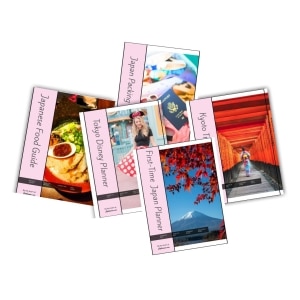
Our Japan trip planners can help. You might like our First-Timers Japan Planner, which will help you plan your trip to Tokyo, Kyoto and Osaka step-by-step, including tips on everything from picking hotels to sightseeing and dining. Or our super-duper Tokyo Disney Planner makes arranging your park trip MUCH easier. Find them in our Planners store – printable and digital versions are available.
Visiting the Museum
If you want to visit the Osaka Museum of Housing and Living, it is open six days a week, closed on Tuesdays, from 10 am to 5 pm, with last admission at 4:30 pm. Check the opening hours around the New Year period as it does close during some of this.
The museum costs 600 yen for adults and 300 yen for high school or University students. Kids under 15 are free. You can book tickets in advance on their website or via Klook, but it’s not necessary.

The closest station to the museum is Tenjimbashisuji 6-chome Station. Three lines stop here – the dark brown Hakyu-Senri line, the lighter brown Sakaisuji Line and the pink Tanimachi line.
Take exit 3, which will bring you out right by the museum, but you might still be a little bit confused when you get here and can’t see anything that looks ‘museumy’. The Museum is actually on top of a council building, so look for this entrance – and then follow the signs – they are in English.
What Else is Nearby
The museum is at one end of Tenjimbashi, Osaka’s longest covered shopping street. You can combine a visit here with visiting the attractions around Umeda in our three-day Osaka plan. Alternatively, visit later in the day and enjoy the nearby Tenma area – this is one of Osaka’s most local bar-hopping areas (book a tour here so you know exactly where to go).
It’s also a very easy train journey to/from Shinsekai from here – just jump on the Sakaisuji line to Ebisucho.
We came here after spending the morning at Katsouji – the Daruma temple. This is a bit out of the centre of Osaka, but it works well as it’s a straight journey on the Hakyu-Serai line from Kita Serai, the closest station to the shrine.
Who Writes This Blog?
My name is Helen Foster, and I’m a journalist and author. My travel articles have appeared in publications including The Australian, Escape, RAC Horizons, Jetstar Magazine, Sainsbury’s Magazine, and more.
I’ve travelled to Japan nine times before – solo and with my partner and visited over 50 towns and cities. My last visit was in April 2026, so everything here is pretty up to date.

