
- Famous Mount Fuji Photo Spots – And a Few New Ones To Try - 27 October 2026
- What to Do in Kawaguchiko – When You Can’t See Mount Fuji - 21 October 2026
- Kennin-ji: Kyoto’s Temple for Art Lovers - 19 October 2026
There are a lot of iconic places to take pictures of Mount Fuji – I know, I took over 200 pictures of the mountain on my last trip! This guide highlights the most famous spots – plus, some fun ones you might not have seen before.
One of the benefits of visiting Japan earlier than I normally do on my last trip was that the skies were Fuji-friendly!
I saw it on over 12 different days from at least five different locations – I got shots of it by the beach near Kamakura, seaside shots from the famous black beach near Shimizu, I developed an obsession with pictures with stations or with vending machines in – and of course, I got some iconic snapshot pictures from the classic spots around Lake Kawaguchiko and Shimoyoshida.
Article by Helen Foster. Disclosure: Some links in this post are affiliate links. See our Affiliate Disclosure.
This post covers both options – it’s a mix of the pictures I liked best from some smaller spots, and the classic photo locations.
Now, don’t get me wrong – I don’t think I’m a brilliant photographer and, I’m sure anyone with talent could take far better pictures than me in all of these places. My aim with this post is simply to tell you where to go, so you can.
Around Kawaguchiko
Lake Kawaguchiko and Kawaguchiko town are the most popular places for people to visit to see Mount Fuji – and, if the weather is right, there are photo spots around virtually around every corner. But here are some of the ones I liked best – or, the most famous spots to visit.
Saiko Lake, Near Kawaguchiko
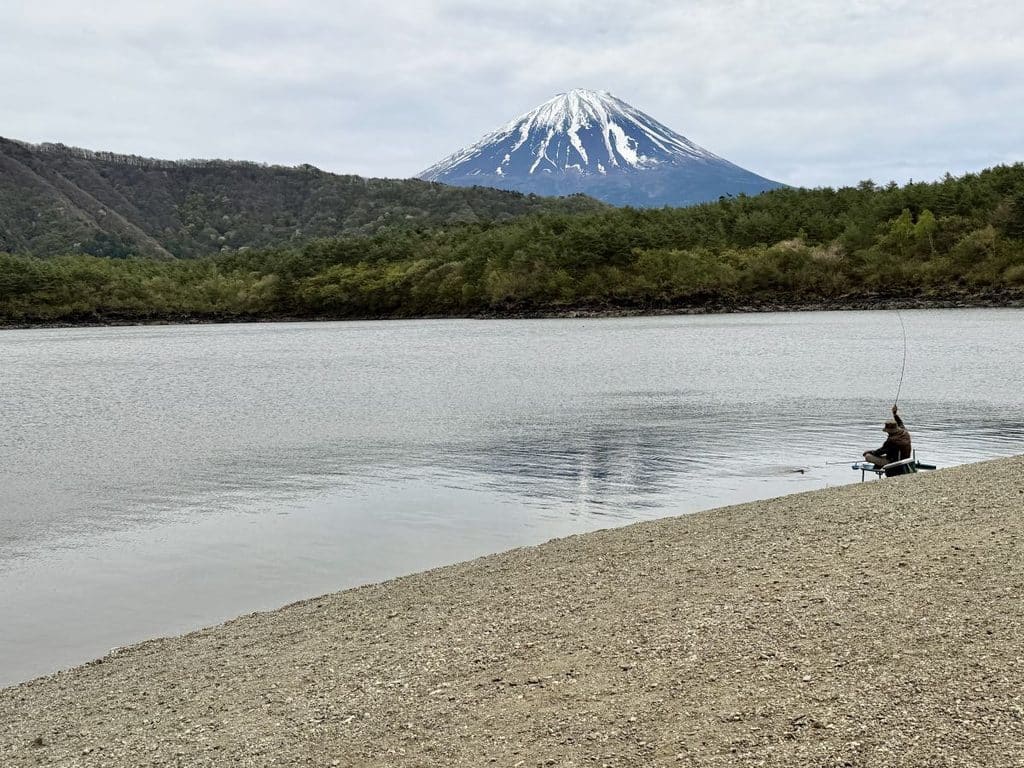
This is probably my favourite picture I’ve taken of Mount Fuji.
Saiko Lake is a short walk from the open air museum called Saiko Iyashi no Sato Nemba – it’s a replica of an old village that used to be on this site until it was destroyed by a typhoon. Today, it’s a great place to visit, and full of opportunities to buy some unique souvenirs – and down the road is this gorgeous view!
I loved the fact that the shores were lined by fishermen just having a lovely day.
How to Get There
If you’re coming from Kawaguchiko, catch the Green Sightseeing Bus (also known at the Saiko Line) to the
Nenbaminshuku stop. The viewpoint is about a three minute walk from here.
If you’re visiting the village first, then just follow the road to the east from the park. The lake is about an eight minute walk.
Oshino Hakkai
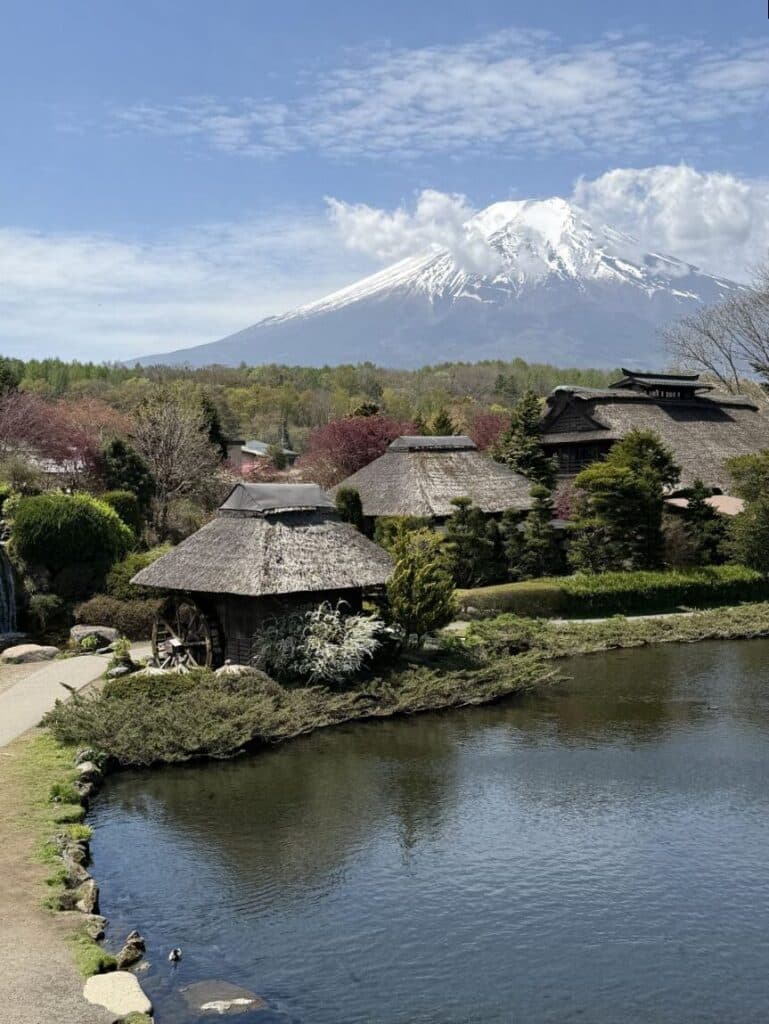
I can see why this is a popular stop on many Mount Fuji sightseeing tours – it mixes potentially gorgeous views of Mount Fuji with some beautiful crystal clear pools.
The Oshino Hakkai area itself is free to enter, but this picture was taken in the museum area that you do pay to get in. If the water in the pool here is still, the reflection is stunning. You don’t have to go in here to take good pictures though – some of the other pools also have reflections in them, but you might need a bit of patience to avoid other people in your shot.
If you’re staying in Mount Fuji, try and get here before 10 am to beat the majority of the crowds – the general area is open 24-7.
How to Get There
Oshino Hakkai is reached by local bus from both Kawaguchiko or Mount Fuji stations. The exact route will depend on where you start and the time of day, Google Maps is your friend to find the best option.
The area is generally free to enter and you’ll find Mount Fuji views all over – but, if you want to take your version of this picture, head into the on-site museum. It costs just 300 yen for adults and it has far smaller crowds than the rest of the park.
Oishi Park
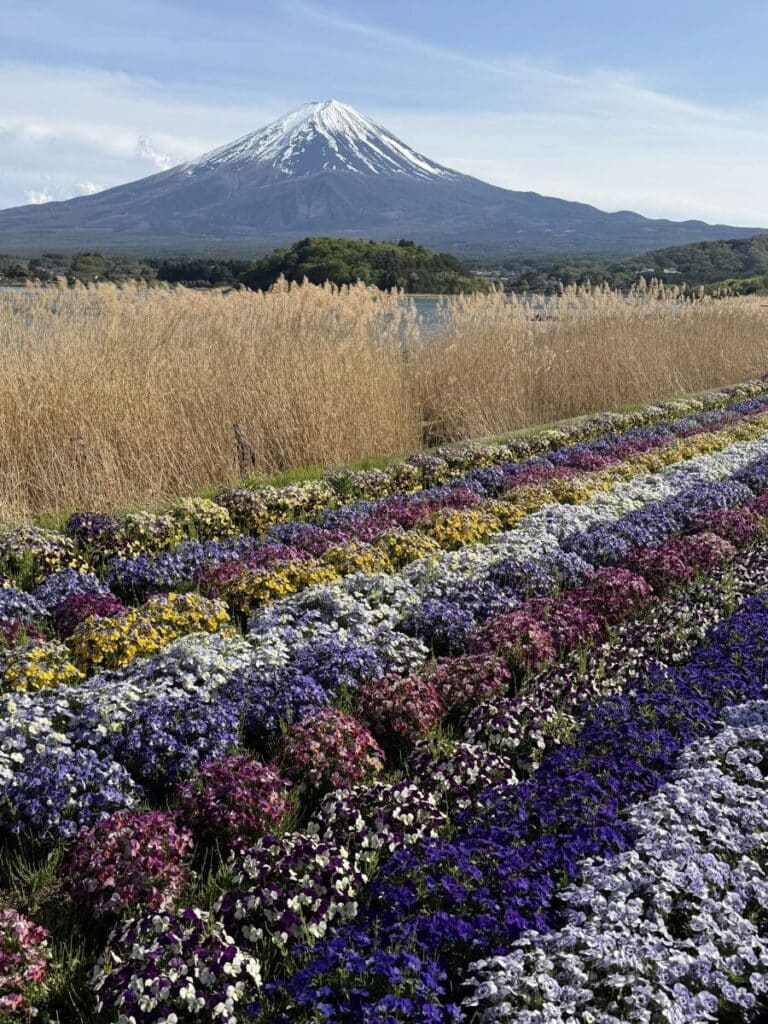
This park is famous for its view of flowers in front of Mount Fuji. The flowers change with the seasons so you could go there twice a few months apart and not take the same picture
Despite the fact that this place gets very crowded, it’s easy to take pictures with no people in them because the flowers create a natural barrier between where people can walk and the lake/mountain.
How to Get There
Oishi Park is located at the end of the Red Bus route. It is open 24 hours a day so, if you want to beat the tour bus crowds come here early or at the end of the day when most people have gone home.
Just note the hours for the red and green sightseeing buses as they don’t run super early or late.
Kawaguchiko Backstreets
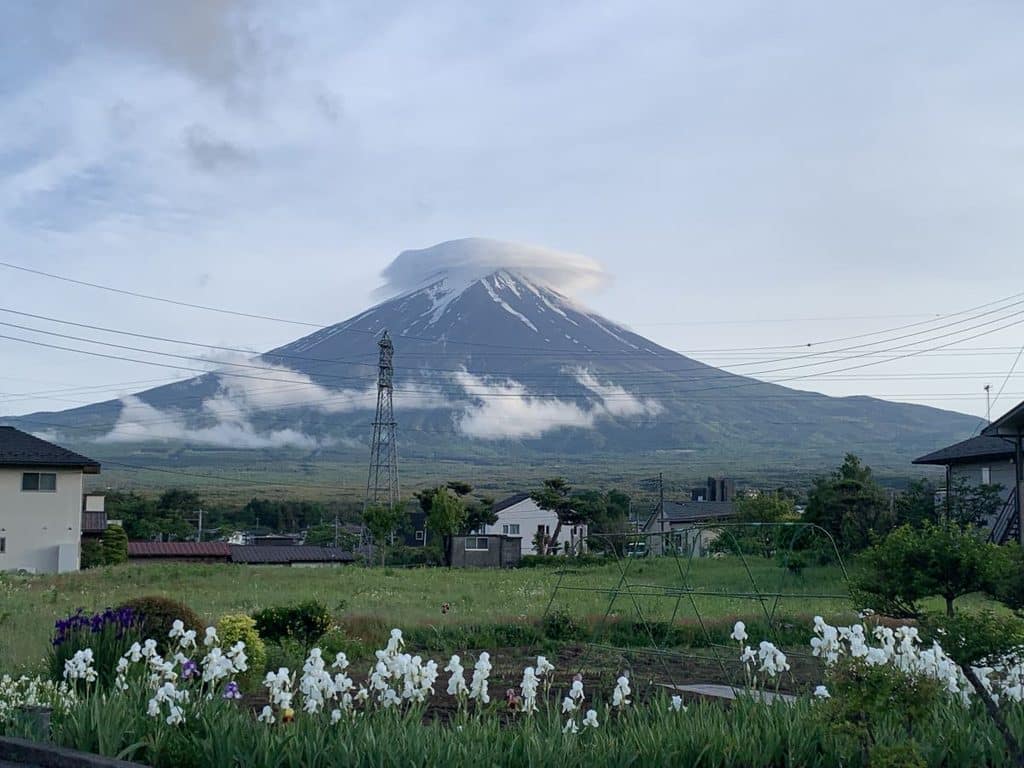
This is another favourite picture of Mount Fuji because I wasn’t expecting to get it.
As I said in my post on what to do on a cloudy day in Mount Fuji, the first time I went to Mount Fuji the weather was awful. Most of the day, I couldn’t even tell you where the mountain was supposed to be.
But, as the day went on, the clouds started to clear and about 6pm, Fuji-san decided to show itself with a beautiful blue sky behind it.
At this point I just went wandering around the backstreets to see what views I could find – and I found this. I like the white flowers in front of the white fluffy clouds.
How to Get There
If the mountain is visible most of the streets around Kawaguchiko will give you a good view. This specific spot is close to The Garden Resort and Condominium.
Mount Fuji and Vending Machine
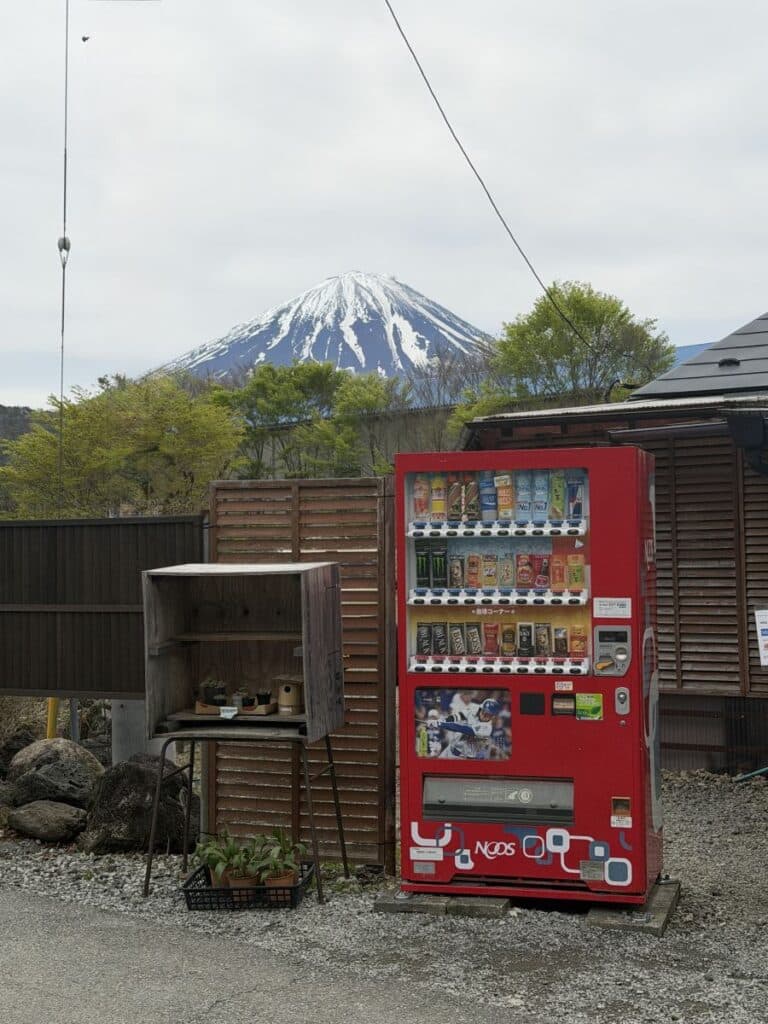
Sounds like a painting doesn’t it. Looking back over my pictures I realised the pictures I like best are the ones where the mountain appears just with normal things around it rather than the picture postcard shots.
This one was taken as I left the Saiko Iyashi no Sato Nemba village. I was heading to the bus stop and noticed the vending machine because I was thirsty – then I saw what was peeking out behind it.
How to Get There
If you’re coming from Kawaguchiko, catch the Green Sightseeing Bus (also known at the Saiko Line) to the
Saiko-iyashinosato-nenba stop. The machine is close to where the bus stops.
Mount Fuji, Train and Vending Machine
See, it’s a series! All good artists have a series (joke!).
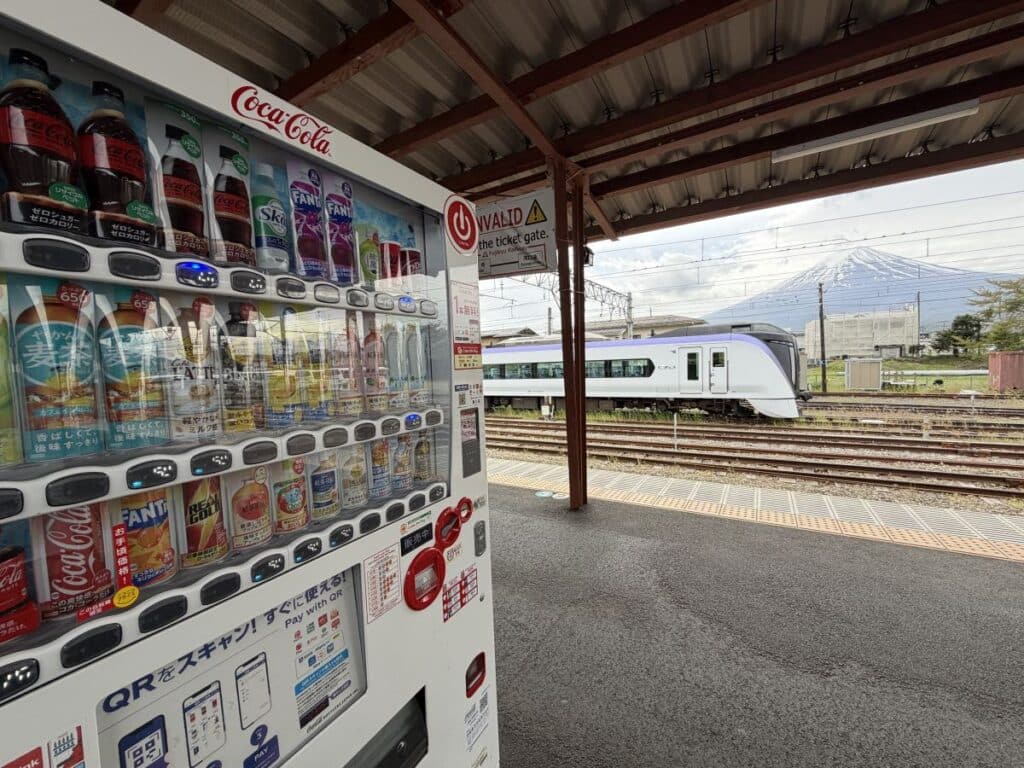
One of the fun things about running a practical blog like this is that you often have to take pictures of very boring things – like train ticket machines, vending machines, or, in this case, I needed a picture of that white and purple train on the track in the middle of the picture.
Any way you can make this more interesting is helpful – like adding the world’s most famous mountain.
Which is why I like this picture. I used it to illustrate my piece on how to get to Kawaguchiko from Tokyo which is also a must-read if you haven’t planned your journey yet.
How to Find the Spot
It’s on the platform at Kawaguchiko Station.
Shrine Dragon and Mountain
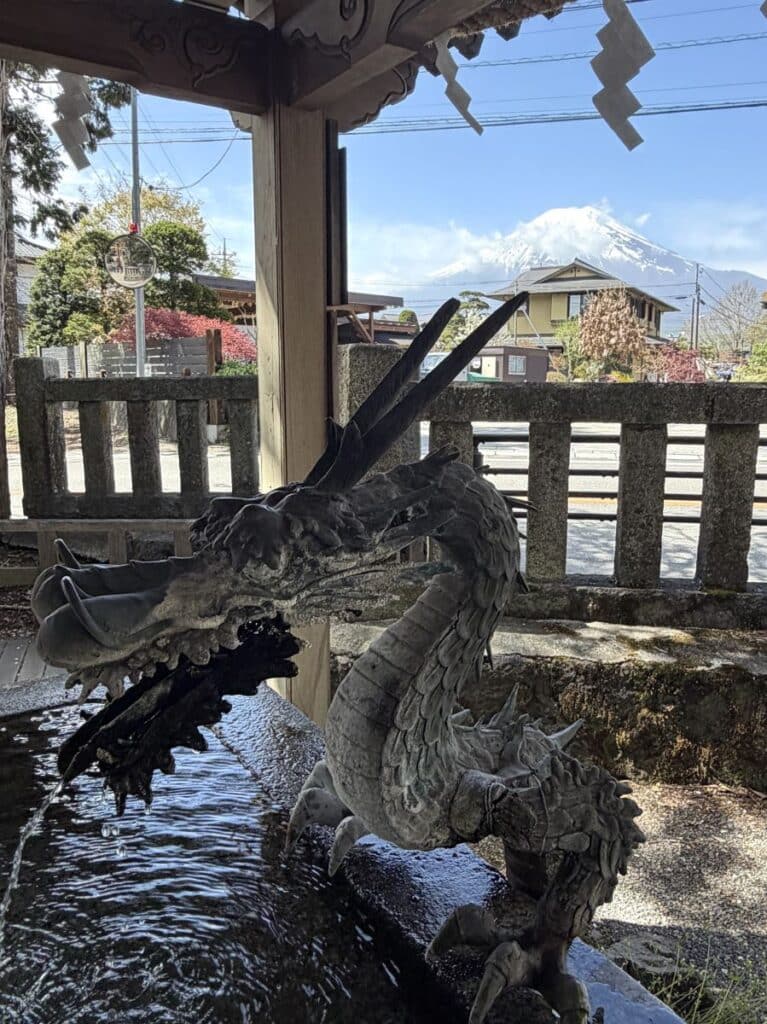
While hundreds of tourists visit the pretty ponds at Oshino Hakkai to get pictures of Mount Fuji, no-one else was at the small shrine behind the pool area.
It’s called the Sengen Shrine.
I liked the way the mountain just appears behind the dragon at the handwashing trough.
How to Get There
Head to Oshino Hakkai as per the directions above. Then, head toward the north west of the pond area – toward Kagami-iki pond. The shrine is about a minute walk away.
There are two Sengen Shrine in this area marked on Google Maps. You want the one closest to the ponds, don’t end up at the wrong one.
Honcho Street
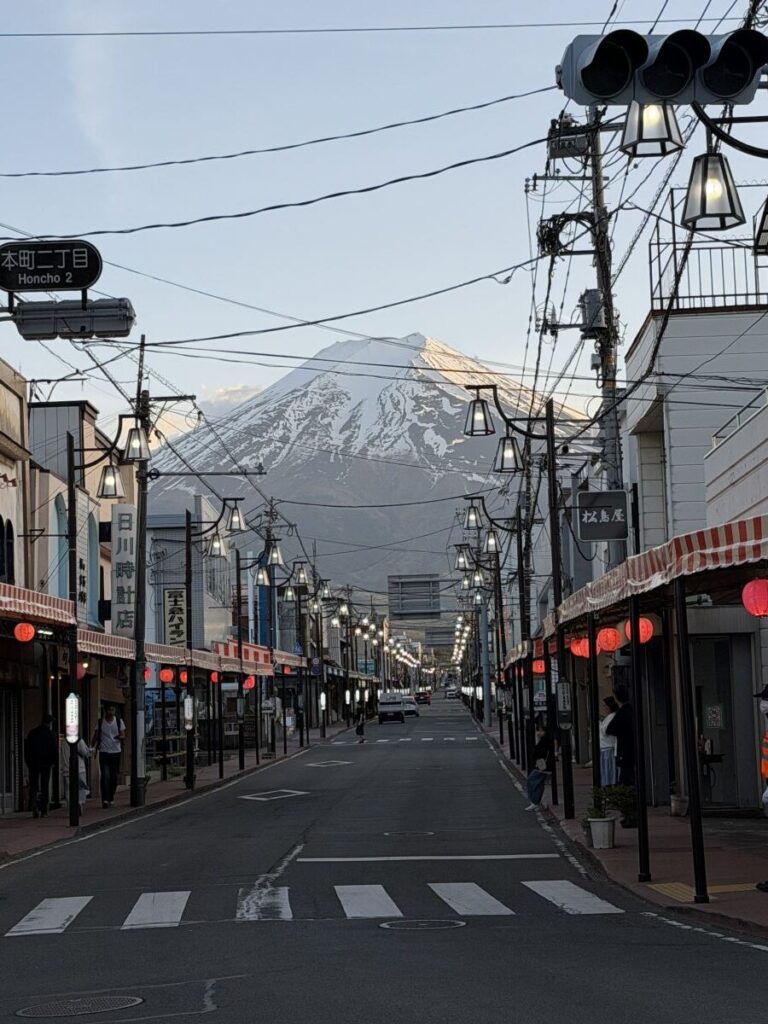
This shopping street has become a social media hotspot as people try and get shots of themselves crossing the road with Mount Fuji behind them.
The problem is, people stopped remembering that this is a busy road that people use to get from A-B during their normal day – not a photo shoot location, so, now the crossings are carefully controlled with guards.
If you don’t want 100 posing people in your shot, come early or after 6pm when most of the day trippers have gone home – but, even at this time of day, if you do want a picture on the crossing, cross only when its lights are green – and for the love of all that is holy, GET OFF THE ROAD WHEN THEY CHANGE.
How to Get There
There are two stations an 8-9 minute walk away from this spot – Gekkouji and Shimoyoshida. Both of them are connected to Kawaguchiko Station on the local line.
The point where the road curves is the best photo spot. Use Fab Cafe Fuji or the Shimoyoshida Information Centre as your marker on Google Maps.
The New Honcho Street
I was staying near Honcho Street and so I wandered around the backstreets a bit and discovered a few of them actually have good views of Mount Fuji – without having to hold up traffic to take your picture.
The one in the picture below has now been discovered by social media so it might not be as quiet as when I took this, but it’s called Nishiura Street.
I like the old buildings and signs with the mountain behind them.

How to Find the Spot
Use Gekkouji or Shimoyoshida Station – Gekkouji is marginally nearer. If Nishiura Street doesn’t come up on maps, use a restaurant called Benkei as your guide.
The Tori Gate
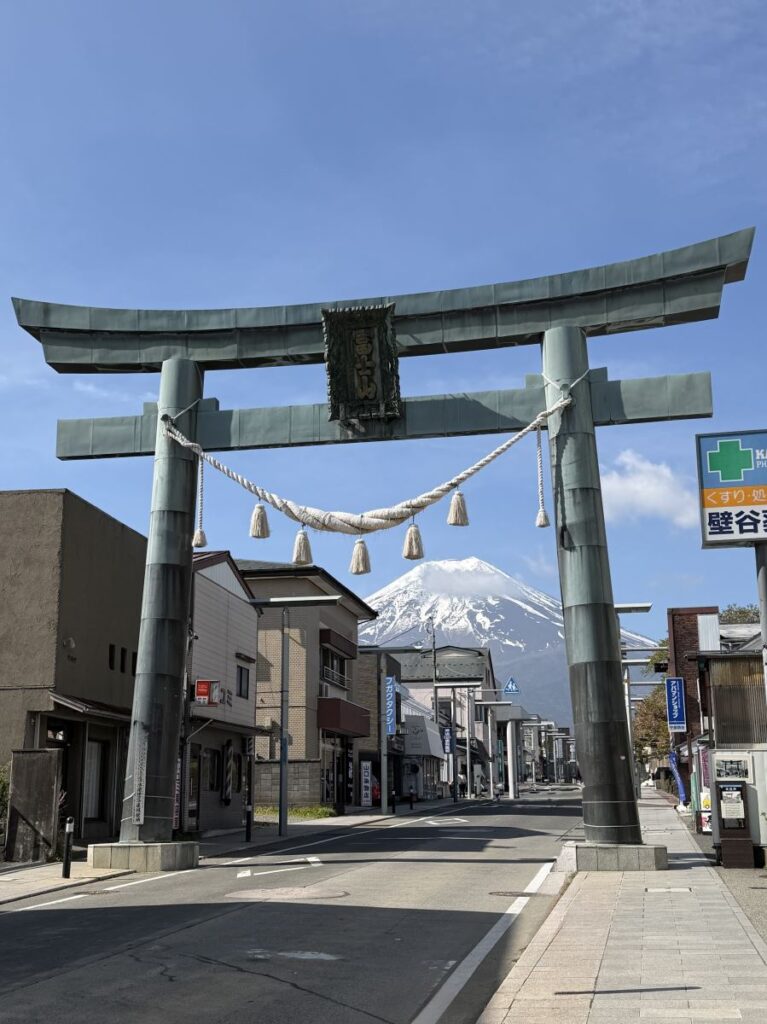
This is an example of a place where someone good at photography could get a cracking picture. I, only the otherhand, took a photo!
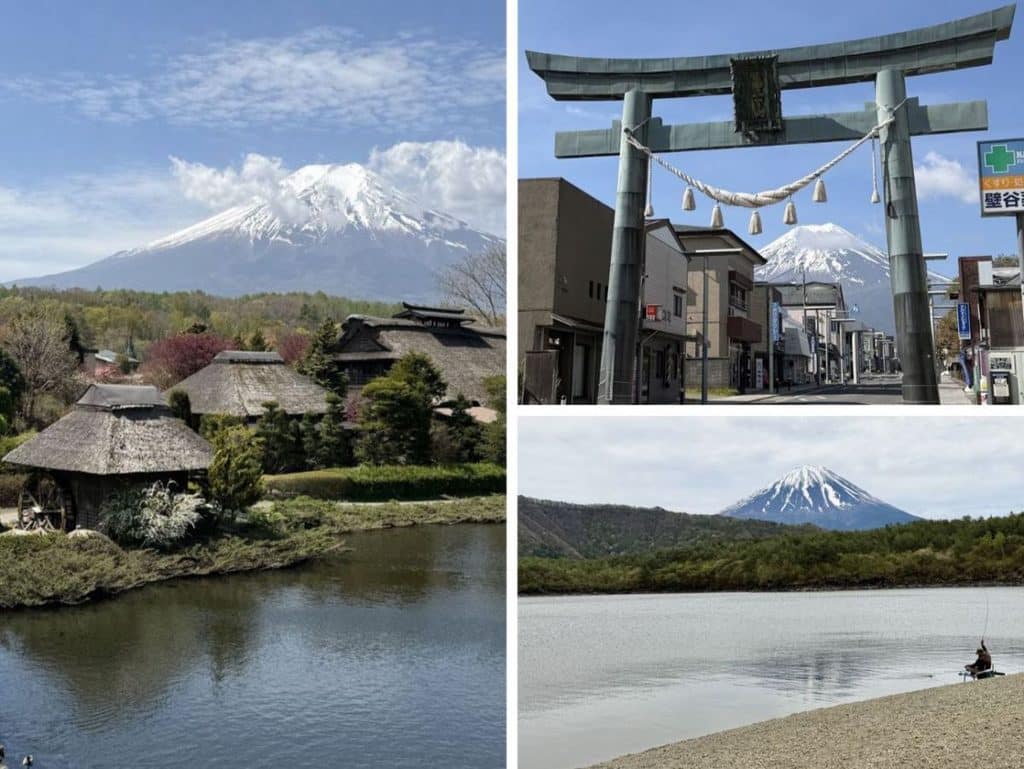
The spot is called Kanadorii. The original gate that stood here, built in 1799, was covered in copper earning it the name the Golden Torii. This one was built in 1957 and is also covered in copper, but, time means it’s now more green, but, it still frames Mount Fuji beautifully though.
This is a busy road, so you’ll need patience to get a shot with no cars in.
How to Get There
It’s a two minute walk from Mount Fuji Station – you’ll find it marked on Google Maps as Kanadorii.
I have heard that the rooftop of this station is also a good picture spot, but I couldn’t work out how to get up there when I was there – and my bus was due so I had to hurry.
Chureito Pagoda
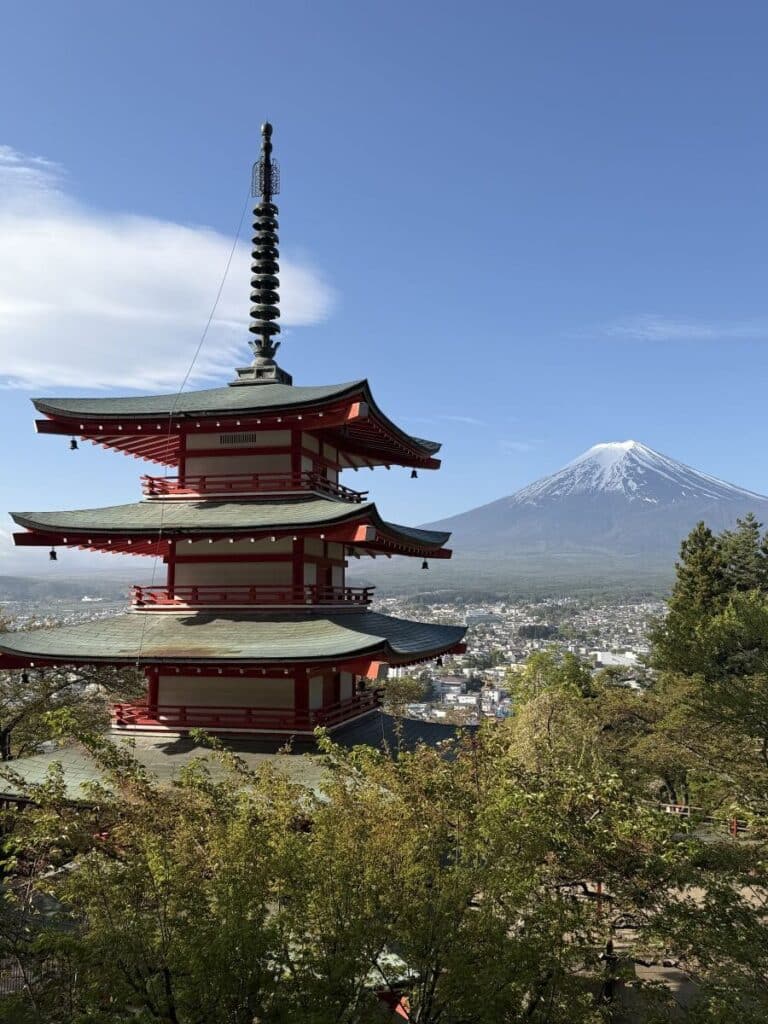
I hate this picture! I climbed all the way up a hill to take a worse version of a picture I bought from a stock photo site before I got the chance to visit myself.
But, it’s an iconic image and, it is a beautiful thing to see in person so I would still say go. At the right time of day.
Oh and yes, Mount Fuji is normally on the other side of the pagoda in most pictures.
Don’t stress, there is no AI trickery here, I did climb all the steps at 7 am – but, most people take their picture from the viewing deck, which then makes it look like Mount Fuji is on the left of the picture, however there is a second photo area off to the right, and, if you take your picture from here, the angle shifts and it’s on the right.
How to Get There
The closest station is Shimoyoshida which is a 20 minute walk away. The walk to the observation deck does involve climbing 398 steps (there is a sloping hill walk if you can’t go up or down steps).
The grounds are open 24 hours a day and if you can get here before 8 am, the crowds will be lower. Come here at 2pm and there can be a queue to get up the top – come here during cherry blossom season and that queue can be an hour or two long.
Time your visit carefully. Early morning or late afternoon when most of the day trippers have left is best. Being able to visit here without crowds is one of the best arguments for for staying overnight at Mount Fuji.
Gekkouji Station
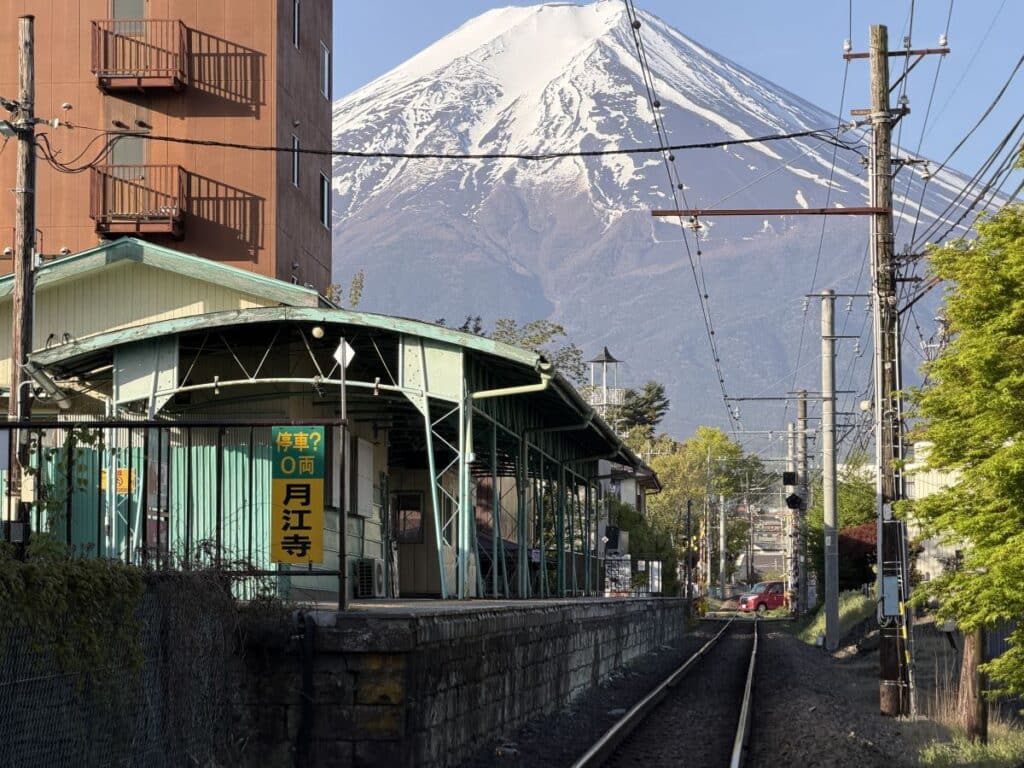
I was looking to make sure I wasn’t about to get mown down by a train when crossing tracks near Gekkouji and realised there was a very cool looking snow-topped Mount Fuji behind me.
Before anyone yells, I did not take this from the tracks, I was safely on the side of the tracks by the crossing – and I firmly suggest you stick to the same rules.
How to Get There
It’s just a tiny bit north east of the station itself. Use the Megumi Hair Salon as your guide. Once again, I repeat – you do not need to stand on the tracks to the take the picture.
Think Twice About the Lawson
Taking a picture of this convenience store with Mount Fuji behind it has become a must-do for many people visiting Kawaguchiko – but it does make me laugh, as there are actually three convenience stores with a view of Mount Fuji behind them around here, yet everyone goes to the same one – there’s absolutely no-one causing havoc outside the 7-11 down the road.
At least things have calmed down a little bit. There’s now an organised queue for people wanting their photo taken, and the new barrier is low enough to allow pictures but stops people running into the road to get them.
The local people still hate it though and the fact that people cut holes in the first barrier so they could still get the shot makes me despair of humanity. Kawaguchiko is the only place in Japan where I have felt unwelcome as a tourist and behaviour like that is why. Please don’t add to the problem – skip the infamous Lawson picture!
Further Afield
Because Mount Fuji is so big, you can see if from many areas around the Hakone and Shizuoka region. So, here’s a few places you might see it even if you’re not visiting Kawaguchiko.
Mishima Hirokoji Station
I took this when crossing this level crossing slightly south of the Mishima Hirokoji station in Mishima. I looked right to make sure there were no trains coming – and suddenly realised what was in the distance.
I also like the guy with the umbrella walking past. As normal I’ve had to blur his face so you can’t identify him, but I still like the picture.
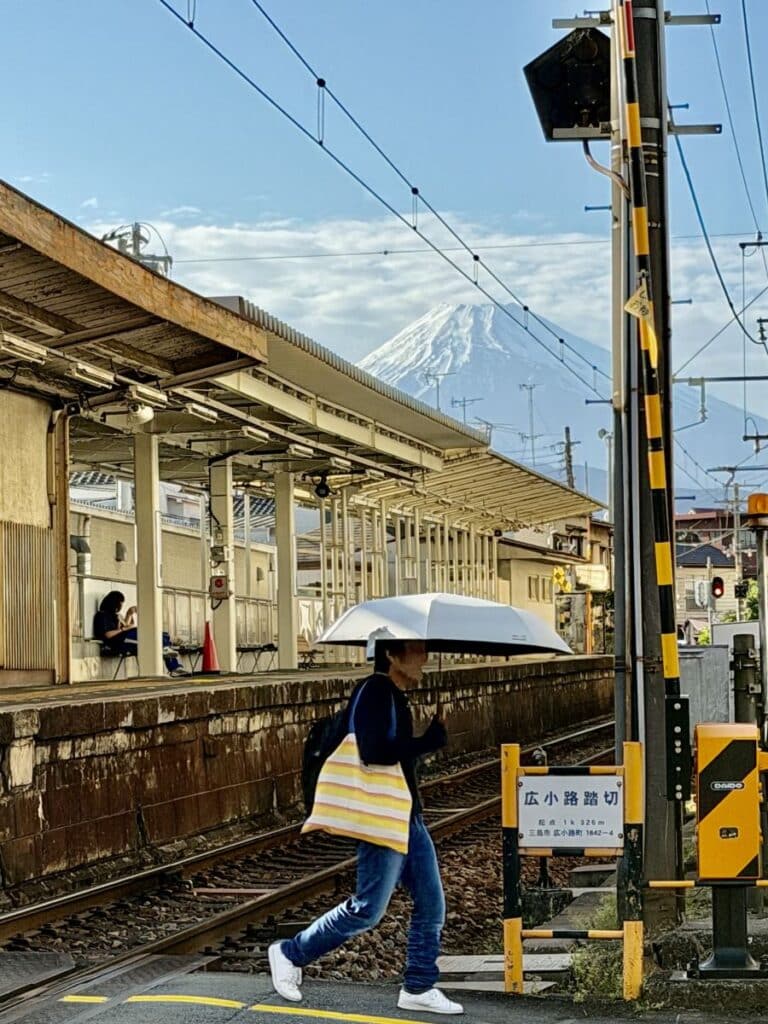
How to Get There
Mishima is on the Shinkansen line between Tokyo and Kyoto. It’s the gateway to Mount Fuji if you are travelling there from Kyoto – you’ll catch the bus to Kawaguchiko from there. Mishima Hirokoji station is a 15 minute walk away from the mainline station.
Shinkansen Bypass, Mishima
This was actually taken out of my hotel room window in Mishima. I couldn’t resist it.
The hotel was the Dormy Inn Mishima,and I discovered that, if you book with them direct you can book a guaranteed Mount Fuji view room.
Every morning for five days I woke up and there it was – but, it had a friend.
Trains.
There’s something about Japan that turns me into a train geek – I stood at another spot in Mishima for 10 minutes waiting for a train to come past just so I could take a picture of it with a cool building in the background so there was no way I could resist getting a picture of these two icons of Japan together.
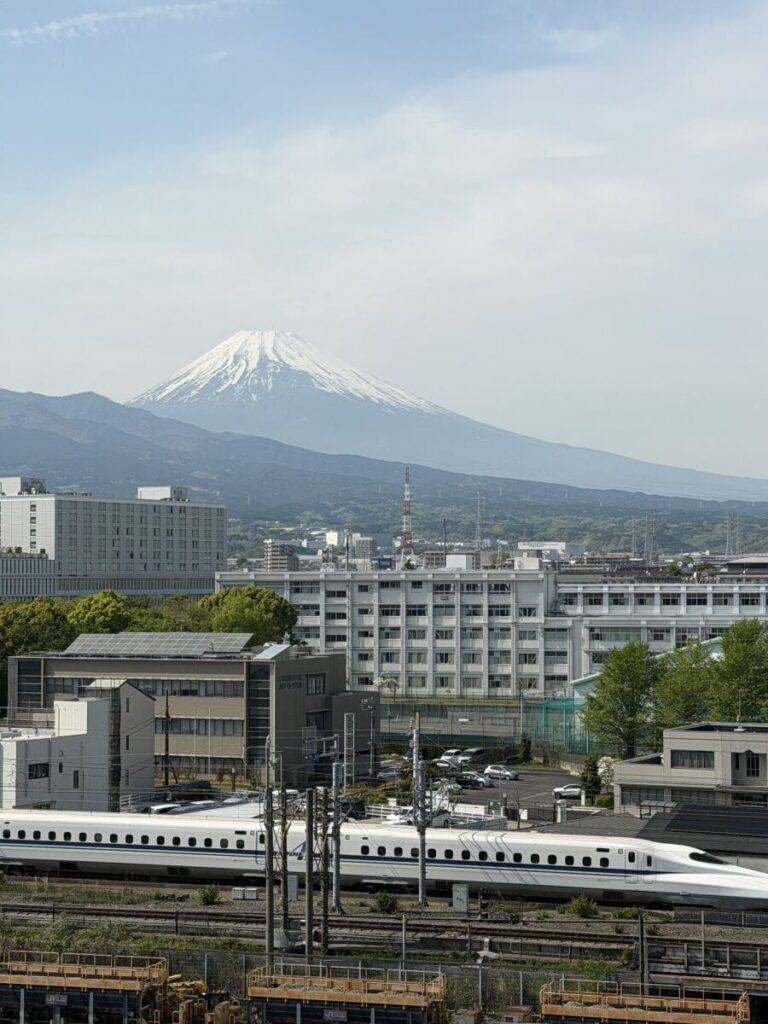
How to Get There
You’ll need to be staying in the hotel in Mount Fuji view room. I was on the 10th floor. The public bath in the hotel also has Mount Fuji views, but you can’t see the trains – or take a camera in there.
Mount Fuji by the Sea
There are a few places where you can take pictures of Mount Fuji with the sea in them – Enoshima and some of the beaches around Kamakura being classic examples, but this is probably the most famous.
It’s the beach by the pine forest called Miho no Matsubara. It’s not located that near Mount Fuji, which is why you often only get a view of the cone peeking above the clouds, but if you’re staying in Mishima, or coming into the cruise port of Shimizu by ship, it’s easy to get here.
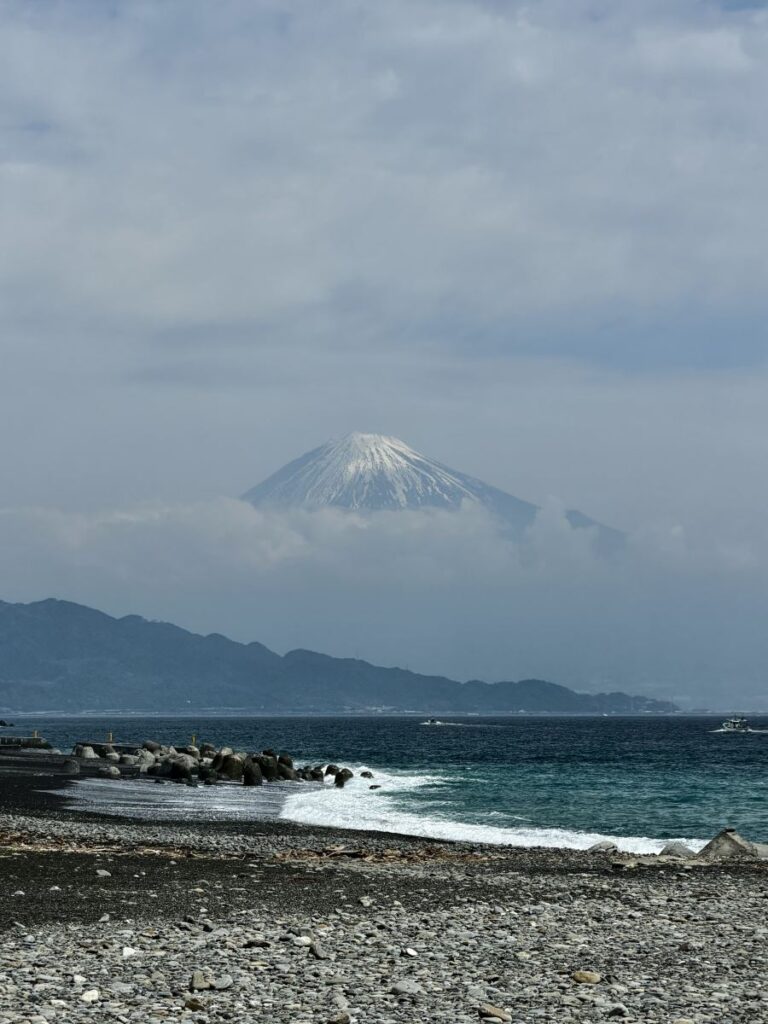
How to Get There
Take the train to Shimizu Station. From here you catch the bus about 30 minutes to the forest.
The bus name and stop name are both in kanji, so, use Google Maps to help you.
Once you arrive, just follow the paths to the shore – and look left. If conditions are right, you’ll see Mount Fuji in the distance.
Lake Aishi, Hakone
This is not my photograph. The day I went to Hakone, that mountain was not coming out!
But, if you’re lucky, you can get a view like this from the shores of Lake Aishi near Motohakone.
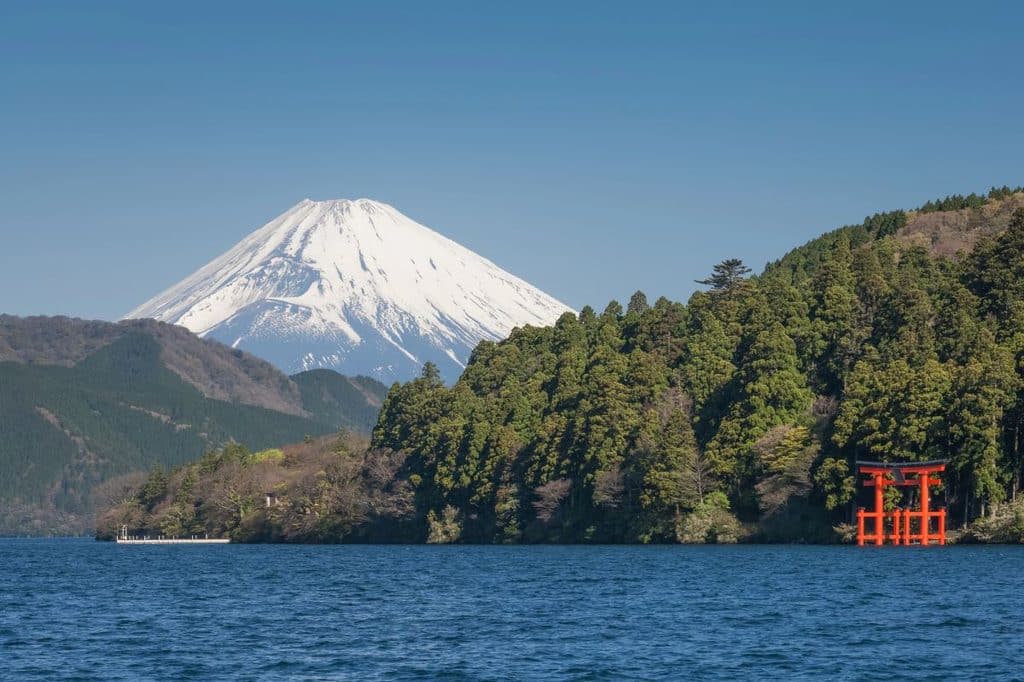
How to Get There
This view can be seen from the Motohakone part of Hakone. This is where you get on or off the Pirate Boat if you are doing the Hakone Loop.
Many buses in Hakone will take you to this spot so the best route will depend on where in Hakone you are leaving from and the time of day so check Google Maps for the best route when you arrive. You cannot get the train to this spot.
You’ll also find many other beautiful spots around Mount Fuji to take your photos – Mishima Skywalk, the Fuji Five Lakes region, Kamakura and Enoshima – some of these I’ve been to but didn’t get great pictures, but there’s no reason you won’t, others I haven’t visited yet.
Just remember to check a Fuji Visibility calendar before you set off to give yourself the maximum chance of spotting this elusive mountain.
Who Writes This Blog?
My name is Helen Foster, and I’m a journalist and author. My travel articles have appeared in publications including The Australian, Escape, RAC Horizons, Jetstar Magazine, Sainsbury’s Magazine, and more.
I’ve travelled to Japan nine times before – solo and with my partner and visited over 50 towns and cities. My last visit was in April 2026, so everything here is pretty up to date.