
- What to Do in Kawaguchiko – When You Can’t See Mount Fuji - 21 October 2026
- Kennin-ji: Kyoto’s Temple for Art Lovers - 19 October 2026
- How to Watch the Oiran Parade at Edo Wonderland, Nikko - 15 October 2026
Osu is Nagoya’s biggest shopping spot. Around 1200 shops line the grid of streets that make up the area. If you’re shopping, you’ll find everything here from electronics to clothing, but tucked away between the shops are a few fun things you should also seek out. Here’s our guide to what to look out for.

Article by Helen Foster. Disclosure: Some links in this post are affiliate links. See our Affiliate Disclosure.
1. Osu Kannon
This shrine, founded in the 14th century, anchors the western end of the Osu Kannon shopping area.
The main hall has been destroyed by fire a couple of times, so the current building was built in 1970, but it’s still an impressive shrine with bright scarlet accents, beautiful lanterns, hundreds of golden statues, and a large surrounding courtyard.

One of the main draws here is the pigeons that live in the shrine. You can feed them, which leads to much flapping and sitting on people’s heads. If you’re not a fan of birds, you might want to steer clear of the feeding area.
However, there are a couple of interesting things here that you might miss if you aren’t looking for them. There’s a memorial to fans used in dance performances, a place to say thanks for dolls that have given you joy – and a place to leave lost teeth and dentures! Each of these also has its own special day and ceremony at the shrine.
If you are here at 11 am, 1 pm, 3 pm, 5 pm and 6.30 pm, there is also a karakuri doll clock in the shrine grounds.
You’ll also find an antiques market here on the 18th of the month.
2. The Fashion Granny
On the corner of Higashi Niomon Street near the Solo Pizza restaurant is a small statue in a wooden box.
This is Tansu No Baaba, also known as the Grandma of the Chest of Drawers, and legend has it that if you touch the statue, you will never lack for clothing.

It’s a throwback to the time when clothes were very expensive, and so people wanted to protect them from tears and staining. Whether it now works to prevent you from standing in front of your wardrobe shouting ‘I’ve got nothing to wear,’ because nothing looks right remains to be seen.
3. Bashoji Temple
You might not realise this is a temple at first as it’s set back from the street and has a very modern frontage which even includes video screens. Only if you peer inside do you notice the lanterns lining the ceiling.
When you discover that the entire Osu area, including the temple, was flattened in air raids in 1945, the modern design makes more sense. In fact, the main hall wasn’t completed until 1992 and was actually designed to match the surrounding street.

But this is a temple with a lot of history in Nagoya – take the mechanical doll display that you’ll find here; this re-enacts an important moment in the temple’s history.
The temple was originally built as the family temple for the Oda Clan. When the father of the clan died, his son arrived late for the funeral, dressed inappropriately, and caused a bit of a show, throwing incense around and knocking things over. The doll does a mini play of this at 10 am, 12 pm, 2 pm, 4 pm and 6 pm.
If you miss that, but happen to be here at 11 am, 1 pm, 3 pm, 5 pm or 7 pm, the white dragon statue on the right-hand side of the shrine will also do its own performance.
A movie will play on the screens above the shrine entrance, and then the dragon will fly toward its real-life statue and a fortune will appear in the globe in its claw.
The goshuin here are also some of my favourites featuring foxes and dragons.
Mechanical Dolls in Nagoya
Nagoya is one of the best places in Japan to see displays of mechanical dolls called karakuri.
Dating back to the Edo period, these dolls were used as entertainment on everything from theatre performances to religious ceremonies.
You’ll find displays about karakuri in the Nagoya Science Museum and the Toyota Commemorative Museum of Industry and Technology, but also look out for the dolls around Osu and other areas in Nagoya.
4. Frog Cakes
The shop Aoyagi Sohonke has been making these adorable cakes since 1896. The word frog in Japanese is kaeru, which sounds the same as the word for returning home, so people often buy them as gifts for travellers, but you can also buy single cakes and eat them in the tea room at the back of the shop.

The cakes are stuffed with a thick buttercream, and there are two flavours available: lemon and rum and raisin. I picked the rum and raisin, and it was delicious. The perfect pick-me-up before more shopping!
The store is located in the Osu shopping district close to the Osu Kannon temple. They are open between 10 am and 6.30 pm six days a week; they’re closed on Wednesday.
5. The Giant Waving Cat
This 2.2 metre-high waving cat, officially called the Osu Maneki Neko, is a popular meeting point in Osu.

Don’t Miss the Kimono Shops
While you can buy a lot of things in Osu Kannon, but I had heard that it was one of the best places to pick up a secondhand kimono – and after checking out a few different shops, it didn’t disappoint.
You can buy both robes and accessories here with prices as low as 500 yen. We liked Suhiroya, which had a huge selection at good prices.
If you’re looking for a new kimono, rather than secondhand, this is also a good place to go, but note that some of the fancier shops close on a Tuesday, so if you’re on a kimono crawl, shop another day.
6. Miwa Shrine’s Bunny Statues
Miwa Shrine is a little north of the main shopping area but worth the detour for the cuteness factor.
You’ll find lots of rabbit-shaped statues, prayer plaques and goshuin here.
The rabbit is from a story called The White Rabbit of Inaba.
To cut a long story very short, this clever bunny is said to have tricked a group of sharks into making a bridge for him to hop across a sea. Once the sharks realised he’d deceived them, one of them attacked the rabbit, leaving him wounded.

The hurt rabbit met a group of 81 brothers; one of them told him to bathe in the sea (ow), and another told him to bathe in freshwater. When he did the latter, he turned into a god and blessed the brother who had helped him. That brother then married a princess and, eventually, became a deity himself.
The shrine is dedicated to that brother, now known as Ōmononushi-no-kami.
Stroking the rabbit statue is believed to bring general good fortune, but it’s also said that stroking the rabbit’s body in any area where you have pain will relieve that pain.
People also come here to pray for luck in love, as Ōmononushi-no-kami is also a god of matchmaking. There’s a tree in the shrine which people touch for luck in finding a good match.
7. Nagoya Meshi Samples
Nagoya Meshi consists of a variety of dishes created in Nagoya.
You’ll find them in restaurants all over the city, but Osu is a good place to try them in a street-food setting where you can just buy, say, one skewer of miso pork or a couple of the tebaski chicken wings.

I had a delicious skewer of miso katsu from Onimaru Osu, a stall on the corner of Otsu-dori and Banshoji-dori.
If you want a more substantial meal, though, Yabaton, one of the best places to try Miso Katsu, has a branch in Osu.
See more in our guide to Nagoya Meshi.
8. The Wish-Granting Paper Jizo
This statue is found outside the Yoshu-in temple north of the Osu Shopping District.
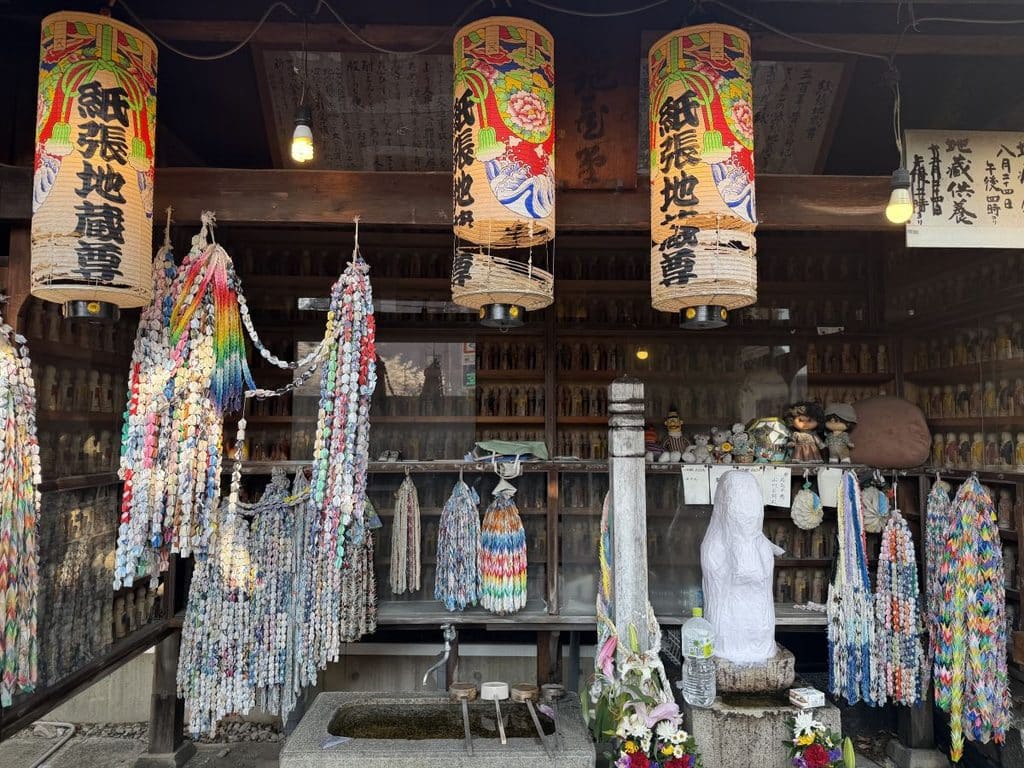
People come here and write their wishes on a piece of white paper and stick it to the Jizo statue – and there are now so many of them that he looks like he’s actually made of papier-mâché.
You can buy the paper at the shrine if you want to add your own wish.
How to Get to Osu Shopping Street
The Osu district is located east of Nagoya Station. It’s served by plenty of buses, but if you want to arrive by train, the two closest stations are Osu Kannon on the Tsurumai Line or Kamimaezu on the Meijo Line.
The best way to explore once you get there is just to wander and see what grabs your attention. A lot is going on!
I’ve been to Nagoya twice and explored Osu both times, but I’m pretty sure there are still more cool things hidden away for me to find next time, so I’m sure that I’ll add to this list again next time I visit.
Who Writes This Blog?
My name is Helen Foster, and I’m a journalist and author. My travel articles have appeared in publications including The Australian, Escape, RAC Horizons, Jetstar Magazine, Sainsbury’s Magazine, and more.
I’ve travelled to Japan nine times before – solo and with my partner and visited over 50 towns and cities. My last visit was in April 2026, so everything here is pretty up to date.

