
- Is it Worth Paying Extra at Tofuku-Ji? - 16 September 2026
- Chopstick Making in Asakusa - 10 September 2026
- 8 Things to See in Osu, Nagoya - 5 September 2026
Nagano is a very walkable city, and it does have a train service that can get you a bit closer to some areas, but if you want to get to the most popular sights like Zenkoji quickly – or, rest your feet on the way back to your hotel, you’ll likely want to use the buses that run around town. Here’s what you need to know so you don’t get confused.

Article by Helen Foster. Disclosure: Some links in this post are affiliate links. See our Affiliate Disclosure.
Where Can You Go By Local Bus in Nagano
Nagano city is compact, easy to explore, and well served by local buses that drop you close to Nagano’s main sights – including the city’s crowning attraction, Zenkoji Temple.
The easiest place to catch local buses to the main sights is at Nagano Station, where most of the local buses stop in a U-shaped area lined with bus stops on the station’s North side (if you’re coming out of the station, use the Zenkoji Exit to bring you to this).
Bus Stop 1 is probably the most useful one for tourists.
You use this to get to Zenko-ji, to the Prefectural Art Gallery and to the west end of Gondo Shopping Street
At least three different buses run from here to Zenkoji, numbers 11, 16 and 17, so you won’t need to wait long for a service.
Catching the Bus to the Snow Monkeys
If you want to catch the bus to the Snow Monkeys, you do not get it from this side of the station. The long-distance buses depart from the East Side of the station.
If you’re interested in visiting the fluffy fellas, check out our Nagano Snow Monkeys guide, which explains how to get to them and what to know once you arrive.
Getting on the Bus and Paying
Riding a local route bus in Nagano might be a bit different from the system you’re used to. Here’s how to do it…
Board at the Back
When using the local bus in Nagano, you enter via the rear door, not the front. Don’t head straight to your seat, though; there’s an important step not to miss.
Get a Ticket/Tap Your IC Card
As you enter the bus, look down to about waist height – you’ll see a machine spitting out paper tickets. Take one of these. It will have a number printed on it. This represents the number of the bus stop you got on – and you need this to work out how much to pay when you get off.
Or, if you’re lucky, there will be an IC card reader, which makes everything much easier.
When I went to Nagano, you couldn’t use IC Cards like Suica on buses. This is slowly changing, so by the time you read this, you might be able to use your IC card. If so, tap this when you get on instead of grabbing the ticket.

Watch the Front Screen
At the front of the bus, usually on the left of the driver, is an electronic display with a lot of numbers on it. At first glance, it will look like a sea of random numbers, but it’s not.
It’s how you work out your fare.
The top numbers – which will start with a symbol and then go up 1, 2, 3, 4, etc show the stop you alighted on. That’s marked on your ticket.
The bigger numbers underneath – say 100, 150, 200, 240, etc – are the fare you need to pay. If you watch the screen, you will see that these gradually increase the further along the route you get.
To work out how much you have to pay, just look at the row corresponding to the number on your ticket when you get to your stop – the big number is the fare.
Press the Stop Request Button
Buses don’t necessarily stop at every stop, so make sure you let the driver know you want to get off by pressing the stop button as you approach your stop.
Pay at the Front as You Get Off
When the screen shows the fare for your ticket number, go forward and either:
Drop the exact cash into the fare box next to the driver, together with your ticket, or
If you are on a bus that accepts IC cards, tap this on the reader by the driver. It will then charge you the right amount. You’re not paying twice. The first tap registers where you entered the bus, the second one calculates your fare and deducts it from the card
FAQs
How Can I Tell Which Bus I Need?
Google Maps has made this process much easier. Simply type your starting point and destination into Google Maps and press public transport – then look for the bus icon. This will tell you the route name and number, and also direct you to the bus stop you need to get on at.
In Nagano, the bus routes use numbers, so at the stop, look on the front of the bus for the number of the route you need. Hold out your hand to make it stop.
I usually also track the little blue dot on Google Maps throughout the journey to make sure I’m going the right way and to know when I’m approaching my stop and need to ring the bell.
How to Get to Togakushi Shrine by Bus
This shrine lies in a pretty forest, located about an hour away from Nagano, and can easily be reached by a direct bus that departs from opposite Nagano Station.
The journey takes about an hour. You catch the bus from Stop 7, which is across the road from the main cluster of bus stops. If you’re coming out of the station, take the Zenko-ji exit, then use the pedestrian crossings to cross to the northern side of the main road close to Don Quijote.
The stop is outside the Alpico Ticket Office. It’s clearly marked with a big 7.
The fastest bus is the reservation-only Togakushi Line. The journey costs ¥2500. Make reservations via the Highway Bus website.
To get to the main entrance, alight at Togakushi Okusha Shrine.
What if I Don’t Have Exact Change?
Drivers won’t give change, but there is usually a change machine at the front of the bus where you can break a ¥1,000 note into coins. You can also use it to change coins into smaller denominations.
It’s usually a good idea to try to use this before you are due to get off, when the bus is stopped at traffic lights for example, rather than holding up the bus as you exit.
To give you an idea, though, the fare from Nagano Station to the stop you need for Zenkoji (Daimaru Corner) is currently ¥190. Google Maps also shows current fares, so you can get an idea before you get on
Buses won’t take notes above ¥1,000 – change these somewhere like a 7-11 or Lawson before you get on.
What If You Forget to Pick Up a Ticket
The reason I decided to write this post was that I didn’t get my ticket when I got on the bus leaving Zenko-ji. Thankfully, the bus only had two other people on it, so the bus driver knew exactly when I got on and charged me accordingly.
If you forget to get a ticket, or, the machine isn’t working, just tell them where you got on – ideally using the stop number rather than the name – and they will work things out.
Or, as I said, Google Maps will show the fare, so you can also just pay the amount shown on that.
Bus Etiquette
The good news is that buses in Nagano tend to be less crowded than those in, say, Kyoto and Nara, but it’s still a good idea to abide by a few rules when using them.
Be Considerate with Luggage
Try not to travel with luggage during rush hour (usually around 7.30 am to 9 am and 5 pm to 7 pm). It’s a pain for the local commuters and also stressful for you.
Around the station is actually one of the best areas to stay in Nagano, and it means you can just drop your bags off easily without having to use any public transport.
If you need to go closer to Zenko-ji, you should be fine getting on the bus in the middle of the day, but in rush hour, consider getting a taxi from outside the station rather than using the bus. It’s only going to be a short drive. And don’t forget you can always send luggage ahead in Japan – our guide on how to use luggage shipping explains things.
If you’re not travelling with big bags, but do have a backpack and the bus is crowded, take it off your back and carry it so you don’t bash people if you turn.
Related Read: Carrying large luggage on public transport is one of the biggest complaints Japanese people have about tourists. See the others here.
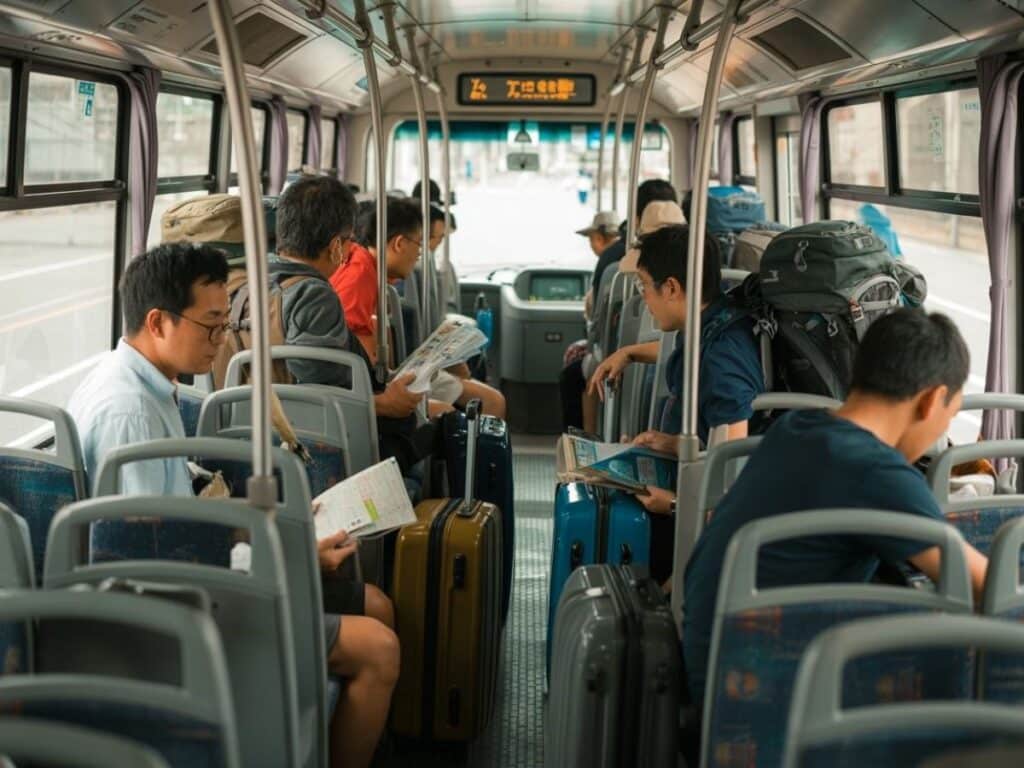
This is an AI image
Get Your Fare Ready
Japan is a stickler for punctuality, so try not to hold up the bus by counting out your fare when you get to the driver. I appreciate it might be a bit tricky to work it out exactly using the screen until you get nearer, but you can get a rough idea as to whether you might need two 100 coins or four and have those ready!
As I’ve mentioned, if you’ve used Google Maps to plan or track your journey, that will show you the exact amount so you can prepare yourself.
Remember, if you need change, it’s polite to try to use the change machine before you reach your end stop.
Don’t Be ‘That Tourist’
Don’t eat, drink, play videos out loud on your phone or talk super loudly when on the bus.
Need Extra Planning Help?
Our Japan trip planners can help. You might like our First-Timers Japan Planner, which will help you plan your trip to Tokyo, Kyoto and Osaka step-by-step, including tips on everything from picking hotels to sightseeing and dining. Or our super-duper Tokyo Disney Planner makes arranging your park trip MUCH easier. Find them in our Planners store – printable and digital versions are available.
Avoid the Priority Seats
These are the seats near the front of the bus and are there for elderly, disabled or pregnant passengers.
Avoid sitting in them if there are other options. If they are all that’s left, it’s okay to sit in them, but keep your eyes open. If someone comes on who might need it more, stand up and subtly vacate.
Handy Bus Phrases to Know
If you are trying to get off a crowded bus, saying ‘sumimasen’ as you pass people will alert them that you are coming through and apologise for getting in their way at the same time!.
As you leave the bus, say ‘arigatou goizaimashite’ (thank you) to the driver.
It’s pronounced – a-ree-gat-oo goi-zai-mash-te – of you can’t remember that, even a-ree-gat-oo is a nice touch.
Related Read: Eight Essential Japanese Phrases to Learn Before Your Trip

Who Writes This Blog?
My name is Helen Foster, and I’m a journalist and author. My travel articles have appeared in publications including The Australian, Escape, RAC Horizons, Jetstar Magazine, Sainsbury’s Magazine, and more.
I’ve travelled to Japan nine times before – solo and with my partner and visited over 50 towns and cities. My last visit was in April 2026, so everything here is pretty up to date.

